QUESTION IMAGE
Question
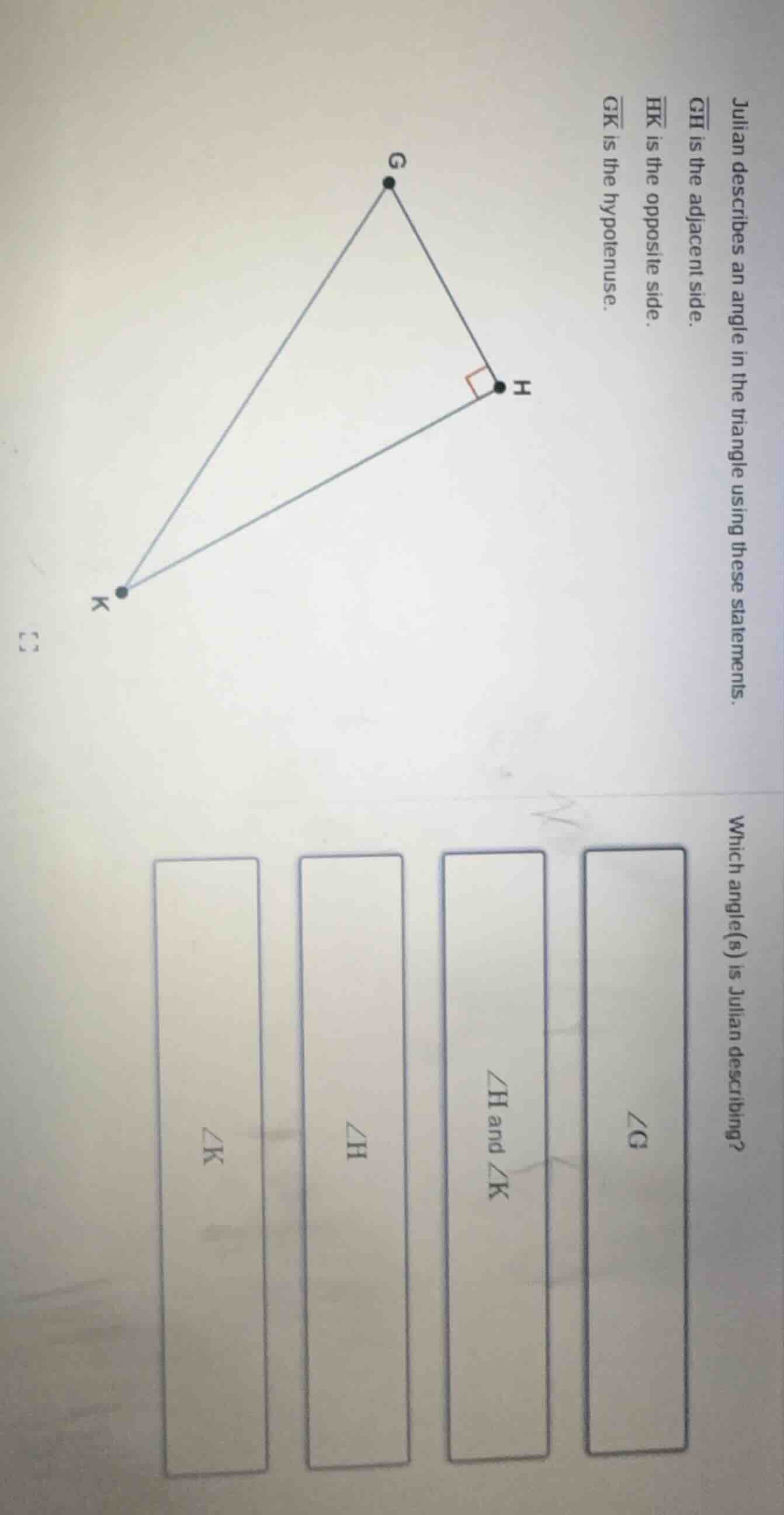
julian describes an angle in the triangle using these statements.
(overline{gh}) is the adjacent side.
(overline{hk}) is the opposite side.
(overline{gk}) is the hypotenuse.
which angle(s) is julian describing?
options: (angle g), (angle h) and (angle k), (angle h), (angle k)
Step1: Recall right triangle side definitions
In a right triangle, for an acute angle:
- Adjacent side: forms the angle with the hypotenuse.
- Opposite side: does not form the angle.
- Hypotenuse: longest side, opposite right angle.
Given \(\triangle GHK\) with right angle at \(H\) (since \(\angle H\) is right - angled, as per the diagram's right - angle mark at \(H\)).
Step2: Analyze for \(\angle K\)
- For \(\angle K\):
- Adjacent side: The side that is part of \(\angle K\) and not the hypotenuse. \(\overline{HK}\) is not adjacent (it's opposite for some angle), \(\overline{GH}\): Let's see, \(\angle K\) is at vertex \(K\). The sides forming \(\angle K\) are \(\overline{HK}\) and \(\overline{GK}\) (hypotenuse). Wait, no, let's re - evaluate. Wait, the right angle is at \(H\), so the triangle has vertices \(G\), \(H\), \(K\) with \(\angle H = 90^{\circ}\).
- For \(\angle K\):
- Adjacent side: The side adjacent to \(\angle K\) (other than hypotenuse) is \(\overline{HK}\)? No, wait, adjacent side to an angle is the side that is one of the two sides forming the angle (excluding hypotenuse). Wait, the hypotenuse is \(\overline{GK}\).
- The adjacent side to \(\angle K\) should be the side that is part of \(\angle K\) and is not the hypotenuse. Wait, the two sides forming \(\angle K\) are \(\overline{HK}\) and \(\overline{GK}\) (hypotenuse). So the other side (non - hypotenuse) forming \(\angle K\) is \(\overline{HK}\)? No, that can't be. Wait, let's use the definitions correctly.
- In right - triangle trigonometry, for angle \(\theta\) (acute) in right triangle \(ABC\) with right angle at \(C\):
- Adjacent side to \(\theta\): the side that is adjacent to \(\theta\) (i.e., one of the sides that form \(\theta\)) and is not the hypotenuse.
- Opposite side to \(\theta\): the side that does not form \(\theta\).
- In our triangle \(\triangle GHK\), right - angled at \(H\), so sides: \(\overline{GH}\), \(\overline{HK}\), \(\overline{GK}\) (hypotenuse).
- For \(\angle K\):
- The sides forming \(\angle K\) are \(\overline{HK}\) and \(\overline{GK}\) (hypotenuse). So the adjacent side (the non - hypotenuse side forming \(\angle K\)) is \(\overline{HK}\)? No, that's not right. Wait, no, the adjacent side to \(\angle K\) should be the side that is between \(\angle K\) and the right angle? Wait, maybe I made a mistake. Let's look at the given statements:
- Statement 1: \(\overline{GH}\) is the adjacent side.
- Statement 2: \(\overline{HK}\) is the opposite side.
- Statement 3: \(\overline{GK}\) is the hypotenuse.
- Let's consider angle \(\angle K\):
- Opposite side to \(\angle K\): The side opposite \(\angle K\) is \(\overline{GH}\) (because in \(\triangle GHK\), side opposite \(\angle K\) is \(\overline{GH}\)). But the statement says \(\overline{HK}\) is the opposite side. Wait, no, maybe the angle is \(\angle G\)? No, wait, let's check angle \(\angle K\) again.
- Wait, adjacent side to an angle: the side that is adjacent (next to) the angle, so for \(\angle K\), the adjacent side would be \(\overline{HK}\) (since \(\angle K\) is at \(K\), between \(\overline{HK}\) and \(\overline{GK}\)), but the statement says \(\overline{GH}\) is the adjacent side. Wait, maybe the angle is \(\angle G\)? No, let's re - express.
- Wait, the right angle is at \(H\), so \(\angle H=90^{\circ}\), so \(\angle G\) and \(\angle K\) are acute angles.
- For \(\angle K\):
- Adjace…

Snap & solve any problem in the app
Get step-by-step solutions on Sovi AI
Photo-based solutions with guided steps
Explore more problems and detailed explanations
\(\angle G\) (assuming the option with \(\angle G\) is the correct one. If the options are labeled, for example, if \(\angle G\) is option A, then the answer would be A. \(\angle G\))