QUESTION IMAGE
Question
juliet serio
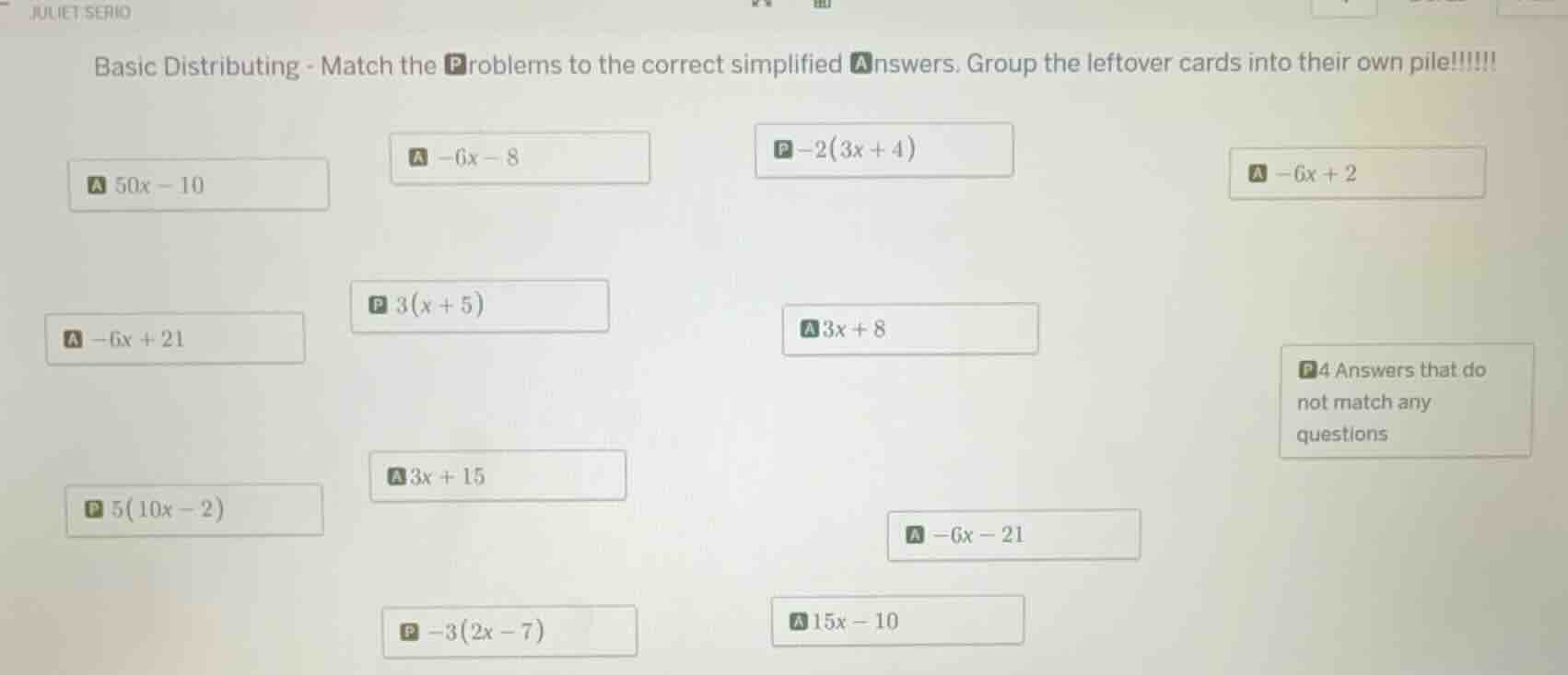
basic distributing - match the problems to the correct simplified answers. group the leftover cards into their own pile!!!!!!
a ( 50x - 10 )
a ( -6x - 8 )
p ( -2(3x + 4) )
a ( -6x + 2 )
a ( -6x + 21 )
p ( 3(x + 5) )
a ( 3x + 8 )
p ( 5(10x - 2) )
a ( 3x + 15 )
a ( -6x - 21 )
p ( -3(2x - 7) )
a ( 15x - 10 )
p 4 answers that do not match any questions
To solve this, we apply the distributive property \(a(b + c)=ab + ac\) to each problem (\(P\)) and match it to the correct answer (\(A\)):
1. Analyze \( \boldsymbol{-2(3x + 4)} \)
Step 1: Distribute \(-2\)
Using the distributive property: \(-2\times3x + (-2)\times4\)
Step 2: Simplify
\(-6x - 8\). So \( -2(3x + 4) \) matches \( -6x - 8 \).
2. Analyze \( \boldsymbol{3(x + 5)} \)
Step 1: Distribute \(3\)
Using the distributive property: \(3\times x + 3\times5\)
Step 2: Simplify
\(3x + 15\). So \( 3(x + 5) \) matches \( 3x + 15 \).
3. Analyze \( \boldsymbol{5(10x - 2)} \)
Step 1: Distribute \(5\)
Using the distributive property: \(5\times10x - 5\times2\)
Step 2: Simplify
\(50x - 10\). So \( 5(10x - 2) \) matches \( 50x - 10 \).
4. Analyze \( \boldsymbol{-3(2x - 7)} \)
Step 1: Distribute \(-3\)
Using the distributive property: \(-3\times2x - (-3)\times7\)
Step 2: Simplify
\(-6x + 21\)? Wait, no, let's re - calculate: \(-3\times2x=-6x\) and \(-3\times(-7) = 21\), so \(-3(2x - 7)=-6x + 21\). Wait, but in the answer options, we have \(-6x + 21\)? Wait, the answer card is \(-6x + 21\)? Wait, the given answer cards: one of them is \(-6x + 21\)? Wait, the user's image shows an answer card \(-6x + 21\)? Wait, let's check again. The problem is \(-3(2x - 7)\), distributing: \(-3\times2x=-6x\), \(-3\times(-7) = 21\), so the result is \(-6x + 21\), which matches the answer card \(-6x + 21\).
Leftover (Unmatched) Cards:
The answer cards \( -6x + 2\), \(3x + 8\), \(-6x - 21\), \(15x - 10\) and the problem cards? Wait, no, let's list all:
- Problems: \(-2(3x + 4)\), \(3(x + 5)\), \(5(10x - 2)\), \(-3(2x - 7)\)
- Matched Answers: \(-6x - 8\), \(3x + 15\), \(50x - 10\), \(-6x + 21\)
The leftover answer cards: \( -6x + 2\), \(3x + 8\), \(-6x - 21\), \(15x - 10\) (these are the 4 answers that do not match any problems as per the "4 Answers that do not match any questions" card)
Final Matches:
- \( -2(3x + 4) \) \(\longleftrightarrow\) \( -6x - 8 \)
- \( 3(x + 5) \) \(\longleftrightarrow\) \( 3x + 15 \)
- \( 5(10x - 2) \) \(\longleftrightarrow\) \( 50x - 10 \)
- \( -3(2x - 7) \) \(\longleftrightarrow\) \( -6x + 21 \)
Leftover Answer Cards: \( -6x + 2\), \(3x + 8\), \(-6x - 21\), \(15x - 10\)

Snap & solve any problem in the app
Get step-by-step solutions on Sovi AI
Photo-based solutions with guided steps
Explore more problems and detailed explanations
To solve this, we apply the distributive property \(a(b + c)=ab + ac\) to each problem (\(P\)) and match it to the correct answer (\(A\)):
1. Analyze \( \boldsymbol{-2(3x + 4)} \)
Step 1: Distribute \(-2\)
Using the distributive property: \(-2\times3x + (-2)\times4\)
Step 2: Simplify
\(-6x - 8\). So \( -2(3x + 4) \) matches \( -6x - 8 \).
2. Analyze \( \boldsymbol{3(x + 5)} \)
Step 1: Distribute \(3\)
Using the distributive property: \(3\times x + 3\times5\)
Step 2: Simplify
\(3x + 15\). So \( 3(x + 5) \) matches \( 3x + 15 \).
3. Analyze \( \boldsymbol{5(10x - 2)} \)
Step 1: Distribute \(5\)
Using the distributive property: \(5\times10x - 5\times2\)
Step 2: Simplify
\(50x - 10\). So \( 5(10x - 2) \) matches \( 50x - 10 \).
4. Analyze \( \boldsymbol{-3(2x - 7)} \)
Step 1: Distribute \(-3\)
Using the distributive property: \(-3\times2x - (-3)\times7\)
Step 2: Simplify
\(-6x + 21\)? Wait, no, let's re - calculate: \(-3\times2x=-6x\) and \(-3\times(-7) = 21\), so \(-3(2x - 7)=-6x + 21\). Wait, but in the answer options, we have \(-6x + 21\)? Wait, the answer card is \(-6x + 21\)? Wait, the given answer cards: one of them is \(-6x + 21\)? Wait, the user's image shows an answer card \(-6x + 21\)? Wait, let's check again. The problem is \(-3(2x - 7)\), distributing: \(-3\times2x=-6x\), \(-3\times(-7) = 21\), so the result is \(-6x + 21\), which matches the answer card \(-6x + 21\).
Leftover (Unmatched) Cards:
The answer cards \( -6x + 2\), \(3x + 8\), \(-6x - 21\), \(15x - 10\) and the problem cards? Wait, no, let's list all:
- Problems: \(-2(3x + 4)\), \(3(x + 5)\), \(5(10x - 2)\), \(-3(2x - 7)\)
- Matched Answers: \(-6x - 8\), \(3x + 15\), \(50x - 10\), \(-6x + 21\)
The leftover answer cards: \( -6x + 2\), \(3x + 8\), \(-6x - 21\), \(15x - 10\) (these are the 4 answers that do not match any problems as per the "4 Answers that do not match any questions" card)
Final Matches:
- \( -2(3x + 4) \) \(\longleftrightarrow\) \( -6x - 8 \)
- \( 3(x + 5) \) \(\longleftrightarrow\) \( 3x + 15 \)
- \( 5(10x - 2) \) \(\longleftrightarrow\) \( 50x - 10 \)
- \( -3(2x - 7) \) \(\longleftrightarrow\) \( -6x + 21 \)
Leftover Answer Cards: \( -6x + 2\), \(3x + 8\), \(-6x - 21\), \(15x - 10\)