QUESTION IMAGE
Question
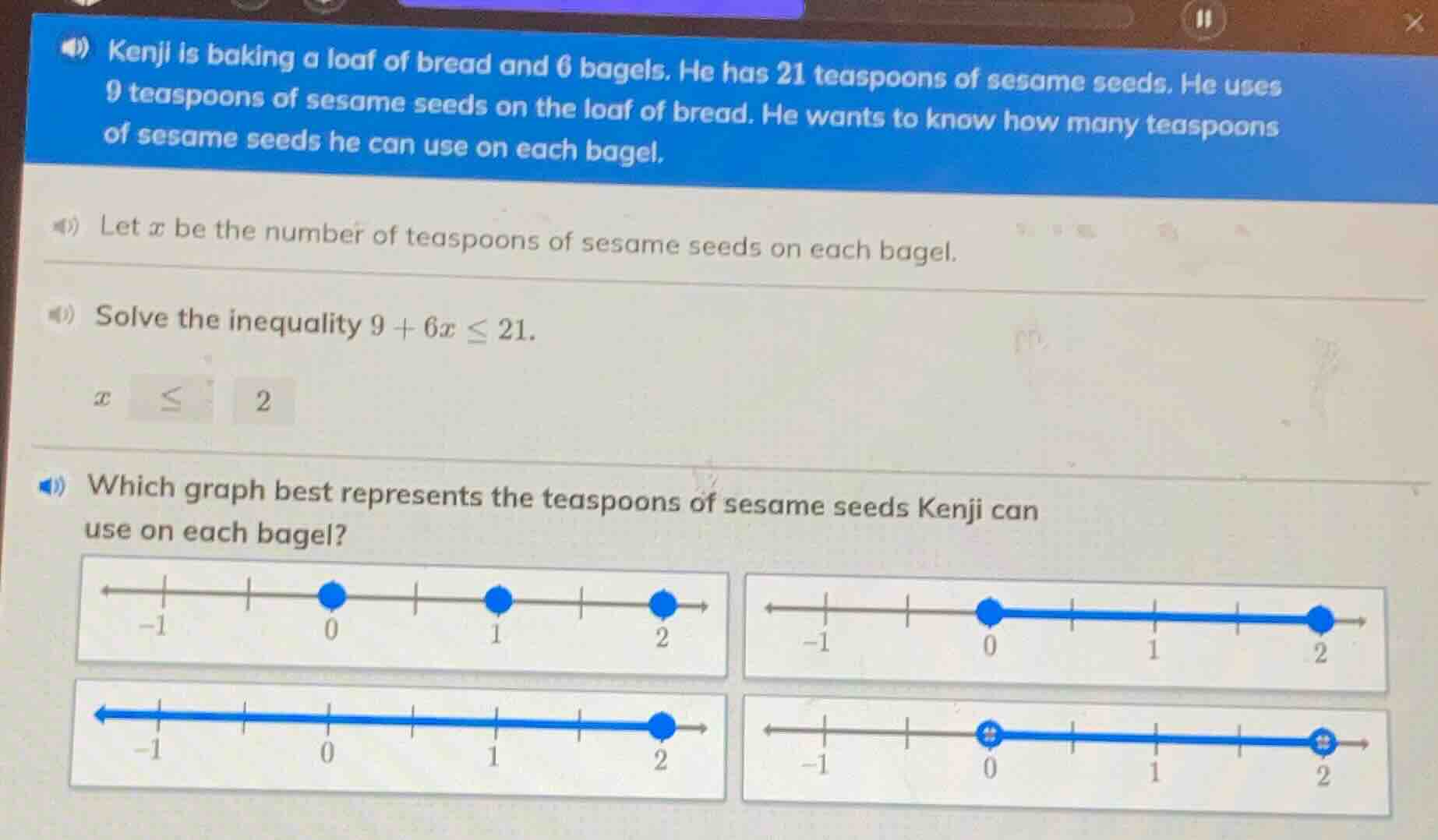
kenji is baking a loaf of bread and 6 bagels. he has 21 teaspoons of sesame seeds. he uses 9 teaspoons of sesame seeds on the loaf of bread. he wants to know how many teaspoons of sesame seeds he can use on each bagel. let ( x ) be the number of teaspoons of sesame seeds on each bagel. solve the inequality ( 9 + 6x leq 21 ). ( x leq 2 ) which graph best represents the teaspoons of sesame seeds kenji can use on each bagel?
Step1: Analyze the inequality solution
We solved the inequality \(9 + 6x\leq21\) and found that \(x\leq2\). Also, since \(x\) represents the number of teaspoons of sesame seeds on each bagel, \(x\) must be non - negative (\(x\geq0\)) because we can't use a negative amount of sesame seeds. So the solution for \(x\) is \(0\leq x\leq2\).
Step2: Analyze the number line graphs
- For a number line graph representing \(0\leq x\leq2\), we need a closed circle at \(0\) (because \(x = 0\) is included) and a closed circle at \(2\) (because \(x=2\) is included), and the line segment between \(0\) and \(2\) should be shaded.
- Let's check the given graphs:
- The first graph has three separate points, which does not represent a range.
- The second graph has a closed circle at \(0\) and a closed circle at \(2\) with the line between them shaded. This matches our solution \(0\leq x\leq2\).
- The third graph has a closed circle at \(2\) and the line is shaded to the left, which would represent \(x\leq2\) but does not account for the non - negativity of \(x\).
- The fourth graph has open circles, but our solution includes the endpoints \(0\) and \(2\), so open circles are incorrect.

Snap & solve any problem in the app
Get step-by-step solutions on Sovi AI
Photo-based solutions with guided steps
Explore more problems and detailed explanations
The graph with a closed circle at 0, a closed circle at 2, and the line segment between them shaded (the second graph among the given options).