QUESTION IMAGE
Question
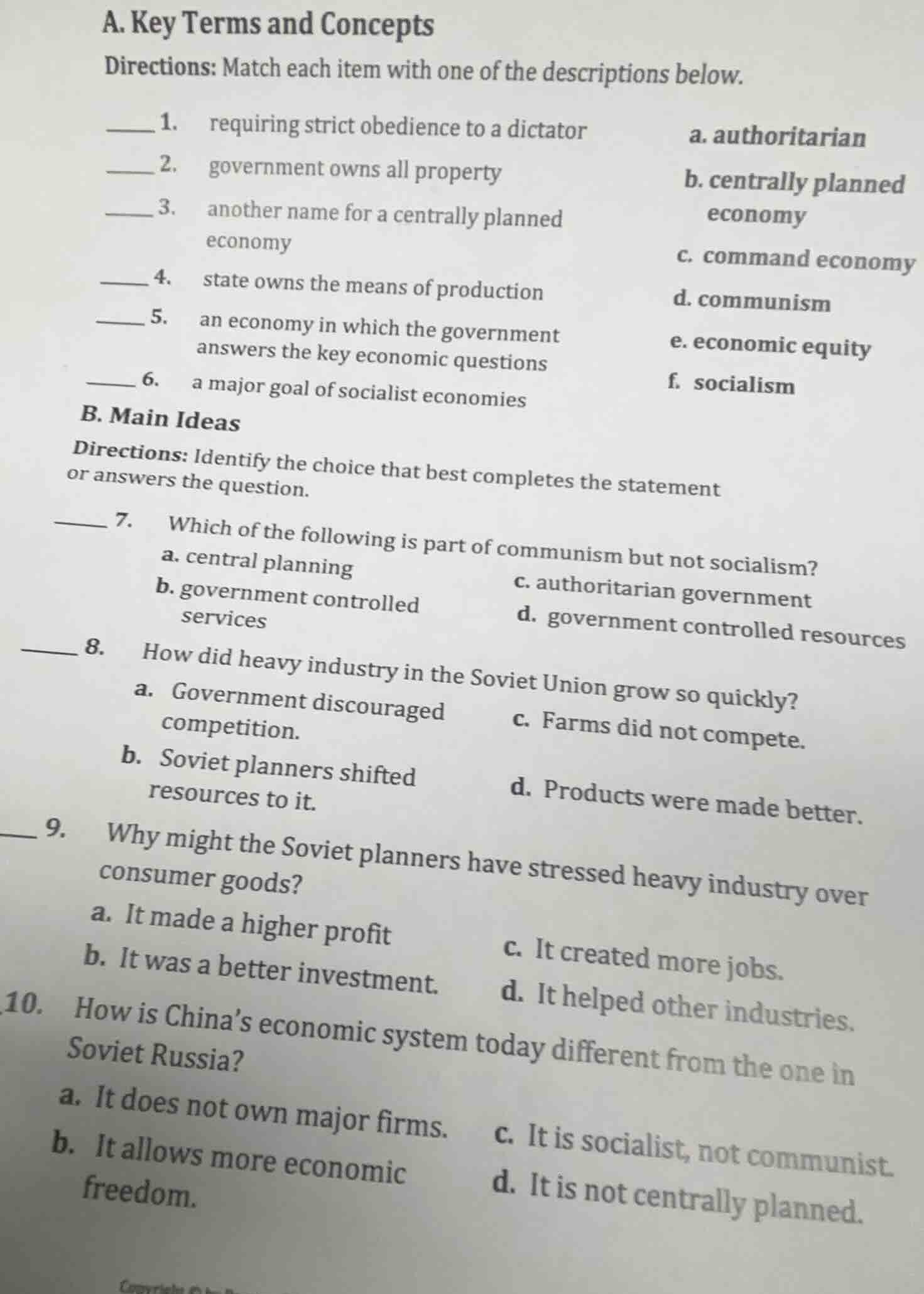
a. key terms and concepts
directions: match each item with one of the descriptions below.
____ 1. requiring strict obedience to a dictator
____ 2. government owns all property
____ 3. another name for a centrally planned economy
____ 4. state owns the means of production
____ 5. an economy in which the government answers the key economic questions
____ 6. a major goal of socialist economies
a. authoritarian
b. centrally planned economy
c. command economy
d. communism
e. economic equity
f. socialism
b. main ideas
directions: identify the choice that best completes the statement or answers the question.
____ 7. which of the following is part of communism but not socialism?
a. central planning
b. government controlled services
c. authoritarian government
d. government controlled resources
____ 8. how did heavy industry in the soviet union grow so quickly?
a. government discouraged competition.
b. soviet planners shifted resources to it.
c. farms did not compete.
d. products were made better.
____ 9. why might the soviet planners have stressed heavy industry over consumer goods?
a. it made a higher profit
b. it was a better investment.
c. it created more jobs.
d. it helped other industries.
____ 10. how is chinas economic system today different from the one in soviet russia?
a. it does not own major firms.
b. it allows more economic freedom.
c. it is socialist, not communist.
d. it is not centrally planned.
Part A (Matching):
- The definition "requiring strict obedience to a dictator" aligns with authoritarian.
- Communism is defined by the government owning all property.
- Command economy is another term for a centrally planned economy.
- Socialism is characterized by the state owning the means of production.
- A centrally planned economy has the government answer key economic questions.
- Economic equity is a core goal of socialist economies.
Part B (Multiple Choice):
- Socialism can exist with non-authoritarian governments, while communism (as implemented) typically has an authoritarian structure; central planning, controlled services, and controlled resources are shared by both.
- The Soviet Union's central planners deliberately allocated resources to heavy industry to drive its rapid growth.
- Heavy industry (like steel, machinery) supports the development of other industries (manufacturing, construction), which was a priority for Soviet planners.
- Unlike the fully centrally planned Soviet economy, modern China allows significant private enterprise and market-based activity, meaning it permits more economic freedom.

Snap & solve any problem in the app
Get step-by-step solutions on Sovi AI
Photo-based solutions with guided steps
Explore more problems and detailed explanations
Part A:
- a. authoritarian
- d. communism
- c. command economy
- f. socialism
- b. centrally planned economy
- e. economic equity
Part B:
- c. authoritarian government
- b. Soviet planners shifted resources to it.
- d. It helped other industries.
- b. It allows more economic freedom.