QUESTION IMAGE
Question
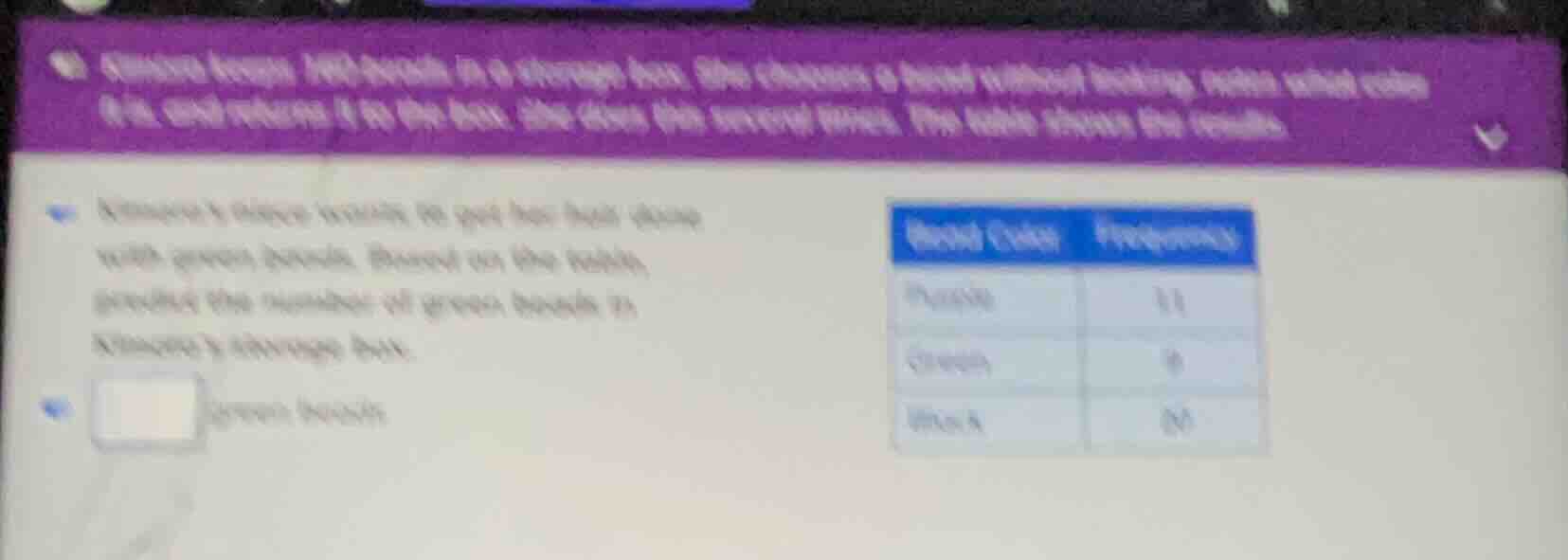
kimora keeps 100 beads in a storage box. she chooses a bead without looking, notes what color it is, and returns it to the box. she does this several times. the table shows the results.
kimora’s friend wants to put her hair done with green beads. based on the table, predict the number of green beads in kimora’s storage box.
| bead color | frequency |
|---|---|
| green | 9 |
| black | 10 |
Step1: Calculate total trials
$11 + n + 19 = 30 + n$
Step2: Find probability of green beads
The relative frequency of green beads is $\frac{n}{30 + n}$, which estimates the true probability of picking a green bead.
Step3: Set up proportion for total beads
Let $G$ = number of green beads. The true probability is $\frac{G}{100}$. Equate to relative frequency:
$\frac{G}{100} = \frac{n}{30 + n}$
Step4: Use missing frequency logic
We know the sum of frequencies corresponds to the trial count, and the proportion scales to 100 beads. First find total trials: $11 + 19 + n = 30 + n$. The relative frequency of green is $\frac{n}{30 + n}$. For 100 beads, $G = 100 \times \frac{n}{30 + n}$.
We can also note that the sum of the frequencies must correspond to the ratio of total beads. First calculate the total number of trials: $11 + 19 = 30$, so total trials are $30 + n$. The probability of picking green is $\frac{n}{30 + n}$. To find $G$, we use the fact that $\frac{G}{100} = \frac{n}{30 + n}$. Cross-multiplying gives $G(30 + n) = 100n$. But we can also recognize that the relative frequency of non-green beads is $\frac{30}{30 + n}$, so the number of non-green beads is $100 \times \frac{30}{30 + n} = 60$ (since $100 - G = 60$). Solving $\frac{30}{30 + n} = \frac{60}{100}$:
$60(30 + n) = 30 \times 100$
$1800 + 60n = 3000$
$60n = 1200$
$n = 20$
Then $G = 100 \times \frac{20}{30 + 20} = 100 \times \frac{20}{50} = 40$

Snap & solve any problem in the app
Get step-by-step solutions on Sovi AI
Photo-based solutions with guided steps
Explore more problems and detailed explanations
40 green beads