QUESTION IMAGE
Question
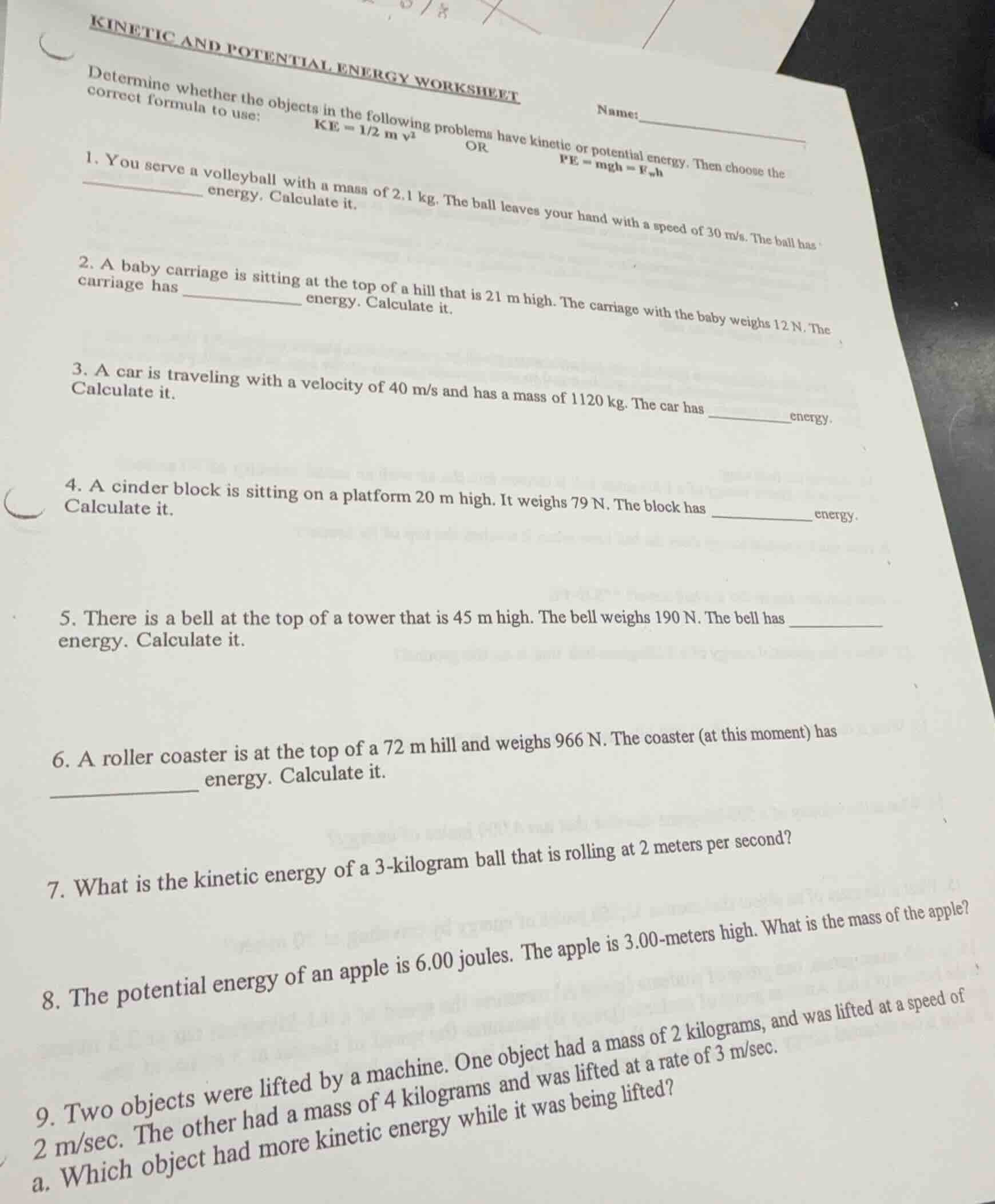
kinetic and potential energy worksheet
name:_________________________
determine whether the objects in the following problems have kinetic or potential energy. then choose the correct formula to use:
$ke = \frac{1}{2} m v^2$ or $pe = mgh = f_w h$
- you serve a volleyball with a mass of 2.1 kg. the ball leaves your hand with a speed of 30 m/s. the ball has __________ energy. calculate it.
- a baby carriage is sitting at the top of a hill that is 21 m high. the carriage with the baby weighs 12 n. the carriage has __________ energy. calculate it.
- a car is traveling with a velocity of 40 m/s and has a mass of 1120 kg. the car has __________ energy. calculate it.
- a cinder block is sitting on a platform 20 m high. it weighs 79 n. the block has __________ energy. calculate it.
- there is a bell at the top of a tower that is 45 m high. the bell weighs 190 n. the bell has __________ energy. calculate it.
- a roller coaster is at the top of a 72 m hill and weighs 966 n. the coaster (at this moment) has __________ energy. calculate it.
- what is the kinetic energy of a 3-kilogram ball that is rolling at 2 meters per second?
- the potential energy of an apple is 6.00 joules. the apple is 3.00-meters high. what is the mass of the apple?
- two objects were lifted by a machine. one object had a mass of 2 kilograms, and was lifted at a speed of 2 m/sec. the other had a mass of 4 kilograms and was lifted at a rate of 3 m/sec.
a. which object had more kinetic energy while it was being lifted?
Step1: Identify energy type, use KE formula
The moving volleyball has kinetic energy. Use $KE = \frac{1}{2}mv^2$.
$m=2.1\ \text{kg}, v=30\ \text{m/s}$
$KE = \frac{1}{2} \times 2.1 \times 30^2 = \frac{1}{2} \times 2.1 \times 900 = 945\ \text{J}$
Step2: Identify energy type, use PE formula
The stationary carriage at height has potential energy. Use $PE = F_w h$.
$F_w=12\ \text{N}, h=21\ \text{m}$
$PE = 12 \times 21 = 252\ \text{J}$
Step3: Identify energy type, use KE formula
The moving car has kinetic energy. Use $KE = \frac{1}{2}mv^2$.
$m=1120\ \text{kg}, v=40\ \text{m/s}$
$KE = \frac{1}{2} \times 1120 \times 40^2 = \frac{1}{2} \times 1120 \times 1600 = 896000\ \text{J}$
Step4: Identify energy type, use PE formula
The stationary block at height has potential energy. Use $PE = F_w h$.
$F_w=79\ \text{N}, h=20\ \text{m}$
$PE = 79 \times 20 = 1580\ \text{J}$
Step5: Identify energy type, use PE formula
The stationary bell at height has potential energy. Use $PE = F_w h$.
$F_w=190\ \text{N}, h=45\ \text{m}$
$PE = 190 \times 45 = 8550\ \text{J}$
Step6: Identify energy type, use PE formula
The stationary coaster at height has potential energy. Use $PE = F_w h$.
$F_w=966\ \text{N}, h=72\ \text{m}$
$PE = 966 \times 72 = 69552\ \text{J}$
Step7: Use KE formula for rolling ball
Use $KE = \frac{1}{2}mv^2$.
$m=3\ \text{kg}, v=2\ \text{m/s}$
$KE = \frac{1}{2} \times 3 \times 2^2 = \frac{1}{2} \times 3 \times 4 = 6\ \text{J}$
Step8: Rearrange PE formula to solve for mass
Use $PE = mgh$, rearrange to $m = \frac{PE}{gh}$.
$PE=6.00\ \text{J}, h=3.00\ \text{m}, g=9.8\ \text{m/s}^2$
$m = \frac{6.00}{9.8 \times 3.00} \approx 0.204\ \text{kg}$
Step9a: Calculate KE for both objects, compare
Use $KE = \frac{1}{2}mv^2$ for each object.
Object 1: $m=2\ \text{kg}, v=2\ \text{m/s}$
$KE_1 = \frac{1}{2} \times 2 \times 2^2 = 4\ \text{J}$
Object 2: $m=4\ \text{kg}, v=3\ \text{m/s}$
$KE_2 = \frac{1}{2} \times 4 \times 3^2 = 18\ \text{J}$
$18>4$, so the 4 kg object has more KE.

Snap & solve any problem in the app
Get step-by-step solutions on Sovi AI
Photo-based solutions with guided steps
Explore more problems and detailed explanations
- Kinetic; 945 J
- Potential; 252 J
- Kinetic; 896000 J
- Potential; 1580 J
- Potential; 8550 J
- Potential; 69552 J
- 6 J
- $\approx0.204$ kg
- a. The 4-kilogram object lifted at 3 m/sec