QUESTION IMAGE
Question
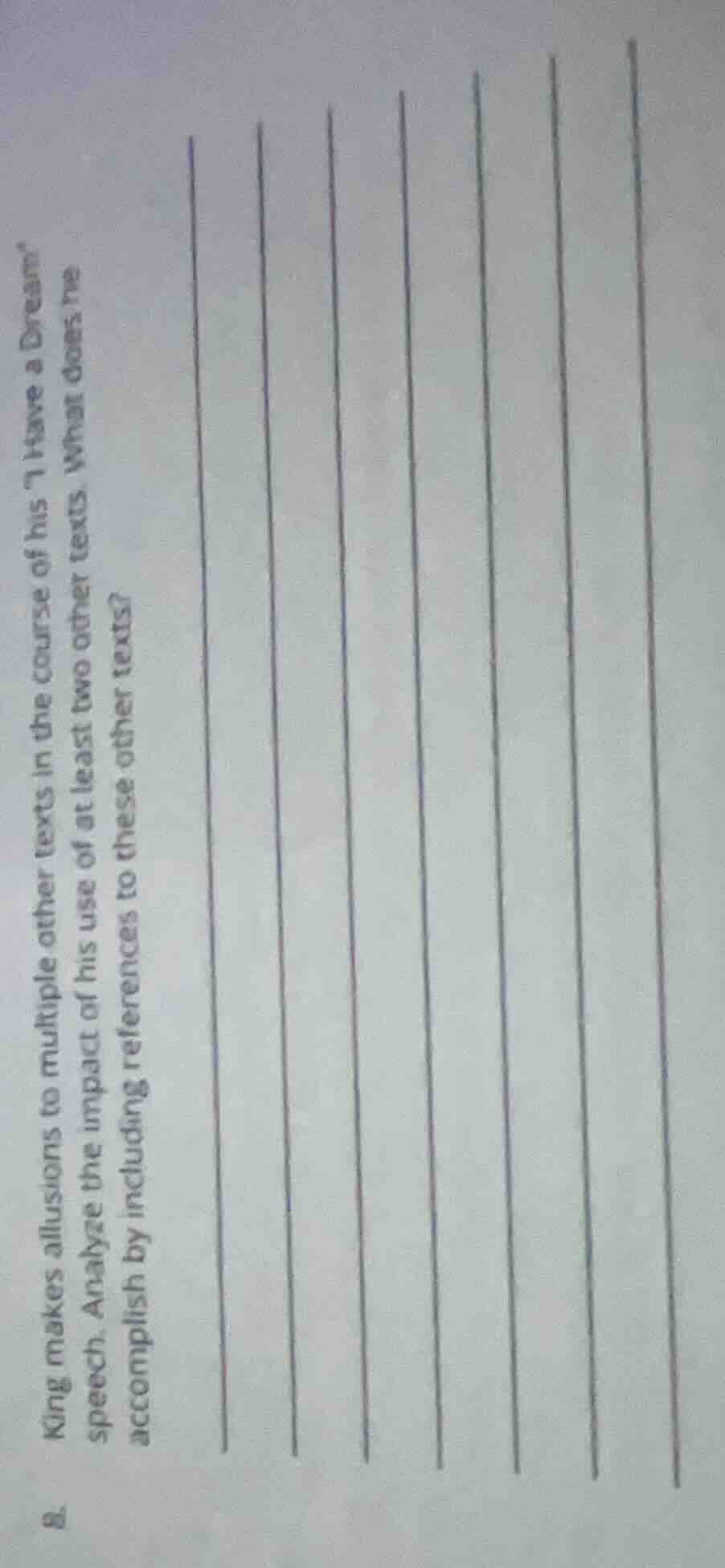
- king makes allusions to multiple other texts in the course of his \i have a dream\ speech. analyze the impact of his use of at least two other texts. what does he accomplish by including references to these other texts?
Brief Explanations
- Reference to the Emancipation Proclamation: King alludes to this 1863 executive order early in the speech. By referencing it, he frames the civil rights struggle as a fulfillment of America's own promised freedom, arguing that Black Americans were still denied the "unalienable rights" of the nation's founding ideals. This grounds his demand in existing national moral and legal frameworks, making his cause feel like a completion of American justice rather than a radical break.
- Biblical Allusions (e.g., "Promised Land"): King frequently uses religious imagery, including referencing the Hebrew Bible's story of the Israelites' journey to the Promised Land. This resonates deeply with both Black Christian communities (a core part of his audience) and broader American religious values. It casts the civil rights movement as a righteous, divinely aligned quest for liberation, evoking empathy and moral authority, and positions the struggle as part of a timeless fight for justice.
These allusions connect King's message to shared cultural, historical, and moral touchstones, making his demands for equality feel legitimate, familiar, and deeply rooted in the values his audience already claimed to hold. They also expand the scope of the speech beyond a specific moment, framing the civil rights movement as part of a larger, ongoing struggle for freedom and justice.

Snap & solve any problem in the app
Get step-by-step solutions on Sovi AI
Photo-based solutions with guided steps
Explore more problems and detailed explanations
By referencing texts like the Emancipation Proclamation and biblical narratives, King achieves three key goals:
- He anchors his demand for racial equality in America's own founding and legal promises, framing the civil rights movement as a push to fulfill, not rewrite, national ideals.
- He leverages shared religious and cultural touchstones (especially biblical allusions) to build moral authority, resonate with diverse audiences (including Black Christian communities and mainstream religious Americans), and cast the struggle as a righteous, timeless quest for justice.
- He elevates the specific grievances of Black Americans to a universal fight for human dignity, linking their struggle to broader, globally recognized narratives of liberation and equality.