QUESTION IMAGE
Question
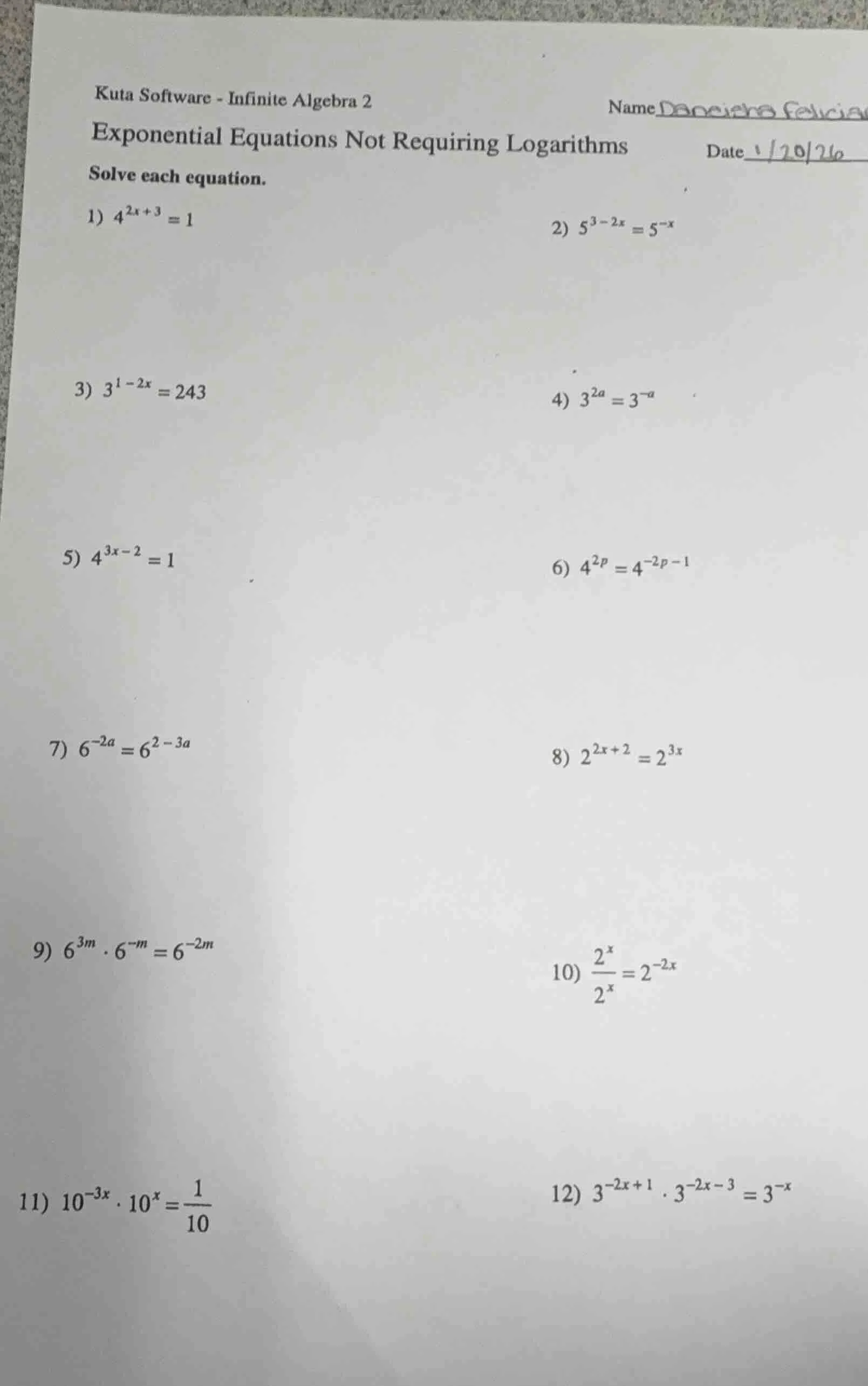
kuta software - infinite algebra 2
exponential equations not requiring logarithms
solve each equation.
- $4^{2x + 3} = 1$
- $5^{3 - 2x} = 5^{-x}$
- $3^{1 - 2x} = 243$
- $3^{2a} = 3^{-a}$
- $4^{3x - 2} = 1$
- $4^{2p} = 4^{-2p - 1}$
- $6^{-2a} = 6^{2 - 3a}$
- $2^{2x + 2} = 2^{3x}$
- $6^{3m} \cdot 6^{-m} = 6^{-2m}$
- $\frac{2^x}{2^x} = 2^{-2x}$
- $10^{-3x} \cdot 10^x = \frac{1}{10}$
- $3^{-2x + 1} \cdot 3^{-2x - 3} = 3^{-x}$
Problem 1: \( 4^{2x + 3} = 1 \)
Step 1: Recall that \( a^0 = 1 \) for \( a
eq 0 \)
So we can rewrite the right - hand side as \( 4^0 \). Then the equation becomes \( 4^{2x+3}=4^0 \).
Step 2: Use the property of exponential functions: if \( a^m=a^n \), then \( m = n \) (for \( a>0,a
eq1 \))
Since the base \( 4>0 \) and \( 4
eq1 \), we can set the exponents equal to each other: \( 2x + 3=0 \).
Step 3: Solve for \( x \)
Subtract 3 from both sides: \( 2x=-3 \). Then divide both sides by 2: \( x =-\frac{3}{2} \).
Step 1: Use the property of exponential functions \( a^m=a^n\Rightarrow m = n \) ( \( a = 5>0,a
eq1 \))
Set the exponents equal: \( 3-2x=-x \).
Step 2: Solve for \( x \)
Add \( 2x \) to both sides: \( 3=x \).
Step 1: Rewrite 243 as a power of 3
We know that \( 3^5 = 243 \), so the equation becomes \( 3^{1-2x}=3^5 \).
Step 2: Use the property \( a^m=a^n\Rightarrow m = n \) ( \( a = 3>0,a
eq1 \))
Set the exponents equal: \( 1-2x = 5 \).
Step 3: Solve for \( x \)
Subtract 1 from both sides: \( - 2x=4 \). Divide both sides by - 2: \( x=-2 \).

Snap & solve any problem in the app
Get step-by-step solutions on Sovi AI
Photo-based solutions with guided steps
Explore more problems and detailed explanations
\( x =-\frac{3}{2} \)