QUESTION IMAGE
Question
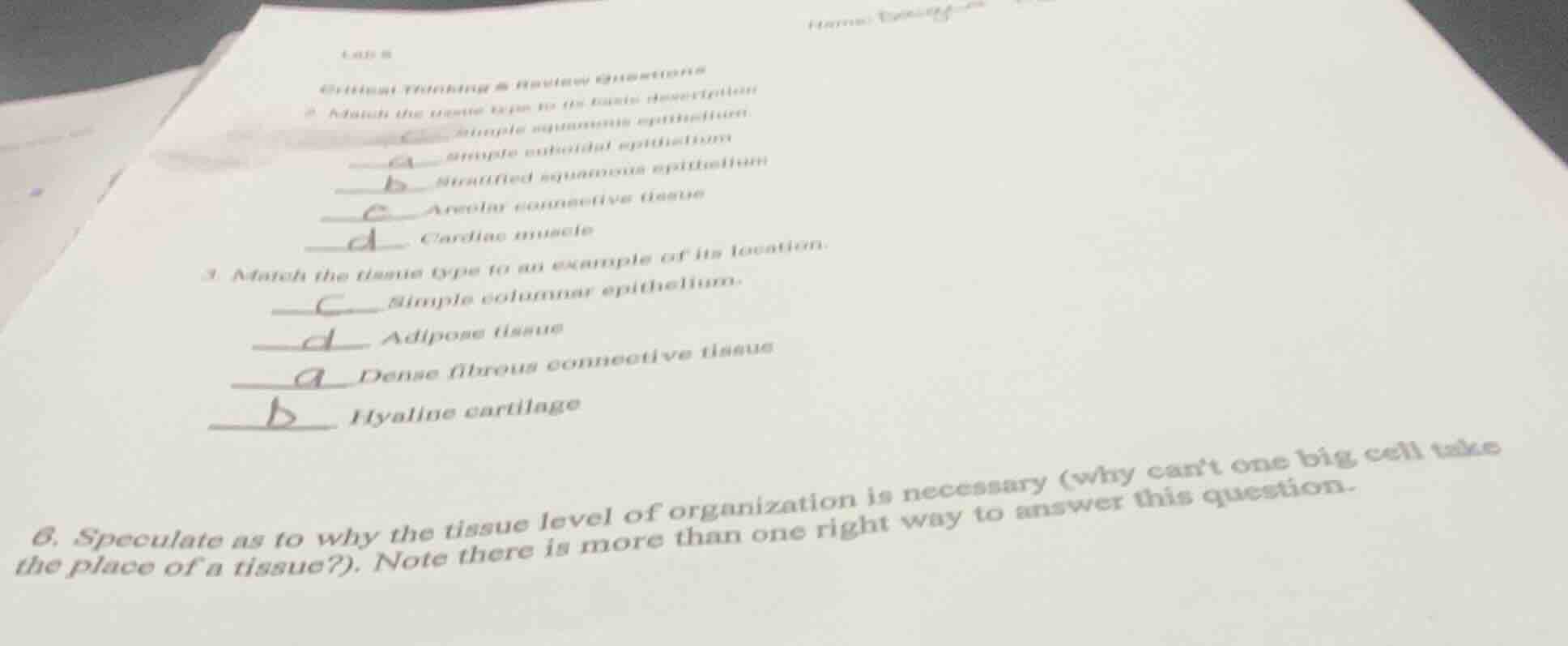
lab 6
critical thinking & review questions
2 match the tissue type to its basic description
c simple squamous epithelium
a simple cuboidal epithelium
b stratified squamous epithelium
e areolar connective tissue
d cardiac muscle
3 match the tissue type to an example of its location.
c simple columnar epithelium
d adipose tissue
a dense fibrous connective tissue
b hyaline cartilage
- speculate as to why the tissue level of organization is necessary (why can’t one big cell take
the place of a tissue?). note there is more than one right way to answer this question.
Brief Explanations
A single large cell cannot replace tissue for key reasons:
- Surface Area to Volume Limitation: As cell size increases, its volume grows faster than its surface area ($\text{Surface Area} \propto r^2$, $\text{Volume} \propto r^3$). This limits the rate of nutrient/waste exchange across the cell membrane, making it impossible for a giant cell to support its own metabolic needs.
- Functional Specialization: Tissues consist of specialized cells adapted for specific tasks (e.g., contraction, secretion, protection). A single cell cannot simultaneously perform all the diverse functions of a tissue or organ system.
- Structural Integrity: Tissues (and extracellular matrix in connective tissues) provide mechanical strength, support, and organization that a single large cell cannot offer, especially for load-bearing or protective roles.
- Damage Resilience: A tissue with many cells can survive damage to individual cells, while a single giant cell would fail entirely if injured.

Snap & solve any problem in the app
Get step-by-step solutions on Sovi AI
Photo-based solutions with guided steps
Explore more problems and detailed explanations
The tissue level of organization is necessary because:
- A single large cell would face fatal surface area-to-volume ratio limitations, unable to exchange nutrients/waste fast enough to support its metabolism.
- Tissues allow for cellular specialization, enabling distinct, targeted functions (e.g., muscle contraction, epithelial protection) that one cell cannot perform simultaneously.
- Tissues (with extracellular matrix in many cases) provide structural strength, support, and resilience that a single cell cannot match, critical for bodily structure and injury resistance.