QUESTION IMAGE
Question
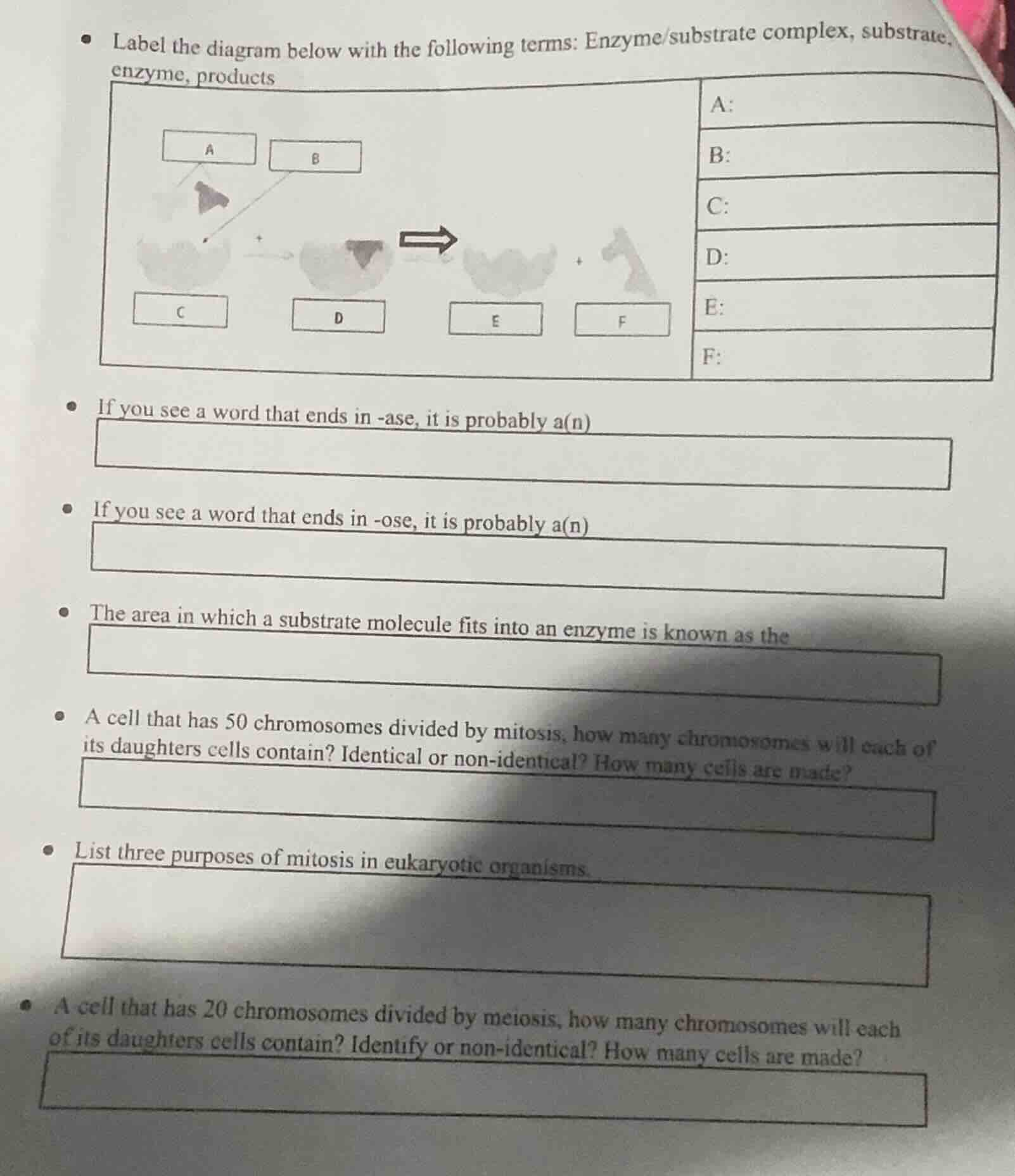
- label the diagram below with the following terms: enzyme/substrate complex, substrate, enzyme, products
- if you see a word that ends in -ase, it is probably a(n)
- if you see a word that ends in -ose, it is probably a(n)
- the area in which a substrate molecule fits into an enzyme is known as the
- a cell that has 50 chromosomes divided by mitosis, how many chromosomes will each of its daughters cells contain? identical or non-identical? how many cells are made?
- list three purposes of mitosis in eukaryotic organisms.
- a cell that has 20 chromosomes divided by meiosis, how many chromosomes will each of its daughters cells contain? identify or non-identical? how many cells are made?
Brief Explanations
- Enzyme-Substrate Diagram: Enzymes (B, C, E) are the stable, reusable structures; the substrate (A) binds to the enzyme to form the enzyme/substrate complex (D), and the reaction produces products (F).
- -ase Suffix: This suffix universally denotes enzymes (biological catalysts).
- -ose Suffix: This suffix is characteristic of sugar molecules (carbohydrates).
- Active Site: This is the specific region on an enzyme where the substrate binds.
- Mitosis: This process produces genetically identical daughter cells with the same chromosome number as the parent, creating 2 cells total, used for growth, repair, and asexual reproduction.
- Meiosis: This reduction division produces 4 genetically non-identical daughter cells, each with half the parent cell's chromosome number, for sexual reproduction.

Snap & solve any problem in the app
Get step-by-step solutions on Sovi AI
Photo-based solutions with guided steps
Explore more problems and detailed explanations
A: Substrate
B: Enzyme
C: Enzyme
D: Enzyme/substrate complex
E: Enzyme
F: Products
- enzyme
- sugar
- active site
- 50 chromosomes; identical; 2 cells
- 1. Growth of the organism, 2. Repair of damaged tissues, 3. Asexual reproduction
- 10 chromosomes; non-identical; 4 cells