QUESTION IMAGE
Question
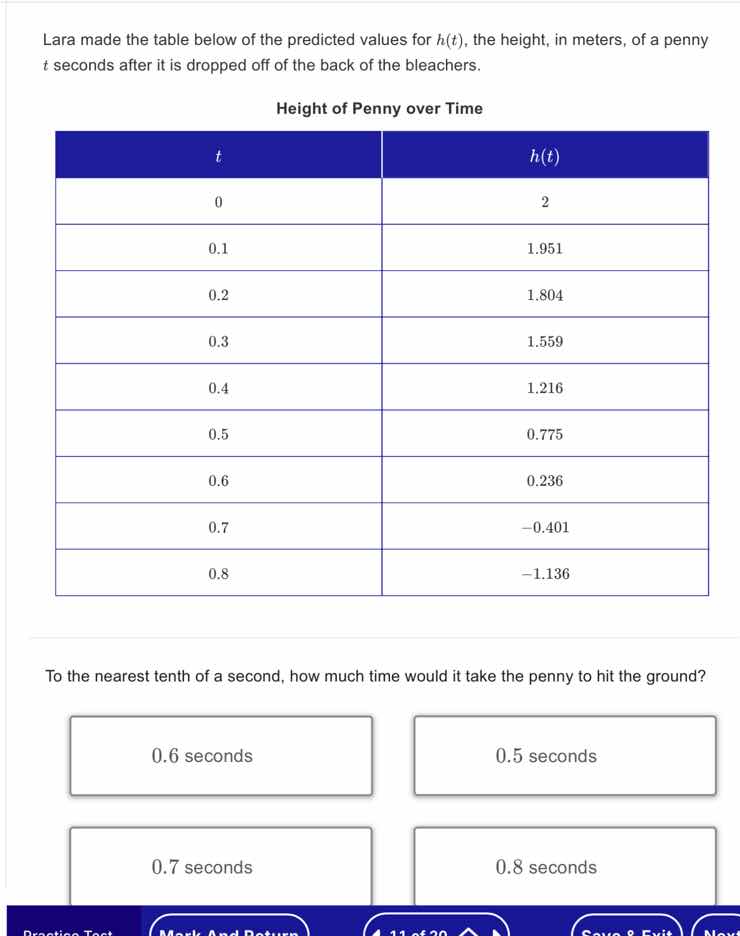
lara made the table below of the predicted values for $h(t)$, the height, in meters, of a penny $t$ seconds after it is dropped off of the back of the bleachers.
height of penny over time
| $t$ | $h(t)$ |
|---|---|
| 0.1 | 1.951 |
| 0.2 | 1.804 |
| 0.3 | 1.559 |
| 0.4 | 1.216 |
| 0.5 | 0.775 |
| 0.6 | 0.236 |
| 0.7 | -0.401 |
| 0.8 | -1.136 |
to the nearest tenth of a second, how much time would it take the penny to hit the ground?
- 0.6 seconds
- 0.5 seconds
- 0.7 seconds
- 0.8 seconds
Step1: Understand the problem
We need to find when the penny hits the ground, which means \( h(t) = 0 \) (height is 0 meters). We look at the table of \( t \) (time in seconds) and \( h(t) \) (height in meters) to see when \( h(t) \) is closest to 0, and then determine the time \( t \) to the nearest tenth of a second.
Step2: Analyze the table values
- At \( t = 0.5 \) seconds, \( h(t)=0.775 \) meters (positive, above ground).
- At \( t = 0.6 \) seconds, \( h(t)=0.236 \) meters (positive, above ground but closer to 0 than at \( t = 0.5 \)).
- At \( t = 0.7 \) seconds, \( h(t)= - 0.401 \) meters (negative, below ground, meaning it has hit the ground before or at this time).
- At \( t = 0.8 \) seconds, \( h(t)= - 1.136 \) meters (negative, further below ground).
We need to see between which two times the height crosses from positive to negative (since that's when it hits the ground). Between \( t = 0.6 \) ( \( h = 0.236 \)) and \( t = 0.7 \) ( \( h=- 0.401 \) ), the height goes from positive to negative. Now we check which time is closer to when \( h(t) = 0 \).
The value at \( t = 0.6 \) is \( 0.236 \) (distance from 0 is \( 0.236 \)), and at \( t = 0.7 \) is \( 0.401 \) (distance from 0 is \( 0.401 \)). Wait, no, actually, when moving from \( t = 0.6 \) ( \( h = 0.236 \)) to \( t = 0.7 \) ( \( h=-0.401 \) ), the zero crossing is between 0.6 and 0.7. But we need to find to the nearest tenth. Let's calculate the difference:
At \( t = 0.6 \), \( h = 0.236 \); at \( t = 0.7 \), \( h=-0.401 \). The change in \( h \) is \( - 0.401-0.236=-0.637 \) over a time change of \( 0.7 - 0.6 = 0.1 \) seconds. We need to find \( \Delta t \) such that \( 0.236+\frac{0 - 0.236}{- 0.637}\times0.1 \). Wait, maybe simpler: look at the values. At \( t = 0.6 \), height is 0.236 (still above ground), at \( t = 0.7 \), height is - 0.401 (below ground). So the time when it hits the ground is between 0.6 and 0.7. Now, which is closer to 0.6 or 0.7? The height at 0.6 is 0.236, at 0.7 is - 0.401. The absolute value of 0.236 is 0.236, and of - 0.401 is 0.401. Wait, no, actually, when the height goes from positive to negative, the zero crossing is between 0.6 and 0.7. But the question is to the nearest tenth. Let's check the options. The options are 0.6, 0.5, 0.7, 0.8.
Wait, maybe I made a mistake. Wait, at \( t = 0.6 \), \( h = 0.236 \) (above ground), at \( t = 0.7 \), \( h=-0.401 \) (below ground). So the penny hits the ground between 0.6 and 0.7 seconds. Now, to find the nearest tenth, we see that 0.6 is 0.236 above ground, 0.7 is 0.401 below ground. The distance from 0.6 to 0 (in terms of height) is 0.236, and from 0.7 to 0 (in terms of height) is 0.401. Wait, no, the time when it hits the ground is when \( h(t) = 0 \). Let's use linear approximation between \( t = 0.6 \) ( \( h = 0.236 \)) and \( t = 0.7 \) ( \( h=-0.401 \) ).
The formula for linear approximation is \( t = t_1+\frac{0 - h(t_1)}{h(t_2)-h(t_1)}\times(t_2 - t_1) \), where \( t_1 = 0.6 \), \( h(t_1)=0.236 \), \( t_2 = 0.7 \), \( h(t_2)=-0.401 \).
So \( t = 0.6+\frac{0 - 0.236}{- 0.401 - 0.236}\times(0.7 - 0.6) \)
\( t = 0.6+\frac{- 0.236}{- 0.637}\times0.1 \)
\( t = 0.6+\frac{0.236}{0.637}\times0.1 \)
\( \frac{0.236}{0.637}\approx0.370 \)
\( t\approx0.6 + 0.037\approx0.637 \) seconds. Rounding to the nearest tenth, that's 0.6 seconds? Wait, no, wait 0.637 is closer to 0.6 or 0.7? 0.637 - 0.6 = 0.037, 0.7 - 0.637 = 0.063. So 0.637 is closer to 0.6 (since 0.037 < 0.063)? Wait, no, 0.637 is 0.6 when rounded to the nearest tenth? Wait, 0.637: the tenths place is 6, the hundredths place…

Snap & solve any problem in the app
Get step-by-step solutions on Sovi AI
Photo-based solutions with guided steps
Explore more problems and detailed explanations
0.6 seconds