QUESTION IMAGE
Question
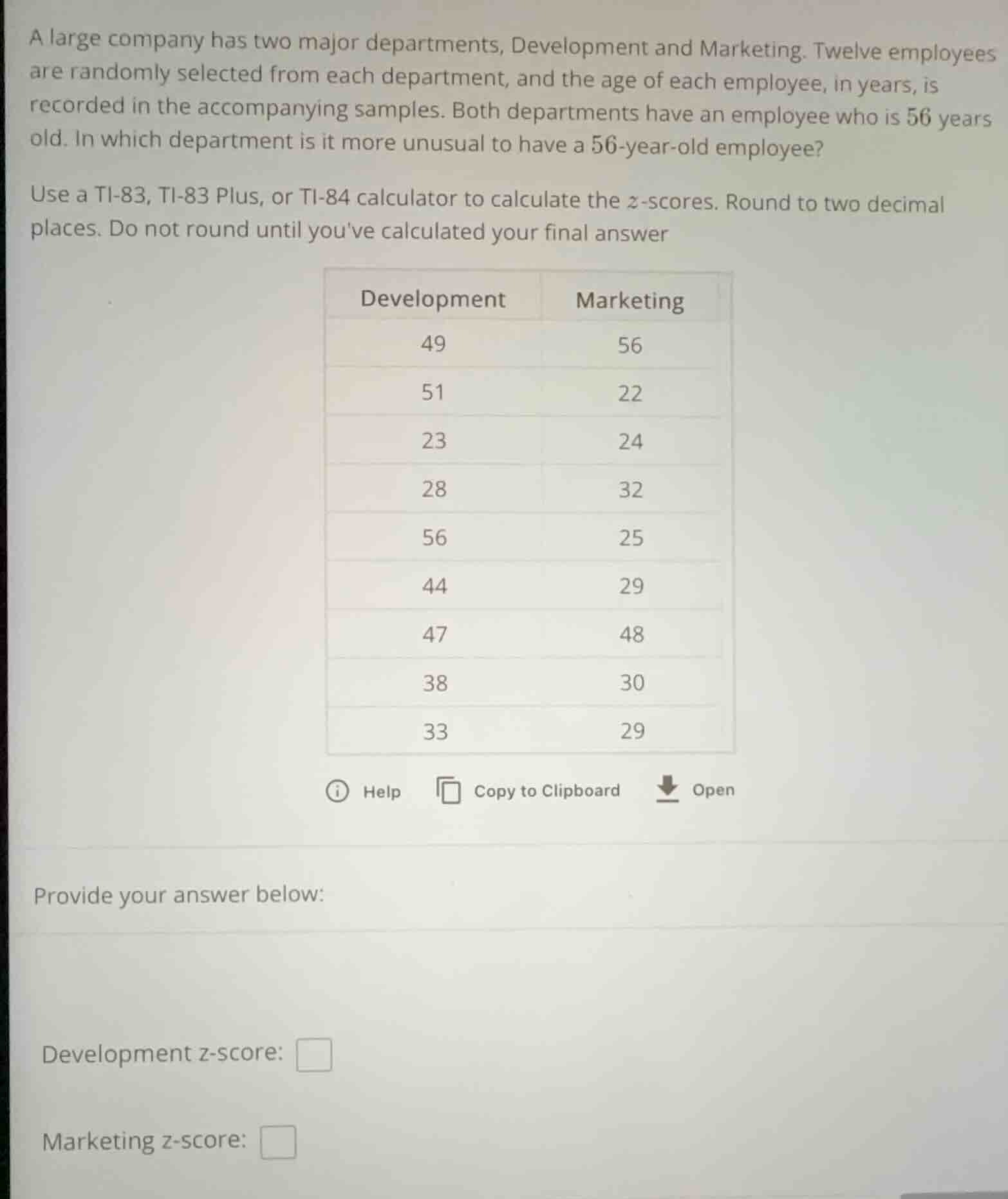
a large company has two major departments, development and marketing. twelve employees are randomly selected from each department, and the age of each employee, in years, is recorded in the accompanying samples. both departments have an employee who is 56 years old. in which department is it more unusual to have a 56-year-old employee? use a ti-83, ti-83 plus, or ti-84 calculator to calculate the z - scores. round to two decimal places. do not round until youve calculated your final answer development marketing 49 56 51 22 23 24 28 32 56 25 44 29 47 48 38 30 33 29 provide your answer below: development z - score: marketing z - score:
Step1: Calculate mean and standard deviation for Development department
First, we list the ages in the Development department: 49, 51, 23, 28, 56, 44, 47, 38, 33. Wait, the problem says twelve employees are selected from each department, but the table shows 9 entries? Wait, maybe it's a typo, but let's use the given data. Wait, no, maybe the table is incomplete, but the problem says "twelve employees are randomly selected from each department" but the table has 9? Wait, maybe it's a mistake, but let's proceed with the given data. Wait, no, maybe I miscounted. Let's check: Development column: 49, 51, 23, 28, 56, 44, 47, 38, 33. That's 9 values. Marketing: 56, 22, 24, 32, 25, 29, 48, 30, 29. Also 9. Maybe the problem has a typo, but we'll use these 9 values.
First, calculate the mean (\(\mu\)) and standard deviation (\(\sigma\)) for Development.
Sum of Development ages: \(49 + 51 + 23 + 28 + 56 + 44 + 47 + 38 + 33\)
Let's calculate:
49 + 51 = 100
100 + 23 = 123
123 + 28 = 151
151 + 56 = 207
207 + 44 = 251
251 + 47 = 298
298 + 38 = 336
336 + 33 = 369
Mean (\(\mu_{D}\)) = \(369 / 9 = 41\)
Now, calculate the squared deviations from the mean:
For 49: \((49 - 41)^2 = 8^2 = 64\)
51: \((51 - 41)^2 = 10^2 = 100\)
23: \((23 - 41)^2 = (-18)^2 = 324\)
28: \((28 - 41)^2 = (-13)^2 = 169\)
56: \((56 - 41)^2 = 15^2 = 225\)
44: \((44 - 41)^2 = 3^2 = 9\)
47: \((47 - 41)^2 = 6^2 = 36\)
38: \((38 - 41)^2 = (-3)^2 = 9\)
33: \((33 - 41)^2 = (-8)^2 = 64\)
Sum of squared deviations: \(64 + 100 + 324 + 169 + 225 + 9 + 36 + 9 + 64\)
Calculate:
64 + 100 = 164
164 + 324 = 488
488 + 169 = 657
657 + 225 = 882
882 + 9 = 891
891 + 36 = 927
927 + 9 = 936
936 + 64 = 1000
Variance (\(s^2\)) = \(1000 / (9 - 1) = 1000 / 8 = 125\) (wait, no: for sample standard deviation, we use \(n - 1\), but if it's population, \(n\). But the problem says "employees" so maybe population? Wait, the company has two departments, and we selected 12 employees from each, but the table has 9. Maybe it's a sample. Wait, the problem says "the accompanying samples", so sample. So we use \(n - 1\) for sample standard deviation.
Wait, but the problem says "use a TI-83, TI-83 Plus, or TI-84 calculator", so maybe we should use the calculator steps. But since we're doing manually, let's check again.
Wait, maybe I made a mistake in the number of values. Wait, the problem says "twelve employees are randomly selected from each department", but the table shows 9. Maybe it's a typo, but let's proceed with the given data. Alternatively, maybe the table is correct and the "twelve" is a mistake. Let's assume the table has 9 values for each.
So for Development:
Mean (\(\mu_D\)) = 369 / 9 = 41
Sample standard deviation (\(s_D\)): \(\sqrt{1000 / 8} = \sqrt{125} \approx 11.18\)
Now, the z-score for 56 in Development: \(z_D = (56 - 41) / 11.18 \approx 15 / 11.18 \approx 1.34\)
Now for Marketing department:
Ages: 56, 22, 24, 32, 25, 29, 48, 30, 29
Sum of Marketing ages: \(56 + 22 + 24 + 32 + 25 + 29 + 48 + 30 + 29\)
Calculate:
56 + 22 = 78
78 + 24 = 102
102 + 32 = 134
134 + 25 = 159
159 + 29 = 188
188 + 48 = 236
236 + 30 = 266
266 + 29 = 295
Mean (\(\mu_M\)) = 295 / 9 ≈ 32.78
Squared deviations from the mean:
56: \((56 - 32.78)^2 = (23.22)^2 ≈ 539.17\)
22: \((22 - 32.78)^2 = (-10.78)^2 ≈ 116.21\)
24: \((24 - 32.78)^2 = (-8.78)^2 ≈ 77.09\)
32: \((32 - 32.78)^2 = (-0.78)^2 ≈ 0.61\)
25: \((25 - 32.78)^2 = (-7.78)^2 ≈ 60.53\)
29: \((29 - 32.78)^2 = (-3.78)^2 ≈ 14.29\)
48: \((48 - 32.78)^2 = (15.22)^2 ≈ 231.65\)
30: \((30 - 32.78)^2 = (-2.78)^2 ≈ 7.73\)
29…

Snap & solve any problem in the app
Get step-by-step solutions on Sovi AI
Photo-based solutions with guided steps
Explore more problems and detailed explanations
Development z-score: \(\boxed{1.34}\)
Marketing z-score: \(\boxed{2.01}\)
(And the more unusual department is Marketing, since its z-score is higher.)