QUESTION IMAGE
Question
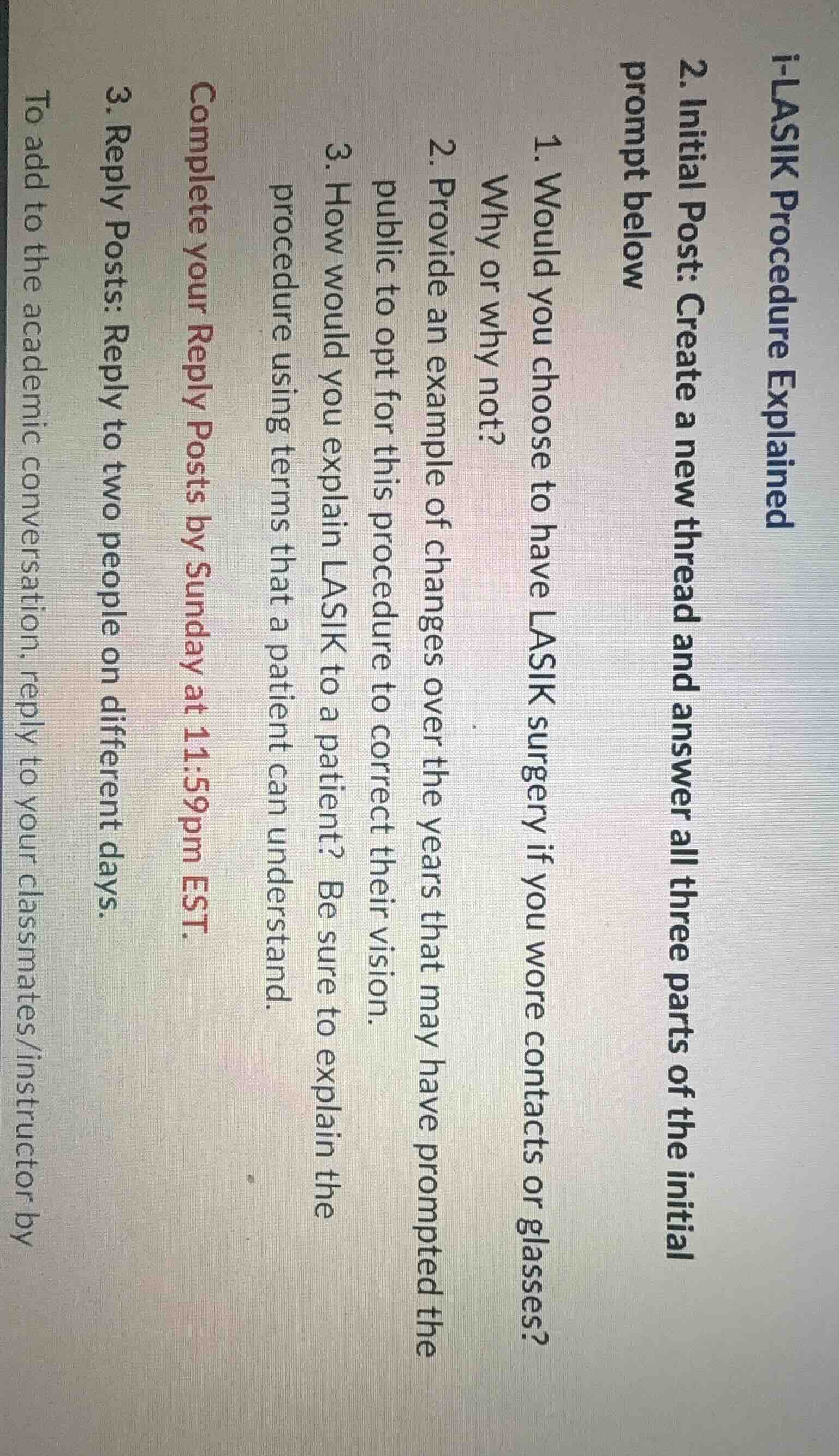
i - lasik procedure explained
- initial post: create a new thread and answer all three parts of the initial prompt below
- would you choose to have lasik surgery if you wore contacts or glasses? why or why not?
- provide an example of changes over the years that may have prompted the public to opt for this procedure to correct their vision.
- how would you explain lasik to a patient? be sure to explain the procedure using terms that a patient can understand.
complete your reply posts by sunday at 11:59pm est.
- reply posts: reply to two people on different days.
to add to the academic conversation, reply to your classmates/instructor by
Brief Explanations
- For the first question: The choice depends on personal lifestyle, cost tolerance, and risk comfort. LASIK offers permanent vision correction, eliminating the hassle of glasses/contacts, which is ideal for active people, but it has upfront costs and small risks.
- For the second question: One key change is the shift from traditional LASIK to i-LASIK (intraLASIK), which uses a laser instead of a blade to create the corneal flap. This change was prompted by demand for lower risk of flap complications and more precise, customizable procedures.
- For the third question: The explanation uses simple, patient-friendly language to break down the i-LASIK process.

Snap & solve any problem in the app
Get step-by-step solutions on Sovi AI
Photo-based solutions with guided steps
Explore more problems and detailed explanations
- I would choose i-LASIK surgery. For active daily activities like hiking or playing sports, glasses and contacts are cumbersome (contacts require daily care, glasses can slip or break), and i-LASIK provides a long-term, low-maintenance solution. The procedure's high success rate for common vision issues like myopia also makes it a low-risk, high-reward option for me, despite the upfront cost.
- A major change in LASIK over time is the adoption of all-laser (i-LASIK) systems instead of microkeratome blades to create the corneal flap. Early LASIK used a sharp blade to cut the flap, which carried small risks of flap tears, irregular cuts, or infection. As patient demand for safer, more precise procedures grew, and laser technology advanced, surgeons shifted to femtosecond lasers for flap creation. This laser creates a thinner, more uniform flap with far fewer complications, leading to better visual outcomes and higher patient satisfaction.
- "Let me walk you through what happens during i-LASIK, step by step: First, we’ll use a special laser (no blades!) to create a thin, hinged flap on the clear outer layer of your eye, called the cornea. We’ll gently lift this flap to expose the underlying corneal tissue. Next, we’ll use another laser to reshape this inner tissue—this is what fixes your nearsightedness, farsightedness, or astigmatism, by adjusting how light bends as it enters your eye. Once the shaping is done, we’ll lay the flap back down, and it will stick on its own without stitches. The whole procedure takes about 15 minutes per eye, and most people notice better vision within a day or two."