QUESTION IMAGE
Question
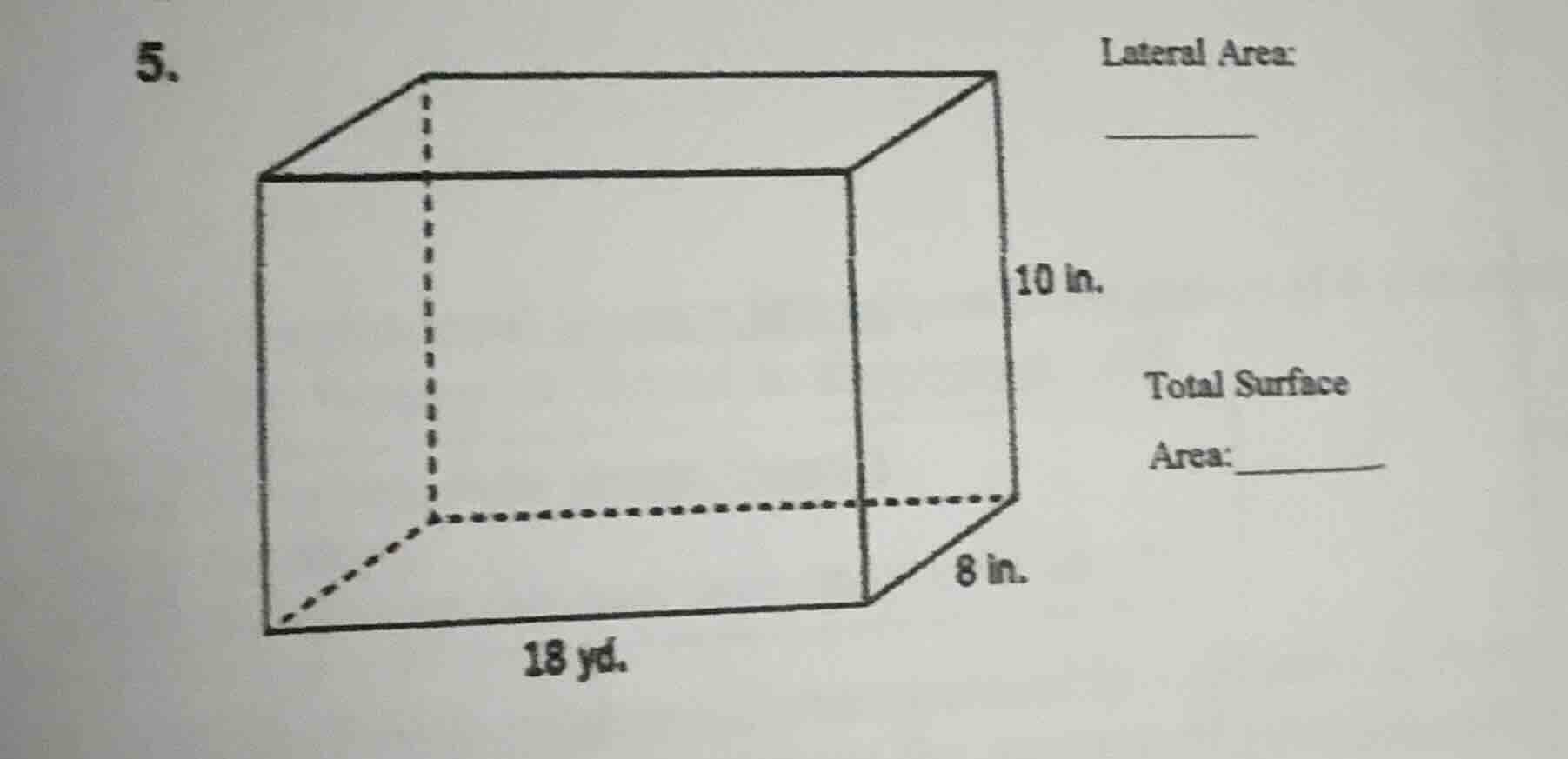
5.
lateral area:
10 in.
total surface
area:
8 in.
18 yd.
Step1: Identify the shape and formula for lateral area of a rectangular prism
The shape is a rectangular prism. The formula for the lateral area (LA) of a rectangular prism is \( LA = 2h(l + w) \), where \( l \) is length, \( w \) is width, and \( h \) is height. Here, \( l = 18 \) yd (wait, units: length is 18 yd, width 8 in, height 10 in – but units are inconsistent. Wait, maybe it's a typo, assume all in inches? Or maybe 18 in? Wait, the diagram: length 18 yd? No, probably 18 in. Let's assume length \( l = 18 \) in, width \( w = 8 \) in, height \( h = 10 \) in.
Step2: Calculate lateral area
Using \( LA = 2h(l + w) \)
Substitute \( h = 10 \), \( l = 18 \), \( w = 8 \)
\( LA = 2\times10\times(18 + 8) \)
\( = 20\times26 \)
\( = 520 \) square inches. Wait, but if length is 18 yd, convert to inches: 18 yd = 18×36 = 648 in. Then \( LA = 2×10×(648 + 8) = 20×656 = 13120 \) in². But the diagram has 18 yd, 8 in, 10 in – units are mixed. Probably a typo, length should be 18 in. So proceed with 18 in, 8 in, 10 in.
Step3: Calculate total surface area (TSA) of rectangular prism
Formula: \( TSA = 2(lw + lh + wh) \)
Substitute \( l = 18 \), \( w = 8 \), \( h = 10 \)
\( TSA = 2×(18×8 + 18×10 + 8×10) \)
\( = 2×(144 + 180 + 80) \)
\( = 2×(404) \)
\( = 808 \) square inches. Wait, but if length is 18 yd (648 in), then:
\( TSA = 2×(648×8 + 648×10 + 8×10) = 2×(5184 + 6480 + 80) = 2×11744 = 23488 \) in². But units are inconsistent. The problem likely has a typo, length should be 18 in. So assuming length 18 in, width 8 in, height 10 in.
Wait, the original diagram: length 18 yd? No, maybe the 18 is in inches. Let's check the problem again. The user's diagram: 18 yd, 8 in, 10 in. But that's inconsistent. Maybe it's 18 in. So proceed with 18 in, 8 in, 10 in.
Lateral Area:
Step1: Recall lateral area formula for rectangular prism
Lateral area (LA) of a rectangular prism is the area of the four vertical faces, formula: \( LA = 2h(l + w) \), where \( h \) is height, \( l \) length, \( w \) width.
Step2: Substitute values (assuming length 18 in, width 8 in, height 10 in)
\( LA = 2 \times 10 \times (18 + 8) \)
\( = 20 \times 26 \)
\( = 520 \) square inches.
Total Surface Area:
Step1: Recall total surface area formula
Total surface area (TSA) of a rectangular prism is \( TSA = 2(lw + lh + wh) \), where \( l \) is length, \( w \) is width, \( h \) is height.
Step2: Substitute values
\( l = 18 \) in, \( w = 8 \) in, \( h = 10 \) in
\( TSA = 2 \times (18 \times 8 + 18 \times 10 + 8 \times 10) \)
\( = 2 \times (144 + 180 + 80) \)
\( = 2 \times 404 \)
\( = 808 \) square inches.
(Note: If length is 18 yd, convert to inches: 18 yd = 18 × 36 = 648 in. Then lateral area: \( 2×10×(648 + 8) = 20×656 = 13120 \) in². Total surface area: \( 2×(648×8 + 648×10 + 8×10) = 2×(5184 + 6480 + 80) = 2×11744 = 23488 \) in². But units are mixed, so likely a typo. Assuming length is 18 in.)

Snap & solve any problem in the app
Get step-by-step solutions on Sovi AI
Photo-based solutions with guided steps
Explore more problems and detailed explanations
Lateral Area: \( \boldsymbol{520} \) square inches (if length is 18 in) or \( \boldsymbol{13120} \) square inches (if length is 18 yd, converted to in). But due to unit inconsistency, maybe the length is 18 in.
Total Surface Area: \( \boldsymbol{808} \) square inches (if length is 18 in) or \( \boldsymbol{23488} \) square inches (if length is 18 yd).
Wait, the problem's diagram: 18 yd, 8 in, 10 in. This is a unit error. But assuming the length is 18 in (maybe a typo), the calculations are as above.
So final answers (assuming length 18 in, width 8 in, height 10 in):
Lateral Area: 520 square inches
Total Surface Area: 808 square inches