QUESTION IMAGE
Question
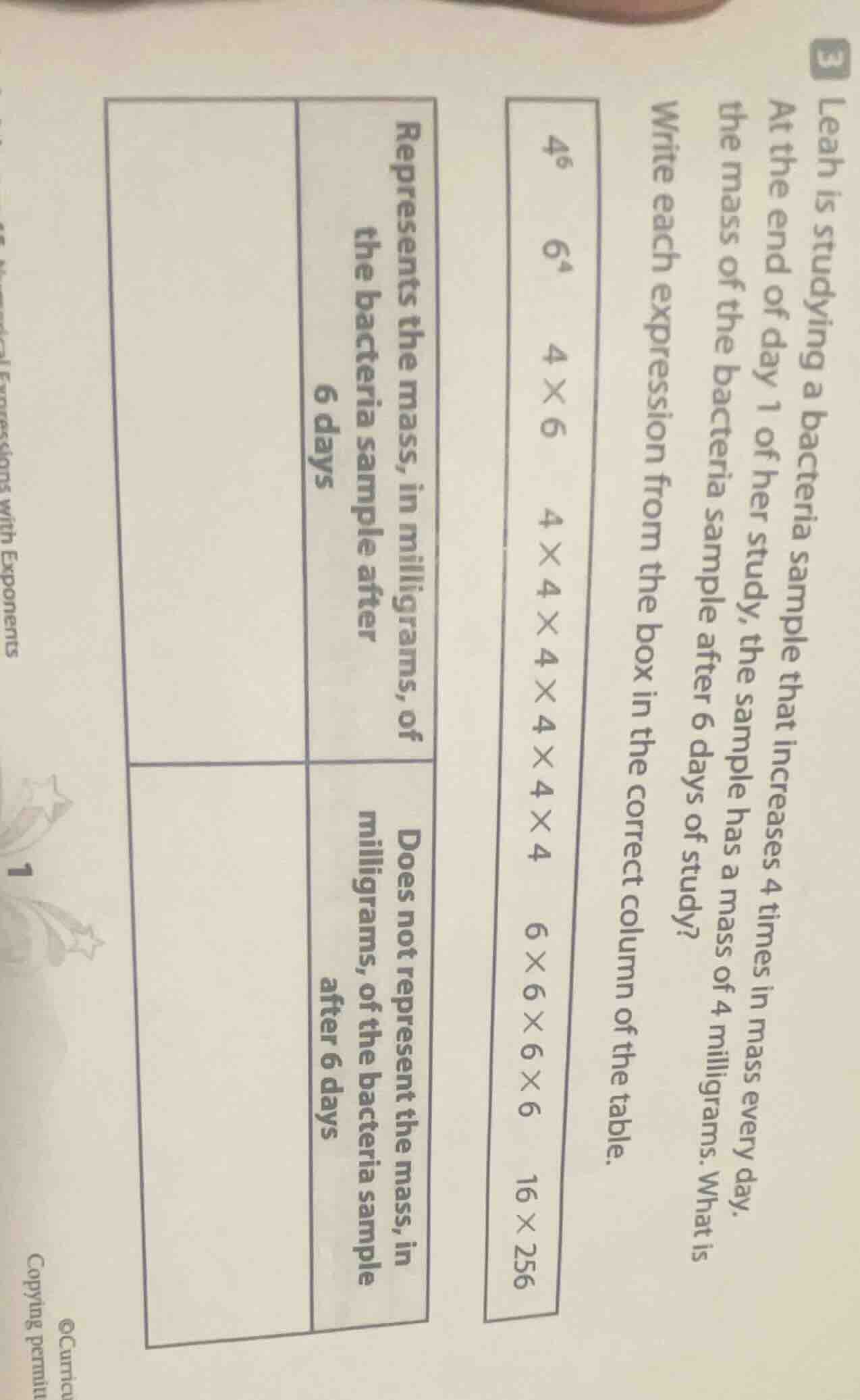
leah is studying a bacteria sample that increases 4 times in mass every day. at the end of day 1 of her study, the sample has a mass of 4 milligrams. what is the mass of the bacteria sample after 6 days of study? write each expression from the box in the correct column of the table. \\(4^6\\) \\(6^4\\) \\(4\times6\\) \\(4\times4\times4\times4\times4\times4\\) \\(6\times6\times6\times6\\) \\(16\times256\\) \\(\
\\)
The mass of the bacteria sample at the end of day 1 is 4 milligrams, and it increases 4 times in mass every day. So after 6 days, the mass should be calculated as the initial mass multiplied by 4 raised to the power of the number of days (since it's a daily 4 - fold increase). The initial mass is 4 mg, and after 6 days, the mass \( M = 4\times4\times4\times4\times4\times4=4^{6}\) (because we multiply 4 six times, once for each day from day 1 to day 6). Also, we can rewrite \(4^{6}\) in other equivalent forms. We know that \(4 = 2^{2}\), but also, we can look at the given expressions:
- \(4^{6}\): This is the mass since it's 4 multiplied by itself 6 times (once per day for 6 days), so it represents the mass.
- \(6^{4}\): This is 6 multiplied by itself 4 times, which is not related to the 4 - fold daily increase of the initial 4 mg mass, so it does not represent the mass.
- \(4\times6\): This is 4 multiplied by 6, which is not the same as 4 multiplied by itself 6 times, so it does not represent the mass.
- \(4\times4\times4\times4\times4\times4\): This is the same as \(4^{6}\), so it represents the mass.
- \(6\times6\times6\times6\): This is \(6^{4}\), which is not related to the growth of the bacteria mass, so it does not represent the mass.
- \(16\times256\): First, \(4^{2}=16\) and \(4^{4} = 256\), so \(16\times256=4^{2}\times4^{4}=4^{2 + 4}=4^{6}\), so it represents the mass.
Now we categorize each expression:
Step 1: Analyze \(4^{6}\)
The mass after 6 days is \(4\times4\times4\times4\times4\times4 = 4^{6}\), so this represents the mass.
Step 2: Analyze \(6^{4}\)
\(6^{4}=6\times6\times6\times6\), which has nothing to do with the 4 - fold daily growth of the 4 mg initial mass, so it does not represent the mass.
Step 3: Analyze \(4\times6\)
\(4\times6 = 24\), while the actual mass after 6 days is \(4^{6}=4096\), so this does not represent the mass.
Step 4: Analyze \(4\times4\times4\times4\times4\times4\)
This is the product of 4 six times, which is the formula for the mass after 6 days (initial mass 4, multiplied by 4 each day for 6 days), so it represents the mass.
Step 5: Analyze \(6\times6\times6\times6\)
This is \(6^{4}\), not related to the bacteria's mass growth, so it does not represent the mass.
Step 6: Analyze \(16\times256\)
Since \(16 = 4^{2}\) and \(256=4^{4}\), \(16\times256 = 4^{2}\times4^{4}=4^{6}\), so it represents the mass.
Now we fill the table:
| Represents the mass, in milligrams, of the bacteria sample after 6 days | Does not represent the mass, in milligrams, of the bacteria sample after 6 days |
|---|

Snap & solve any problem in the app
Get step-by-step solutions on Sovi AI
Photo-based solutions with guided steps
Explore more problems and detailed explanations
Represents the mass, in milligrams, of the bacteria sample after 6 days:
- \(4^{6}\)
- \(4\times4\times4\times4\times4\times4\)
- \(16\times256\)
Does not represent the mass, in milligrams, of the bacteria sample after 6 days:
- \(6^{4}\)
- \(4\times6\)
- \(6\times6\times6\times6\)