QUESTION IMAGE
Question
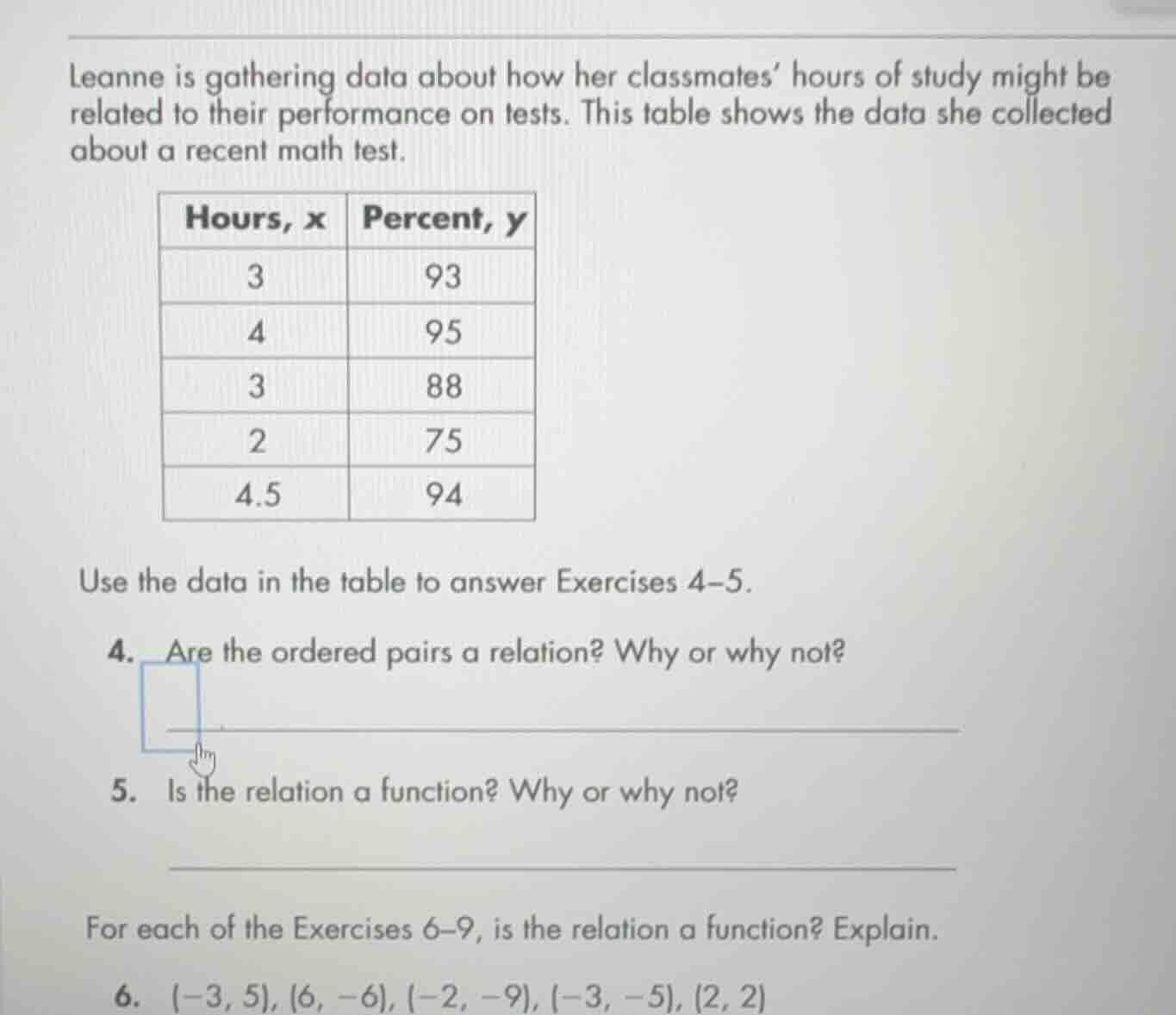
leanne is gathering data about how her classmates’ hours of study might be related to their performance on tests. this table shows the data she collected about a recent math test.
hours, x | percent, y
3 | 93
4 | 95
3 | 88
2 | 75
4.5 | 94
use the data in the table to answer exercises 4–5.
- are the ordered pairs a relation? why or why not?
- is the relation a function? why or why not?
for each of the exercises 6–9, is the relation a function? explain.
- (-3, 5), (6, -6), (-2, -9), (-3, -5), (2, 2)
For Exercise 4:
A relation is defined as any set of ordered pairs that connects inputs (x-values) to outputs (y-values). The given data forms a set of ordered pairs: (3,93), (4,95), (3,88), (2,75), (4.5,94), which fits this definition.
For Exercise 5:
A function is a relation where each input (x-value) has exactly one corresponding output (y-value). Here, the x-value 3 maps to two different y-values (93 and 88), violating the function rule.
For Exercise 6:
A function requires each input to have only one output. The x-value -3 maps to two different y-values (5 and -5), so this does not meet the function criteria.

Snap & solve any problem in the app
Get step-by-step solutions on Sovi AI
Photo-based solutions with guided steps
Explore more problems and detailed explanations
- Yes, the ordered pairs are a relation. Any set of ordered pairs that links inputs to outputs is a relation, and the given data forms such a set.
- No, the relation is not a function. The input value 3 is paired with two different output values (93 and 88).
- No, the relation is not a function. The input value -3 is paired with two different output values (5 and -5).