QUESTION IMAGE
Question
learning objective: students will understand and apply the pythagorean theorem to find unknown side lengths in right triangles.
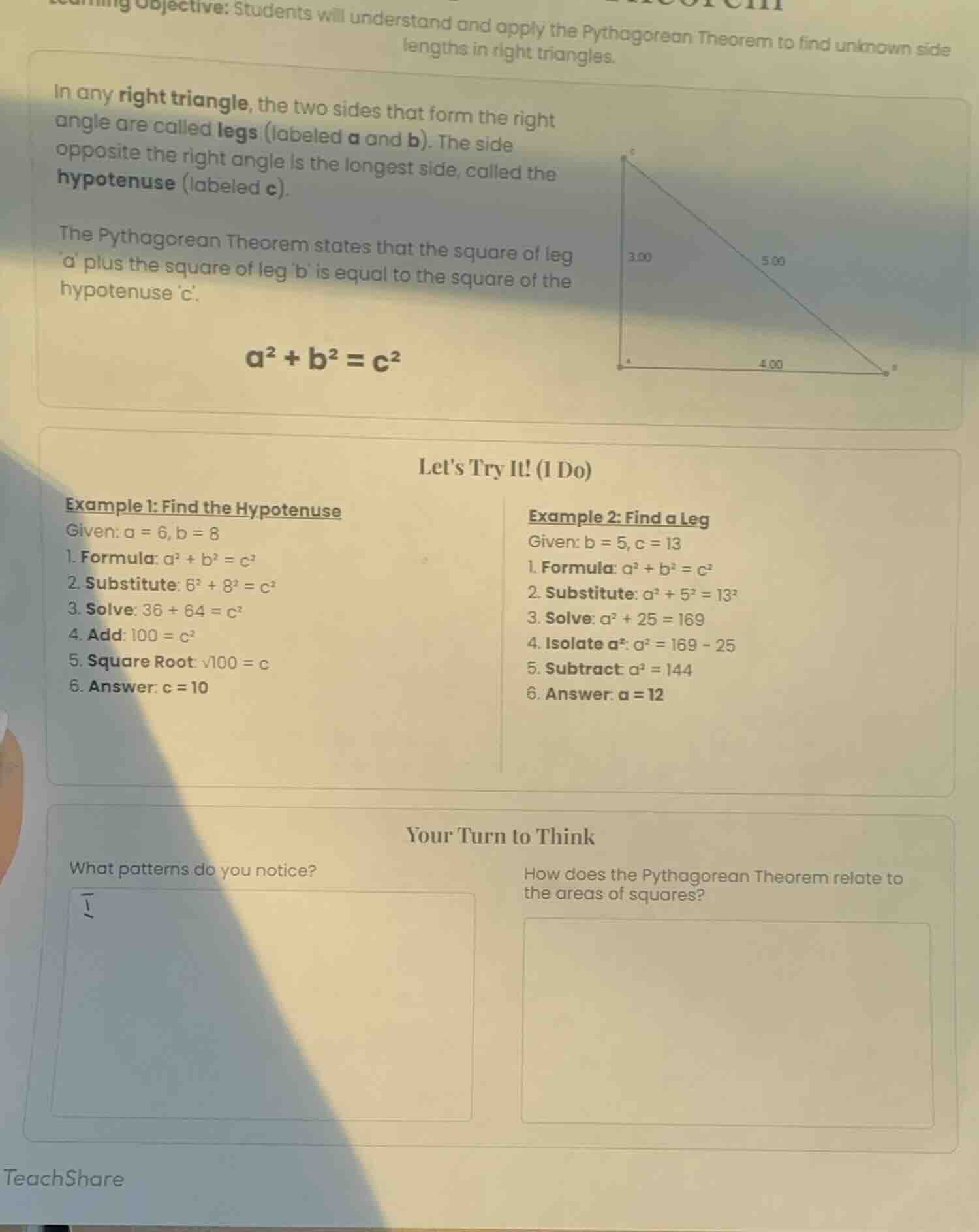
in any right triangle, the two sides that form the right angle are called legs (labeled a and b). the side opposite the right angle is the longest side, called the hypotenuse (labeled c).
the pythagorean theorem states that the square of leg a plus the square of leg b is equal to the square of the hypotenuse c.
a² + b² = c²
lets try it! (i do)
example 1: find the hypotenuse
given: a = 6, b = 8
- formula: a² + b² = c²
- substitute: 6² + 8² = c²
- solve: 36 + 64 = c²
- add: 100 = c²
- square root: √100 = c
- answer: c = 10
example 2: find a leg
given: b = 5, c = 13
- formula: a² + b² = c²
- substitute: a² + 5² = 13²
- solve: a² + 25 = 169
- isolate a²: a² = 169 - 25
- subtract: a² = 144
- answer: a = 12
your turn to think
what patterns do you notice?
how does the pythagorean theorem relate to the areas of squares?
For "What patterns do you notice?":
The examples use Pythagorean triples—sets of integers \(a, b, c\) that satisfy \(a^2 + b^2 = c^2\). The triples here are (6,8,10) (a multiple of the 3,4,5 triple) and (5,12,13), a primitive triple where the numbers share no common factor besides 1. In each case, the hypotenuse is the largest value, and the sum of the squared legs equals the squared hypotenuse.
For "How does the Pythagorean Theorem relate to the areas of squares?":
If you construct a square on each side of the right triangle, the area of the square built on the hypotenuse (area = \(c^2\)) is exactly equal to the sum of the areas of the squares built on the two legs (areas = \(a^2\) and \(b^2\)). This is the geometric interpretation of the formula \(a^2 + b^2 = c^2\).

Snap & solve any problem in the app
Get step-by-step solutions on Sovi AI
Photo-based solutions with guided steps
Explore more problems and detailed explanations
- The problems use integer Pythagorean triples (sets of whole numbers that fit \(a^2 + b^2 = c^2\)), including a scaled triple (6,8,10) and a primitive triple (5,12,13). The hypotenuse is always the largest value.
- The Pythagorean Theorem corresponds to areas: the area of the square drawn on the hypotenuse equals the sum of the areas of the squares drawn on the two legs of the right triangle.