QUESTION IMAGE
Question
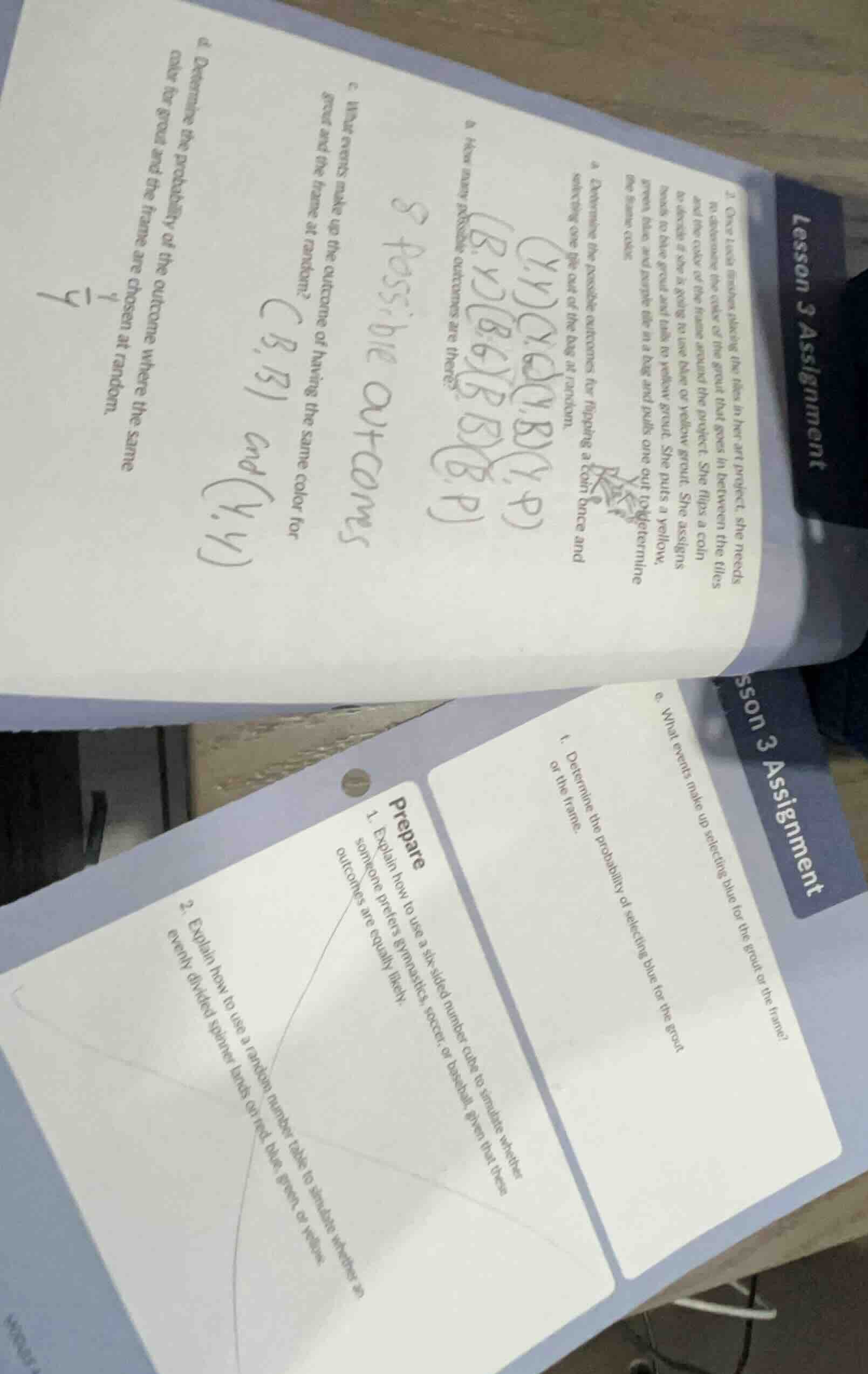
lesson 3 assignment2. once lesia finishes placing the tiles in her art project, she needs to determine the color of the grout that goes in between the tiles and the color of the frame around the project. she flips a coin to decide if she is going to use blue or yellow grout. she assigns heads to blue grout and tails to yellow grout. she puts a yellow, green, blue, and purple tile in a bag and pulls one out to determine the frame color.a. determine the possible outcomes for flipping a coin once and selecting one tile out of the bag at random.b. how many possible outcomes are there?c. what events make up the outcome of having the same color for grout and the frame at random?d. determine the probability of the outcome where the same color for grout and the frame are chosen at random.e. what events make up selecting blue for the grout or the frame?f. determine the probability of selecting blue for the grout or the frame.prepare1. explain how to use a six-sided number cube to simulate whether someone prefers gymnastics, soccer, or baseball, given that these outcomes are equally likely.2. explain how to use a random number table to simulate whether an evenly divided spinner lands on red, blue, green, or yellow.
Step1: Define outcome components
Grout: 2 options (Blue=B, Yellow=Y); Frame: 4 options (Yellow=Y, Green=G, Blue=B, Purple=P). Outcomes are ordered pairs (Grout, Frame).
Step2: List all possible outcomes
$(Y,Y), (Y,G), (Y,B), (Y,P), (B,Y), (B,G), (B,B), (B,P)$
Step3: Count total outcomes
Count the listed pairs: $n(\text{total}) = 8$
Step4: Identify same-color outcomes
Find pairs where grout=frame: $(Y,Y), (B,B)$; $n(\text{same color})=2$
Step5: Calculate same-color probability
Probability = $\frac{\text{Same color outcomes}}{\text{Total outcomes}}$
$\text{Probability} = \frac{2}{8} = \frac{1}{4}$
Step6: Identify blue grout/frame outcomes
Find pairs with grout=B OR frame=B: $(Y,B), (B,Y), (B,G), (B,B), (B,P)$; $n(\text{blue grout/frame})=5$
Step7: Calculate blue grout probability
Probability = $\frac{\text{Blue grout outcomes}}{\text{Total outcomes}}$
Blue grout outcomes: $(B,Y), (B,G), (B,B), (B,P)$; $n(\text{blue grout})=4$
$\text{Probability} = \frac{4}{8} = \frac{1}{2}$
---
Prepare 1: Simulate 3 equal preferences
Assign 2 dice faces per sport: 1-2 = gymnastics, 3-4 = soccer, 5-6 = baseball. Roll the die; the face range determines the selected sport. Each sport has $\frac{2}{6}=\frac{1}{3}$ chance, so outcomes are equally likely.
Prepare 2: Simulate 4 equal spinner colors
Assign 25% of the random number table range to each color: 00-24=red, 25-49=blue, 50-74=green, 75-99=yellow. Pick random numbers from the table; the range determines the selected color.

Snap & solve any problem in the app
Get step-by-step solutions on Sovi AI
Photo-based solutions with guided steps
Explore more problems and detailed explanations
Part 2:
a. All possible outcomes: $(Y,Y), (Y,G), (Y,B), (Y,P), (B,Y), (B,G), (B,B), (B,P)$
b. 8 possible outcomes
c. Same-color outcomes: $(Y,Y), (B,B)$
d. Probability of same color: $\frac{1}{4}$
e. Blue grout or frame outcomes: $(Y,B), (B,Y), (B,G), (B,B), (B,P)$
f. Probability of blue grout: $\frac{1}{2}$
Prepare:
- Assign 2 faces of a 6-sided die to each sport (1-2=gymnastics, 3-4=soccer, 5-6=baseball). Roll the die; the corresponding sport is the simulated preference. Each sport has an equal $\frac{1}{3}$ probability.
- Divide the random number table into 4 equal ranges (00-24, 25-49, 50-74, 75-99) and assign each range to red, blue, green, yellow respectively. Select random numbers from the table; the range of the number determines the simulated spinner color.