QUESTION IMAGE
Question
lesson (eng)
lección (esp)
9 - 12.
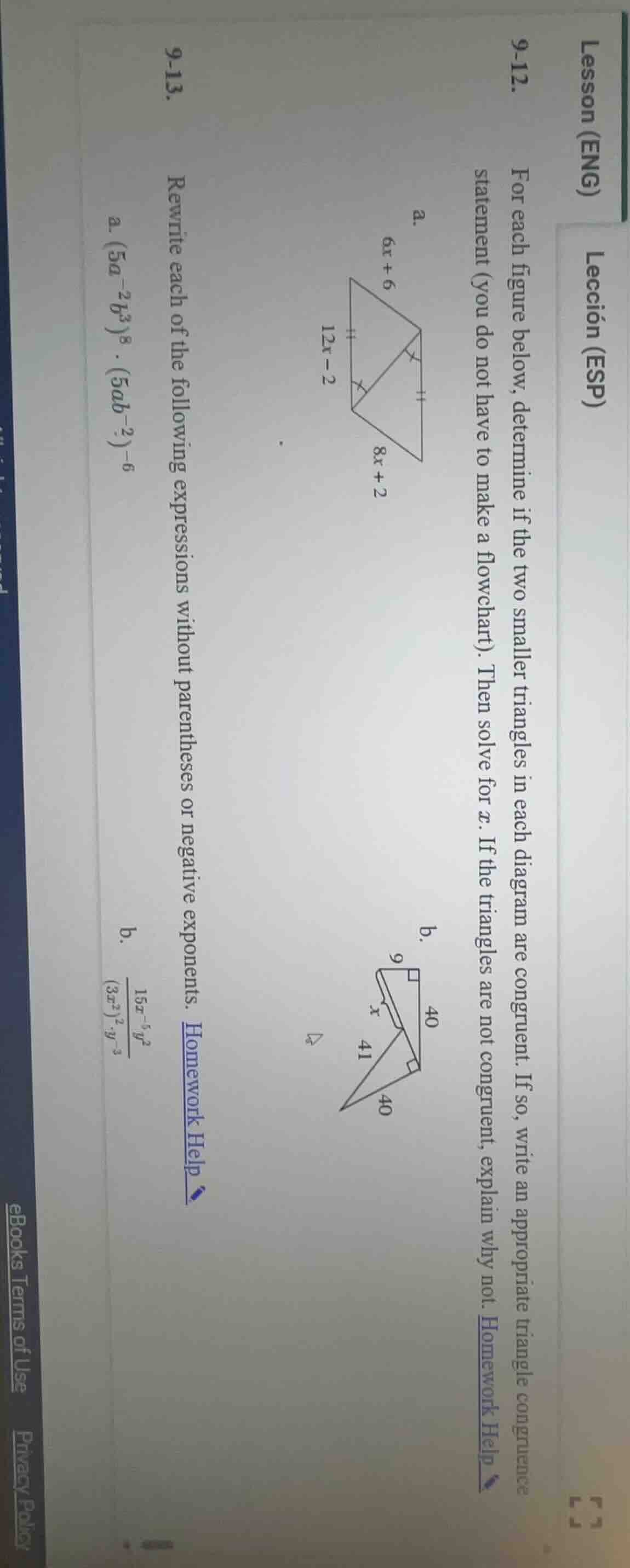
for each figure below, determine if the two smaller triangles in each diagram are congruent. if so, write an appropriate triangle congruence statement (you do not have to make a flowchart). then solve for x. if the triangles are not congruent, explain why not. homework help
a.
triangle diagram with sides 6x + 6, 12x - 2, 8x + 2 and markings
b.
right triangle diagram with sides 9, 40, 41 and another right triangle with sides 40, 41, x
9 - 13.
rewrite each of the following expressions without parentheses or negative exponents. homework help
a. ((5a^{-2}b^{3})^{8}cdot(5ab^{-2})^{-6})
b. (\frac{15x^{-5}y^{2}}{(3x^{2})^{2}cdot y^{-3}})
9-12 a.
Step1: Identify congruent triangles
The figure is a triangle with a segment dividing it, creating two smaller triangles. The markings show two sides are equal (the double marks) and the included angle (marked with x) is common? Wait, no, looking at the sides: the sides of the larger triangle? Wait, the sides are \(6x + 6\), \(12x - 2\), and \(8x + 2\), and the segment divides it into two triangles with some equal sides (the double marks on two sides, and the x marks on the angles? Wait, maybe it's an isosceles triangle? Wait, no, the two smaller triangles: let's assume that the two triangles are congruent by SSS or SAS. Wait, the sides with double marks are equal, and the side with the segment is common? Wait, maybe the two triangles are congruent by SAS? Wait, no, let's check the sides. Wait, the problem says "determine if the two smaller triangles in each diagram are congruent. If so, write an appropriate triangle congruence statement. Then solve for x."
Wait, looking at the sides: the two sides of the larger triangle? Wait, no, the two smaller triangles: let's see, the sides are \(6x + 6\), \(12x - 2\), and \(8x + 2\), and the segment is a common side? Wait, maybe the two triangles are congruent, so their corresponding sides are equal. So \(6x + 6 = 8x + 2\)? Wait, no, maybe \(12x - 2 = 8x + 2\)? Wait, let's think again.
Wait, the diagram: it's a triangle with a segment from one vertex to the opposite side, creating two smaller triangles. The markings: two sides of the larger triangle have double marks (so they are equal), and the two angles at the base have x marks (so they are equal). Wait, maybe the two triangles are congruent by SAS? Wait, no, let's assume that the two triangles are congruent, so their corresponding sides are equal. Let's set \(6x + 6 = 8x + 2\) to solve for x.
Step2: Solve for x
Set \(6x + 6 = 8x + 2\)
Subtract \(6x\) from both sides: \(6 = 2x + 2\)
Subtract 2 from both sides: \(4 = 2x\)
Divide by 2: \(x = 2\)
Wait, but let's check with the other side: \(12x - 2\) when x=2 is \(24 - 2 = 22\), \(8x + 2 = 16 + 2 = 18\), no, that's not equal. Wait, maybe \(12x - 2 = 8x + 2\)?
Set \(12x - 2 = 8x + 2\)
Subtract \(8x\): \(4x - 2 = 2\)
Add 2: \(4x = 4\)
x = 1
Then check \(6x + 6 = 6(1) + 6 = 12\), \(8x + 2 = 8(1) + 2 = 10\), no. Wait, maybe the two triangles are congruent by SSS, so all three sides are equal. Wait, the segment is common, so the two triangles share a side. So the sides are: for the first triangle: \(6x + 6\), the common side, and one of the equal sides. For the second triangle: \(8x + 2\), the common side, and the other equal side. Wait, the two equal sides of the larger triangle are \(12x - 2\) and... Wait, maybe the two triangles are congruent, so \(6x + 6 = 8x + 2\) and \(12x - 2\) is the other side. Wait, no, maybe I made a mistake.
Wait, let's start over. The problem is 9-12 a: a triangle with a segment dividing it into two smaller triangles. The sides of the larger triangle are \(6x + 6\), \(12x - 2\), and \(8x + 2\). The segment is from the vertex to the opposite side, creating two triangles. The markings: two sides of the larger triangle have double marks (so they are equal), and the two angles at the base have x marks (so they are equal). Wait, maybe the two triangles are congruent by SAS: the two equal sides (double marks) and the included angle (the angle with x marks). So the congruence statement is \(\triangle ABC \cong \triangle ACB\)? No, wait, let's name the triangle: let's say the triangle is \( \triangle PQR \), with segment \( PS \) from \( P \) to \( QR \), so \…
Step1: Identify congruent triangles
The figure is a right triangle with a segment from the right angle to the hypotenuse, creating two smaller right triangles. The sides are 9, 40, 41 (since 9-40-41 is a Pythagorean triple: \(9^2 + 40^2 = 81 + 1600 = 1681 = 41^2\)). The two smaller triangles: one has legs 9 and x, hypotenuse 41? No, wait, the original triangle has legs 9 and 40, hypotenuse 41. The segment divides it into two right triangles: one with legs 9 and x, hypotenuse 41? No, wait, the other triangle has legs 40 and 40? No, the diagram shows a right triangle with legs 9 and 40, hypotenuse 41, and a segment from the right angle to the hypotenuse, creating two right triangles: one with leg 40, hypotenuse 41, and the other with leg 9, hypotenuse x? Wait, no, the markings: the two right triangles, one with legs 40 and 40? No, the problem says "determine if the two smaller triangles in each diagram are congruent. If so, write an appropriate triangle congruence statement. Then solve for x."
Wait, the original triangle: legs 9 and 40, hypotenuse 41. The segment is from the right angle to the hypotenuse, so by the geometric mean theorem, the two smaller triangles are similar, but are they congruent? Wait, the sides: one triangle has legs 40 and 40? No, the diagram shows one triangle with legs 40 and 41? No, wait, the right angles are marked, so both smaller triangles are right triangles. The hypotenuse of one is 41, leg 40; the other has leg 9, hypotenuse x, and the other leg is the same as the first? Wait, no, maybe the two triangles are congruent by HL (Hypotenuse-Leg). The hypotenuse of one is 41, leg 40; the hypotenuse of the other is x, leg 40? Wait, no, the diagram shows one triangle with leg 40, hypotenuse 41, and the other with leg 9, hypotenuse x, and the segment is the common leg. Wait, maybe the two triangles are congruent, so their corresponding sides are equal. So the leg 40 is common? Wait, no, the original triangle has legs 9 and 40, hypotenuse 41. The segment is from the right angle to the hypotenuse, so the two smaller triangles: one has legs 9 and y, hypotenuse 41; the other has legs 40 and y, hypotenuse x. But since it's a right triangle, by HL, if the hypotenuse and a leg are equal, then the triangles are congruent. Wait, the hypotenuse of one is 41, leg 40; the hypotenuse of the other is x, leg 40? No, the leg 40 is in both? Wait, no, the original leg is 40, so the segment divides the hypotenuse into two parts, but the legs of the smaller triangles: one has leg 9, the other has leg 40. Wait, maybe the two triangles are congruent, so \(x = 41\)? No, that doesn't make sense. Wait, the Pythagorean triple: 9-40-41. The two smaller triangles: one is similar to the original, and to each other. But are they congruent? Let's check the sides. The original triangle: legs 9, 40, hypotenuse 41. The two smaller triangles: one has legs 9 and \(a\), hypotenuse \(b\); the other has legs 40 and \(a\), hypotenuse \(c\). By the geometric mean theorem, \(a^2 = 9 \times 40 = 360\), so \(a = \sqrt{360} = 6\sqrt{10}\), which is not an integer, so maybe the triangles are congruent? Wait, the diagram shows one triangle with leg 40, hypotenuse 41, and the other with leg 9, hypotenuse x, and the segment is the common leg. Wait, maybe the two triangles are congruent by HL: the hypotenuse of one is 41, leg 40; the hypotenuse of the other is x, leg 40. So if they are congruent, then \(x = 41\) and the other leg is 9, but \(40^2 + 9^2 = 1600 + 81 = 1681 = 41^2\), so yes! Wait, the two smaller triangles: one has legs 40 and 9, hypotenuse 41?…
Step1: Apply power of a product rule
\((5a^{-2}b^3)^8 \cdot (5ab^{-2})^{-6}\)
First, apply \((xy)^n = x^n y^n\) to each term:
\(5^8 (a^{-2})^8 (b^3)^8 \cdot 5^{-6} (a)^{-6} (b^{-2})^{-6}\)
Step2: Apply power of a power rule
\((x^m)^n = x^{mn}\):
\(5^8 a^{-16} b^{24} \cdot 5^{-6} a^{-6} b^{12}\)
Step3: Apply product rule for exponents
\(x^m \cdot x^n = x^{m + n}\) for like bases:
For \(5\): \(5^8 \cdot 5^{-6} = 5^{8 - 6} = 5^2 = 25\)
For \(a\): \(a^{-16} \cdot a^{-6} = a^{-16 - 6} = a^{-22}\)
For \(b\): \(b^{24} \cdot b^{12} = b^{24 + 12} = b^{36}\)
Step4: Rewrite with positive exponents
\(a^{-22} = \frac{1}{a^{22}}\), so:
\(25 \cdot \frac{1}{a^{22}} \cdot b^{36} = \frac{25b^{36}}{a^{22}}\)

Snap & solve any problem in the app
Get step-by-step solutions on Sovi AI
Photo-based solutions with guided steps
Explore more problems and detailed explanations
The two triangles are congruent (e.g., \(\triangle ABC \cong \triangle ACB\) or specific names), and \(x = 2\).