QUESTION IMAGE
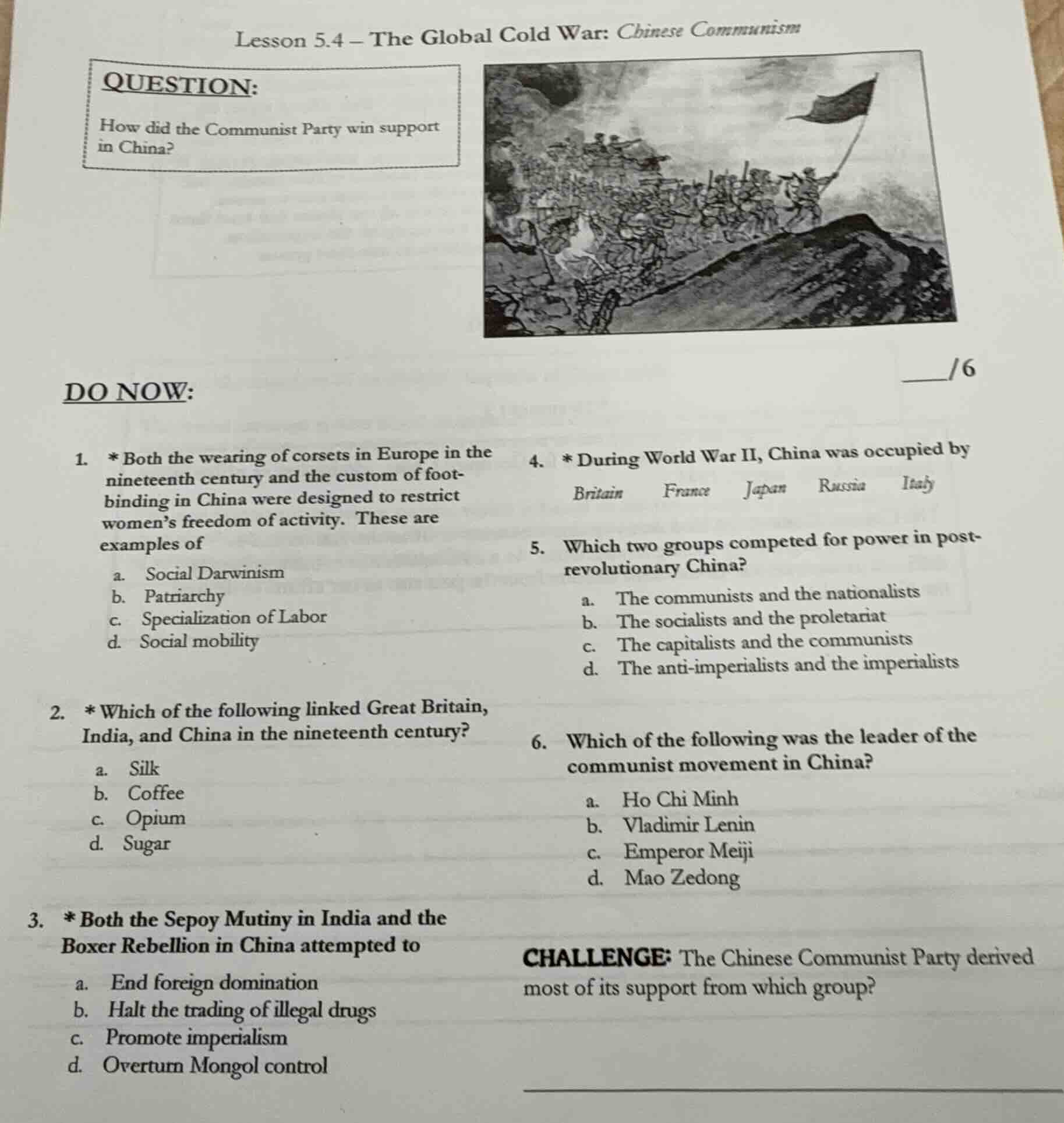
Question
lesson 5.4 – the global cold war: chinese communism
question:
how did the communist party win support in china?
do now:
- * both the wearing of corsets in europe in the nineteenth century and the custom of foot - binding in china were designed to restrict women’s freedom of activity. these are examples of
a. social darwinism
b. patriarchy
c. specialization of labor
d. social mobility
- * which of the following linked great britain, india, and china in the nineteenth century?
a. silk
b. coffee
c. opium
d. sugar
- * both the sepoy mutiny in india and the boxer rebellion in china attempted to
a. end foreign domination
b. halt the trading of illegal drugs
c. promote imperialism
d. overturn mongol control
- * during world war ii, china was occupied by
britain france japan russia italy
- which two groups competed for power in post - revolutionary china?
a. the communists and the nationalists
b. the socialists and the proletariat
c. the capitalists and the communists
d. the anti - imperialists and the imperialists
- which of the following was the leader of the communist movement in china?
a. ho chi minh
b. vladimir lenin
c. emperor meiji
d. mao zedong
challenge: the chinese communist party derived most of its support from which group?
Question 1
Corsets in Europe and foot - binding in China restricted women's activity, which is a feature of patriarchy (a social system where men hold power and women are subordinate, with practices that limit women's freedom). Social Darwinism is about survival of the fittest in society, specialization of labor is about dividing work, and social mobility is about moving between social classes. So the correct option is b.
In the 19th century, opium trade linked Great Britain, India, and China. Britain sold opium from India to China, leading to the Opium Wars. Silk, coffee, and sugar were not the main links in this context. So the correct option is c.
The Sepoy Mutiny in India and the Boxer Rebellion in China were both responses to foreign domination. The Sepoys rebelled against British rule, and the Boxers fought against foreign powers in China. They were not about halting drug trade (though opium was part of foreign influence in China, but not the main goal of these rebellions), promoting imperialism, or overturning Mongol control (Mongol control was long gone by these times). So the correct option is a.

Snap & solve any problem in the app
Get step-by-step solutions on Sovi AI
Photo-based solutions with guided steps
Explore more problems and detailed explanations
b. Patriarchy