QUESTION IMAGE
Question
lesson 7.2 - log vs exponent conversions
completed notes (coming soon)
video tutorial
7.2 hw - log vs exponent
score: 1.33/19 answered: 0/10
question 1
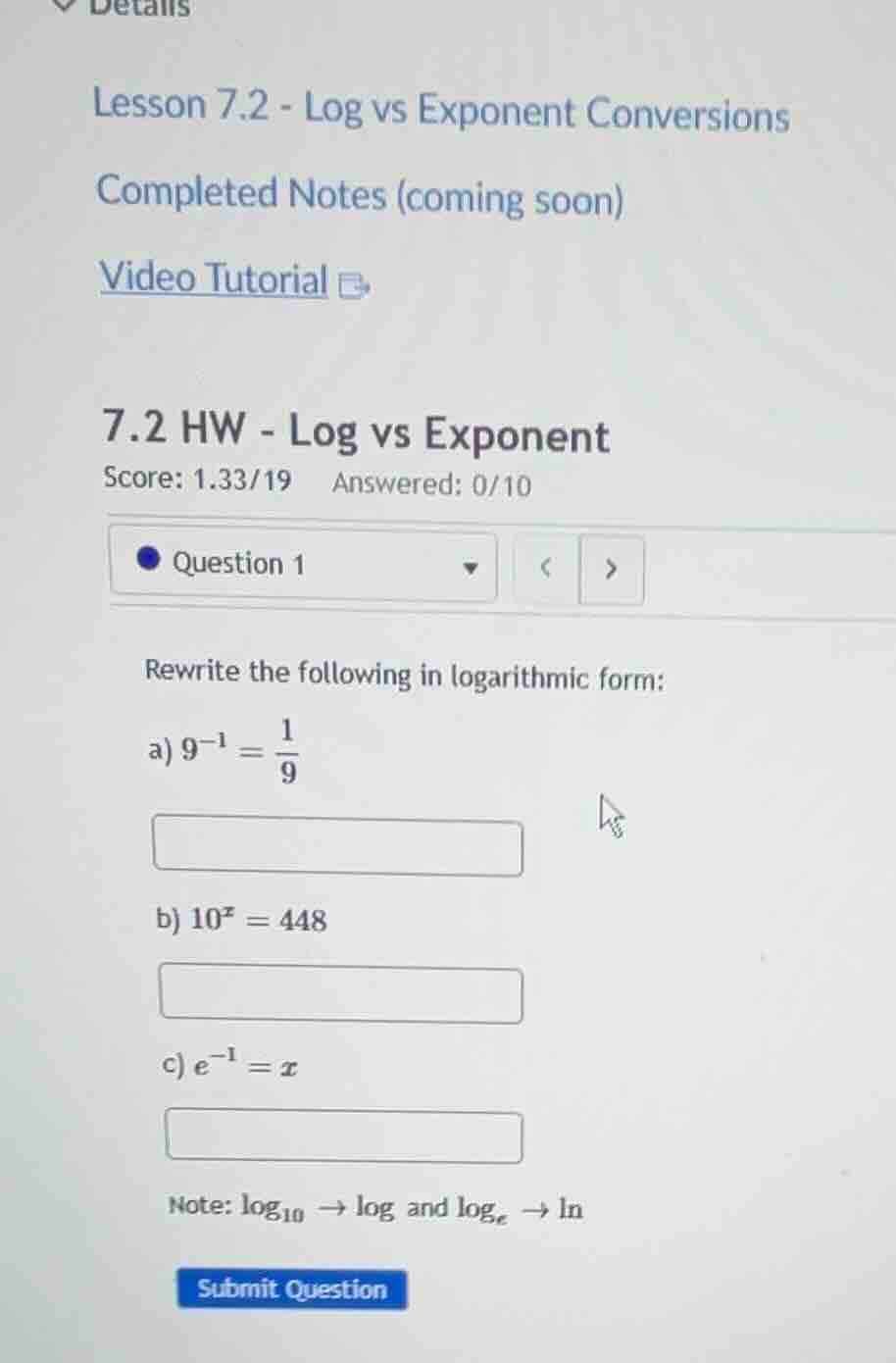
rewrite the following in logarithmic form:
a) $9^{-1} = \frac{1}{9}$
b) $10^x = 448$
c) $e^{-1} = x$
note: $\log_{10} \to \log$ and $\log_{e} \to \ln$
submit question
Part (a)
Step1: Recall the exponential - logarithmic conversion formula
The general form of an exponential equation is \(a^{b}=c\), and its corresponding logarithmic form is \(\log_{a}c = b\), where \(a>0,a
eq1\).
Step2: Identify \(a\), \(b\), and \(c\) from \(9^{-1}=\frac{1}{9}\)
In the equation \(9^{-1}=\frac{1}{9}\), we have \(a = 9\), \(b=- 1\), and \(c=\frac{1}{9}\).
Step3: Apply the conversion formula
Using the formula \(\log_{a}c = b\), we substitute \(a = 9\), \(b=-1\), and \(c=\frac{1}{9}\) to get \(\log_{9}\frac{1}{9}=-1\).
Part (b)
Step1: Recall the exponential - logarithmic conversion formula
The general form of an exponential equation is \(a^{b}=c\), and its corresponding logarithmic form is \(\log_{a}c = b\), where \(a > 0,a
eq1\). Also, for \(a = 10\), we can write \(\log_{10}x=\log x\).
Step2: Identify \(a\), \(b\), and \(c\) from \(10^{x}=448\)
In the equation \(10^{x}=448\), we have \(a = 10\), \(b = x\), and \(c = 448\).
Step3: Apply the conversion formula
Using the formula \(\log_{a}c=b\) and since \(a = 10\), we can write \(\log448=x\) (because \(\log_{10}x=\log x\)).
Part (c)
Step1: Recall the exponential - logarithmic conversion formula for natural logarithm
The general form of an exponential equation with base \(e\) is \(e^{b}=c\), and its corresponding logarithmic form is \(\ln c=b\) (since \(\log_{e}x=\ln x\)).
Step2: Identify \(b\) and \(c\) from \(e^{-1}=x\)
In the equation \(e^{-1}=x\), we can rewrite it as \(e^{-1}=x\) (or \(e^{-1}=x\) is the same as \(e^{-1}=x\)), where the base \(a = e\), \(b=-1\), and \(c = x\).
Step3: Apply the conversion formula
Using the formula for natural logarithm (\(\log_{e}c = b\) which is \(\ln c=b\)), we substitute \(b=-1\) and \(c = x\) to get \(\ln x=-1\).

Snap & solve any problem in the app
Get step-by-step solutions on Sovi AI
Photo-based solutions with guided steps
Explore more problems and detailed explanations
s:
a) \(\log_{9}\frac{1}{9}=-1\)
b) \(\log448 = x\)
c) \(\ln x=-1\)