QUESTION IMAGE
Question
g lesson: \letters from mill girls: part 1\
part 4: quick partner discussion
directions: discuss the questions with a partner. discussion resources and the \letters from mill girls: part 1\ text are provided below for support.
on re... \letters from mill gir...
discussion resources
encouraging synthesis
- what have we discussed?
- how can we summarize our points?
- whats our conclusion?
- whats the main point we want to communicate?
translate read aloud
font size medium
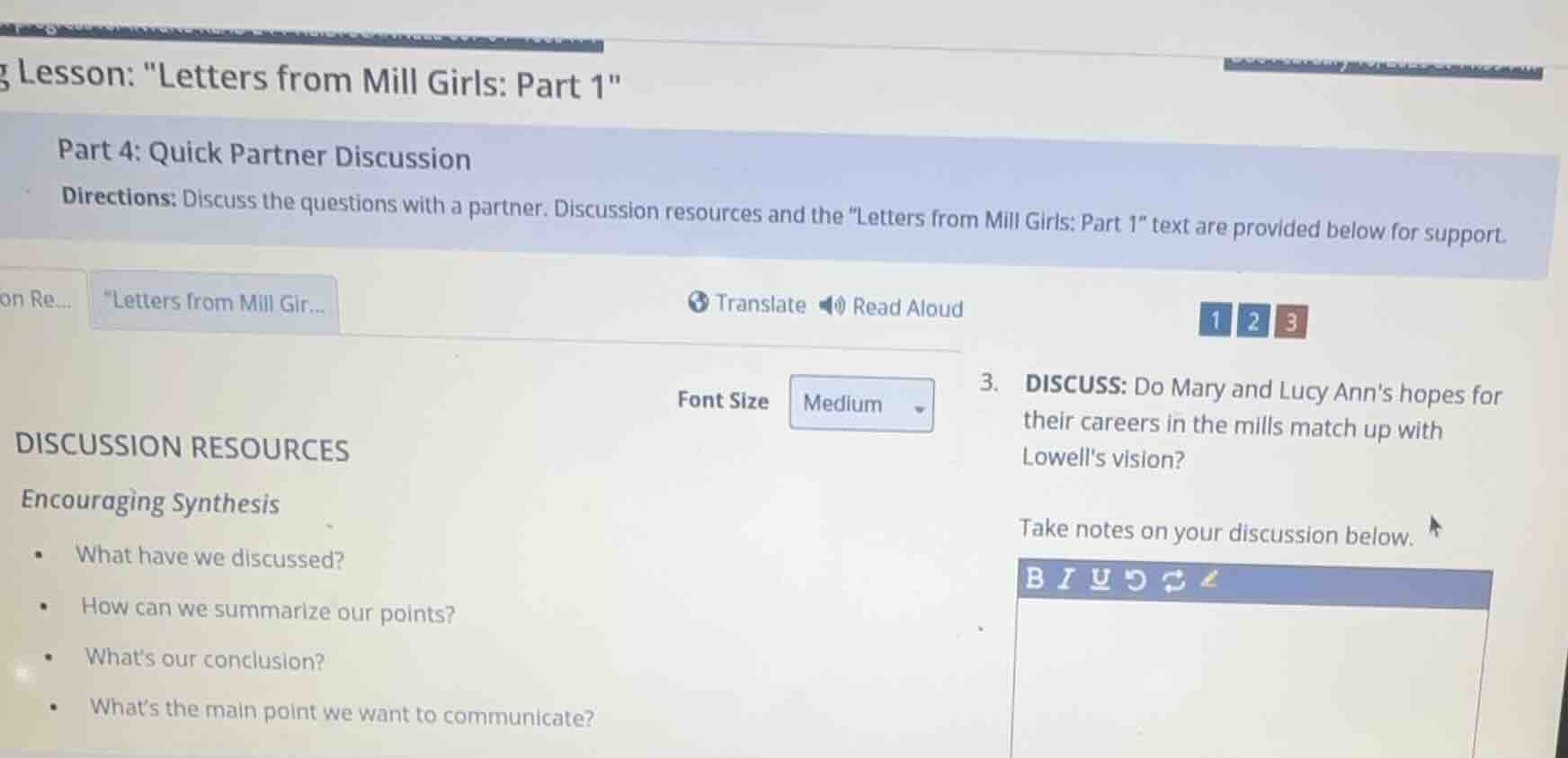
- discuss: do mary and lucy anns hopes for their careers in the mills match up with lowells vision?
take notes on your discussion below.
To answer this, we analyze the context of "Letters from Mill Girls" (likely about Lowell Mill girls, a historical topic).
Step 1: Recall Lowell’s Vision
Francis Cabot Lowell’s vision for mill work (in the Lowell System) emphasized providing young women (mill girls) with a chance for economic independence, education, and moral/intellectual growth, while operating efficient textile mills.
Step 2: Analyze Mary and Lucy Ann’s Hopes (from typical “Letters from Mill Girls” texts)
- Economic Goals: They often hoped for wages to support themselves/families, save money, or gain financial autonomy.
- Social/Educational Goals: They sought opportunities for learning (e.g., night schools), social activities, and a sense of community.
- Moral/Intellectual Growth: They valued the chance to improve themselves, read, write, and engage in cultural pursuits.
Step 3: Compare Hopes to Lowell’s Vision
- Economic Alignment: Lowell’s system provided wages, matching their desire for financial stability.
- Social/Educational Alignment: Lowell’s mills offered schools, libraries, and social events, aligning with their hopes for learning and community.
- Moral/Intellectual Alignment: The system’s emphasis on “respectable” working conditions and self - improvement matched their goals.
Step 4: Address Potential Mismatches (if any)
Some girls might have faced harsh realities (long hours, strict rules) that clashed with idealized hopes, but the core vision of economic opportunity and self - betterment generally aligned.
To determine if Mary and Lucy Ann’s career hopes in the mills match Lowell’s vision, we analyze:
- Lowell’s Vision: Focused on providing young women (mill girls) economic independence, education, moral growth, and a “respectable” working environment (e.g., schools, social activities).
- Girls’ Hopes (from “Letters from Mill Girls”): Often included financial stability (wages), learning opportunities (night schools, libraries), and social/intellectual growth.
- Alignment: Their hopes for wages, education, and self - improvement generally match Lowell’s goals of economic opportunity and moral/intellectual development. While harsh realities (long hours, strict rules) sometimes clashed, the core vision aligned.

Snap & solve any problem in the app
Get step-by-step solutions on Sovi AI
Photo-based solutions with guided steps
Explore more problems and detailed explanations
Mary and Lucy Ann’s career hopes in the mills generally match Lowell’s vision. Lowell aimed to provide young women with economic independence (wages), educational/social opportunities (schools, community life), and moral/intellectual growth. The girls’ hopes for financial stability, learning, and self - betterment align with these goals. However, some practical challenges (e.g., long hours) might have created tensions, but the core vision of economic and personal growth was shared.