QUESTION IMAGE
Question
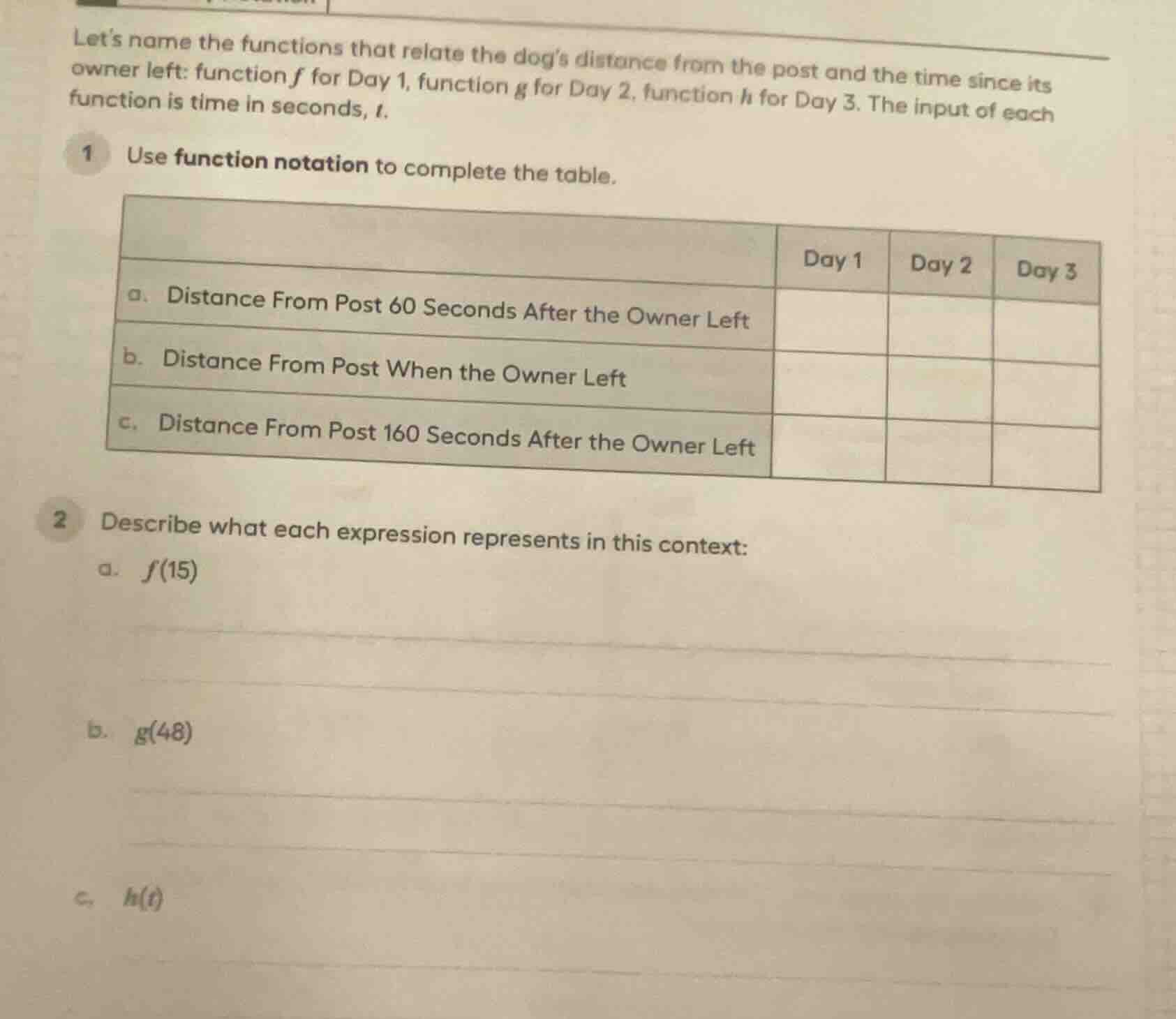
let’s name the functions that relate the dog’s distance from the post and the time since its owner left: function f for day 1, function g for day 2, function h for day 3. the input of each function is time in seconds, t.
1 use function notation to complete the table.
| day 1 | day 2 | day 3 | |
|---|---|---|---|
| b. distance from post when the owner left | |||
| c. distance from post 160 seconds after the owner left |
2 describe what each expression represents in this context:
a. f(15)
b. g(48)
c. h(t)
Question 1
To complete the table using function notation, we use the input \( t \) (time in seconds) for each function:
Part a: Distance From Post 60 Seconds After the Owner Left
- For Day 1 (function \( f \)): \( f(60) \) (since \( t = 60 \) seconds)
- For Day 2 (function \( g \)): \( g(60) \)
- For Day 3 (function \( h \)): \( h(60) \)
Part b: Distance From Post When the Owner Left
When the owner left, \( t = 0 \) seconds (time since owner left is 0).
- For Day 1: \( f(0) \)
- For Day 2: \( g(0) \)
- For Day 3: \( h(0) \)
Part c: Distance From Post 160 Seconds After the Owner Left
- For Day 1: \( f(160) \) ( \( t = 160 \) seconds)
- For Day 2: \( g(160) \)
- For Day 3: \( h(160) \)
Question 2
Part a: \( f(15) \)
In this context, \( f \) is the function for Day 1, and the input \( t = 15 \) seconds. So \( f(15) \) represents the distance of the dog from the post 15 seconds after its owner left on Day 1.
Part b: \( g(48) \)
Here, \( g \) is the function for Day 2, and the input \( t = 48 \) seconds. Thus, \( g(48) \) represents the distance of the dog from the post 48 seconds after its owner left on Day 2.
Part c: \( h(t) \)
\( h \) is the function for Day 3, and \( t \) is the time in seconds since the owner left. So \( h(t) \) represents the distance of the dog from the post \( t \) seconds after its owner left on Day 3.
Final Table for Question 1
| Day 1 | Day 2 | Day 3 | |
|---|---|---|---|
| b. Distance From Post When the Owner Left | \( f(0) \) | \( g(0) \) | \( h(0) \) |
| c. Distance From Post 160 Seconds After the Owner Left | \( f(160) \) | \( g(160) \) | \( h(160) \) |
Final Answers for Question 2
a. \( f(15) \) represents the distance of the dog from the post 15 seconds after its owner left on Day 1.
b. \( g(48) \) represents the distance of the dog from the post 48 seconds after its owner left on Day 2.
c. \( h(t) \) represents the distance of the dog from the post \( t \) seconds after its owner left on Day 3.

Snap & solve any problem in the app
Get step-by-step solutions on Sovi AI
Photo-based solutions with guided steps
Explore more problems and detailed explanations
Question 1
To complete the table using function notation, we use the input \( t \) (time in seconds) for each function:
Part a: Distance From Post 60 Seconds After the Owner Left
- For Day 1 (function \( f \)): \( f(60) \) (since \( t = 60 \) seconds)
- For Day 2 (function \( g \)): \( g(60) \)
- For Day 3 (function \( h \)): \( h(60) \)
Part b: Distance From Post When the Owner Left
When the owner left, \( t = 0 \) seconds (time since owner left is 0).
- For Day 1: \( f(0) \)
- For Day 2: \( g(0) \)
- For Day 3: \( h(0) \)
Part c: Distance From Post 160 Seconds After the Owner Left
- For Day 1: \( f(160) \) ( \( t = 160 \) seconds)
- For Day 2: \( g(160) \)
- For Day 3: \( h(160) \)
Question 2
Part a: \( f(15) \)
In this context, \( f \) is the function for Day 1, and the input \( t = 15 \) seconds. So \( f(15) \) represents the distance of the dog from the post 15 seconds after its owner left on Day 1.
Part b: \( g(48) \)
Here, \( g \) is the function for Day 2, and the input \( t = 48 \) seconds. Thus, \( g(48) \) represents the distance of the dog from the post 48 seconds after its owner left on Day 2.
Part c: \( h(t) \)
\( h \) is the function for Day 3, and \( t \) is the time in seconds since the owner left. So \( h(t) \) represents the distance of the dog from the post \( t \) seconds after its owner left on Day 3.
Final Table for Question 1
| Day 1 | Day 2 | Day 3 | |
|---|---|---|---|
| b. Distance From Post When the Owner Left | \( f(0) \) | \( g(0) \) | \( h(0) \) |
| c. Distance From Post 160 Seconds After the Owner Left | \( f(160) \) | \( g(160) \) | \( h(160) \) |
Final Answers for Question 2
a. \( f(15) \) represents the distance of the dog from the post 15 seconds after its owner left on Day 1.
b. \( g(48) \) represents the distance of the dog from the post 48 seconds after its owner left on Day 2.
c. \( h(t) \) represents the distance of the dog from the post \( t \) seconds after its owner left on Day 3.