QUESTION IMAGE
Question
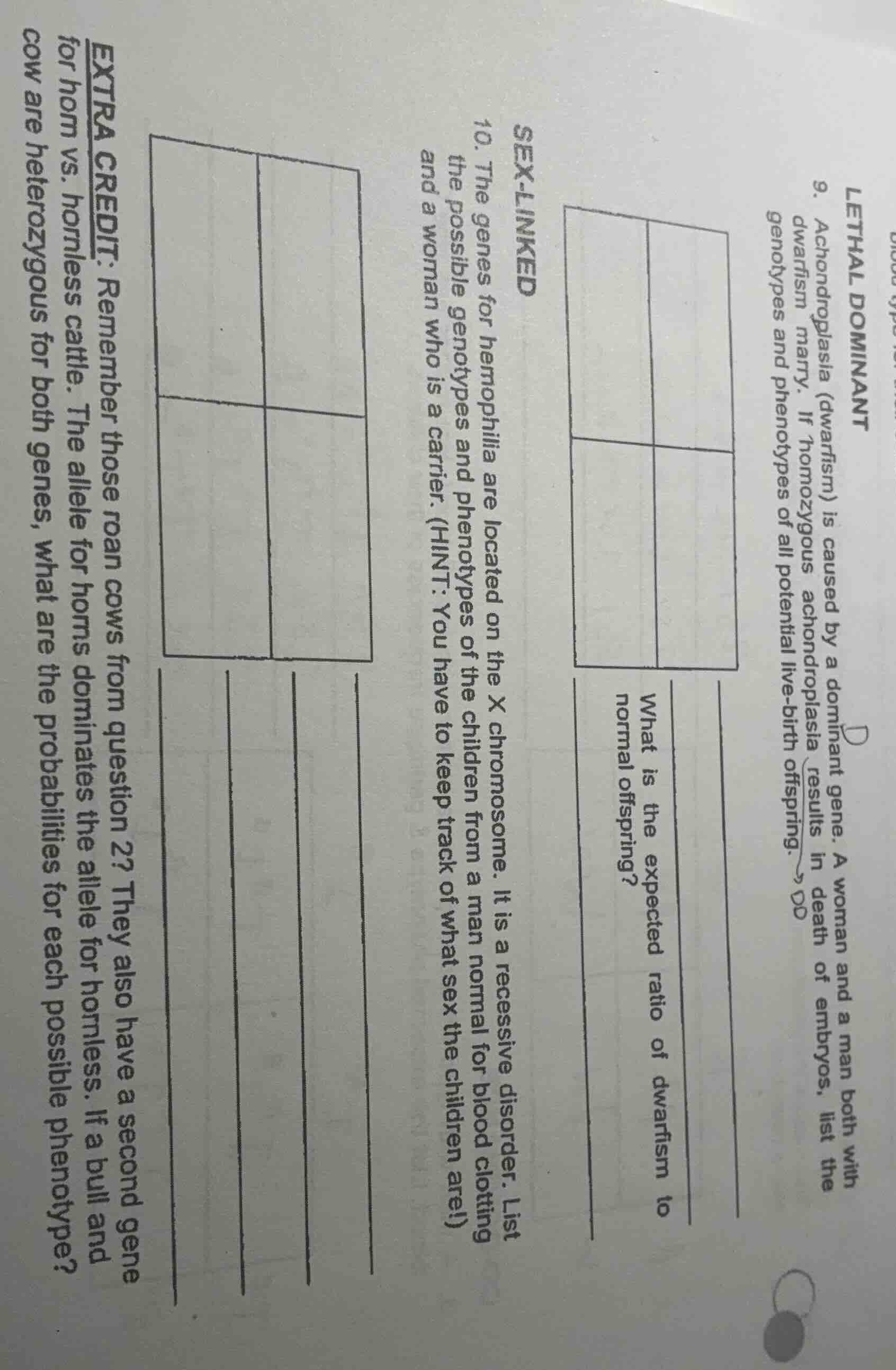
- lethal dominant achondroplasia (dwarfism) is caused by a dominant gene. a woman and a man with dwarfism marry. if homozygous achondroplasia results in death of embryos, list the genotypes and phenotypes of all potential live - birth offspring. what is the expected ratio of dwarfism to normal offspring? 10. sex - linked the genes for hemophilia are located on the x chromosome. it is a recessive disorder. list the possible genotypes and phenotypes of the children from a man normal for blood clotting and a woman who is a carrier. (hint: you have to keep track of what sex the children are!) extra credit: remember those roan cows from question 2? they also have a second gene for horn vs. hornless cattle. the allele for horns dominates the allele for hornless. if a bull and cow are heterozygous for both genes, what are the probabilities for each possible phenotype?
Response
Problem 9: Lethal Dominant (Achondroplasia)
Step 1: Determine Genotypes
- Achondroplasia is caused by a dominant gene (\(D\)), and homozygous dominant (\(DD\)) is lethal (embryonic death).
- The woman and man both have dwarfism (achondroplasia) but are not \(DD\) (since \(DD\) is lethal), so their genotypes must be \(Dd\) (heterozygous, as \(DD\) is lethal and they are alive with dwarfism).
Step 2: Set Up Punnett Square
| \(D\) | \(d\) | |
|---|---|---|
| \(d\) | \(Dd\) (dwarf) | \(dd\) (normal) |
Step 3: Analyze Live Offspring
- Total possible offspring genotypes from Punnett square: \(DD\) (lethal, 1/4), \(Dd\) (2/4), \(dd\) (1/4).
- Excluding \(DD\) (lethal), the live offspring are \(Dd\) (2) and \(dd\) (1), so the ratio of dwarfism (\(Dd\)) to normal (\(dd\)) among live offspring is \(2:1\).
Step 4: List Genotypes and Phenotypes of Live Offspring
- Genotypes: \(Dd\) (2/3 chance) and \(dd\) (1/3 chance) (since we exclude the lethal \(DD\)).
- Phenotypes:
- \(Dd\): Dwarfism (achondroplasia)
- \(dd\): Normal (no dwarfism)
Problem 10: Sex - Linked (Hemophilia)
Step 1: Determine Genotypes
- Hemophilia is a recessive X - linked disorder. Let \(X^H\) be the normal allele and \(X^h\) be the hemophilia allele.
- Man: Normal for blood clotting. Since men have one X and one Y chromosome, his genotype is \(X^HY\) (because if he had \(X^h\), he would have hemophilia as he has only one X chromosome).
- Woman: Carrier. Carriers of X - linked recessive disorders have the genotype \(X^HX^h\) (one normal X, one X with the hemophilia allele).
Step 2: Set Up Punnett Square for Sex - Linked Inheritance
We consider the possible gametes:
- Man (\(X^HY\)) produces gametes \(X^H\) and \(Y\).
- Woman (\(X^HX^h\)) produces gametes \(X^H\) and \(X^h\).
The Punnett square for the combination of these gametes is as follows:
| \(X^H\) (from man) | \(Y\) (from man) | |
|---|---|---|
| \(X^h\) (from woman) | \(X^HX^h\) (female, carrier) | \(X^hY\) (male, hemophilia) |
Step 3: Analyze Genotypes, Phenotypes, and Sex of Children
- Female Offspring:
- Genotypes: \(X^HX^H\) (homozygous normal) and \(X^HX^h\) (carrier).
- Phenotypes: Both \(X^HX^H\) and \(X^HX^h\) females will have normal blood clotting (since the disorder is recessive and they have at least one normal \(X^H\) allele).
- Male Offspring:
- Genotypes: \(X^HY\) (normal) and \(X^hY\) (has hemophilia).
- Phenotypes: \(X^HY\) males have normal blood clotting, \(X^hY\) males have hemophilia.
Step 4: Calculate Probabilities for Each Genotype and Phenotype
- Female Children:
- Probability of \(X^HX^H\): \(\frac{1}{4}\) of all possible offspring (1 out of 4 total squares in the Punnett square), and since half of the offspring are female (2 out of 4), the probability among females is \(\frac{1}{2}\) (or 50%). Phenotype: Normal.
- Probability of \(X^HX^h\): \(\frac{1}{4}\) of all possible offspring, and among females, it is \(\frac{1}{2}\) (50%). Phenotype: Carrier (normal blood clotting, but can pass on the hemophilia allele).
- Male Children:
- Probability of \(X^HY\): \(\frac{1}{4}\) of all possible offspring, and among males, it is \(\frac{1}{2}\) (50%). Phenotype: Normal.
- Probability of \(X^hY\): \(\frac{1}{4}\) of all possible offspring, and among males, it is \(\frac{1}{2}\) (50%). Phenotype: Hemoph…

Snap & solve any problem in the app
Get step-by-step solutions on Sovi AI
Photo-based solutions with guided steps
Explore more problems and detailed explanations
s
Problem 9
- Expected ratio of dwarfism to normal (live offspring): \(2:1\)
- Genotypes of live offspring: \(Dd\) (dwarf, \(\frac{2}{3}\) chance) and \(dd\) (normal, \(\frac{1}{3}\) chance)
- Phenotypes of live offspring: Dwarf (achondroplasia) and Normal (no achondroplasia) with a ratio of \(2:1\)
Problem 10
- Genotypes and Phenotypes of Children:
- Females:
- Genotype \(X^HX^H\): Phenotype - Normal (no hemophilia), Probability - \(\frac{1}{4}\) (of all offspring) or \(\frac{1}{2}\) (of female offspring)
- Genotype \(X^HX^h\): Phenotype - Carrier (normal blood clotting, can pass hemophilia), Probability - \(\frac{1}{4}\) (of all offspring) or \(\frac{1}{2}\) (of female offspring)
- Males:
- Genotype \(X^HY\): Phenotype - Normal (no hemophilia), Probability - \(\frac{1}{4}\) (of all offspring) or \(\frac{1}{2}\) (of male offspring)
- Genotype \(X^hY\): Phenotype - Hemophilia, Probability - \(\frac{1}{4}\) (of all offspring) or \(\frac{1}{2}\) (of male offspring)
Extra Credit
- Probability of horns phenotype: \(\frac{3}{4}\)
- Probability of hornless phenotype: \(\frac{1}{4}\) (If considering roan coat color along with horns/hornless, more complex dihybrid cross would be needed, but with the given info on horns/hornless dominance and heterozygosity, these are the probabilities for the horns/hornless phenotype)