QUESTION IMAGE
Question
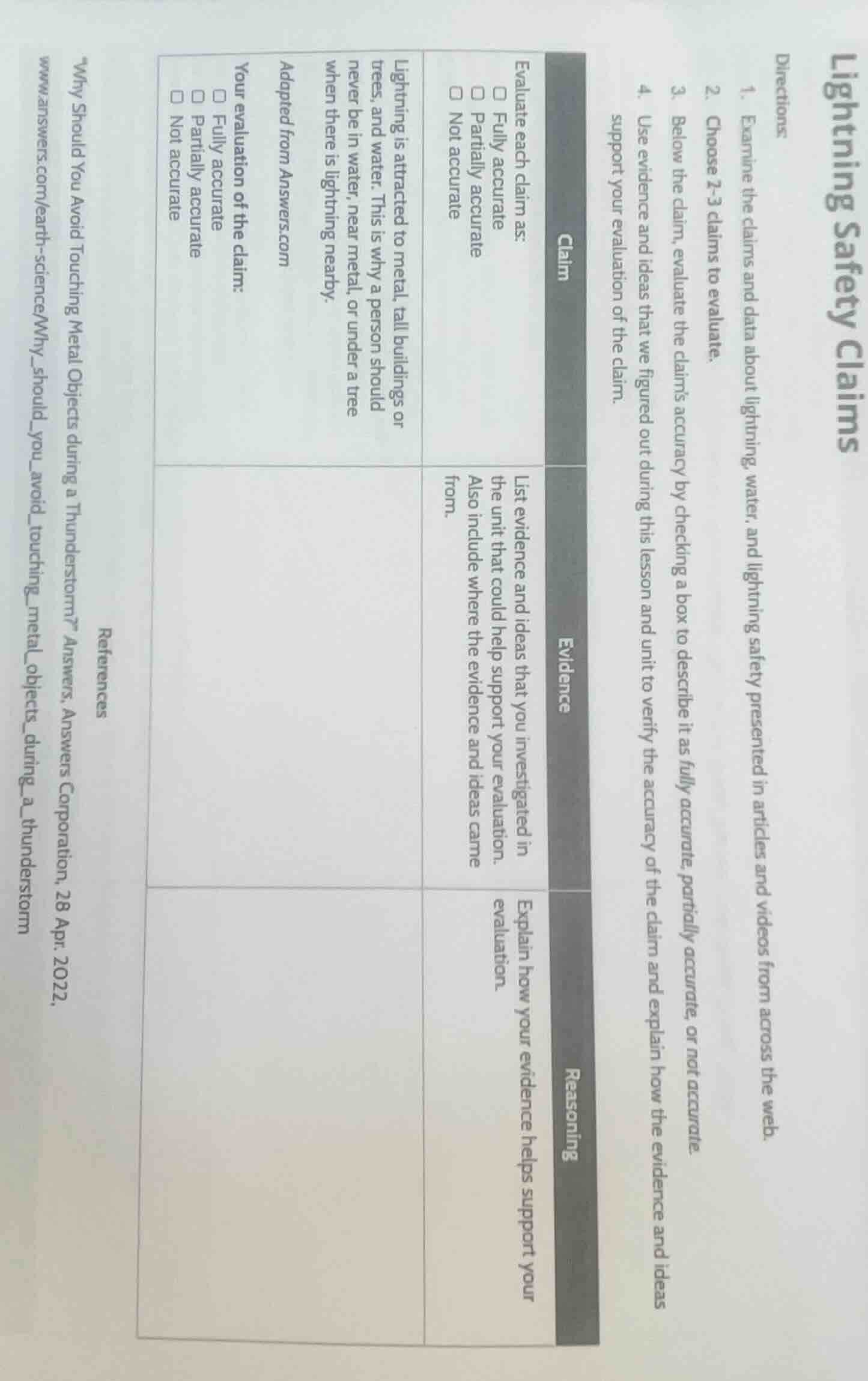
lightning safety claims
directions:
- examine the claims and data about lightning, water, and lightning safety presented in articles and videos from across the web.
- choose 2-3 claims to evaluate.
- below the claim, evaluate the claims accuracy by checking a box to describe it as fully accurate, partially accurate, or not accurate.
- use evidence and ideas that we figured out during this lesson and unit to verify the accuracy of the claim and explain how the evidence and ideas support your evaluation of the claim.
| claim | evidence | reasoning |
|---|
adapted from answers.com
references
\why should you avoid touching metal objects during a thunderstorm?\ answers, answers corporation, 28 apr. 2022,
www.answers.com/earth-science/why_should_you_avoid_touching_metal_objects_during_a_thunderstorm
- Evidence:
- Lightning seeks the shortest path to the ground, so tall objects (trees, buildings) are at high risk of being struck (source: basic physics of electrical discharge, storm safety resources).
- Water is a good electrical conductor, so being in/near water during lightning is dangerous (source: National Weather Service lightning safety guidelines).
- Metal is a conductor, but enclosed metal structures (like cars) can safely shield people via the Faraday effect; open metal objects are a risk (source: physics of electrostatic shielding, storm safety education).
- Reasoning:
- The claim correctly identifies that lightning targets tall objects, and that water/metal (open metal) are lightning hazards, which aligns with established lightning physics. However, it incorrectly states people should never be near metal: enclosed metal (e.g., a hard-topped car) is a safe shelter. This means parts of the claim are accurate, while one key detail is flawed.

Snap & solve any problem in the app
Get step-by-step solutions on Sovi AI
Photo-based solutions with guided steps
Explore more problems and detailed explanations
- Your evaluation of the claim: $\boldsymbol{\square}$ Partially accurate
- Evidence:
- Lightning targets the tallest conductive path to ground, so tall buildings/trees are high-risk (physics of electrical discharge, storm safety resources).
- Water is a good electrical conductor, so being in/near it during lightning is dangerous (National Weather Service guidelines).
- Open metal is a hazard, but enclosed metal (e.g., cars) acts as a safe Faraday cage (electrostatic shielding principles, storm safety education).
- Reasoning:
The claim is partially accurate. It correctly identifies that tall objects, water, and open metal are lightning hazards, but it incorrectly claims people should never be near metal—enclosed metal structures are safe lightning shelters. This mix of correct and incorrect details makes the claim only partially accurate.