QUESTION IMAGE
Question
linear and exponential growth: medium
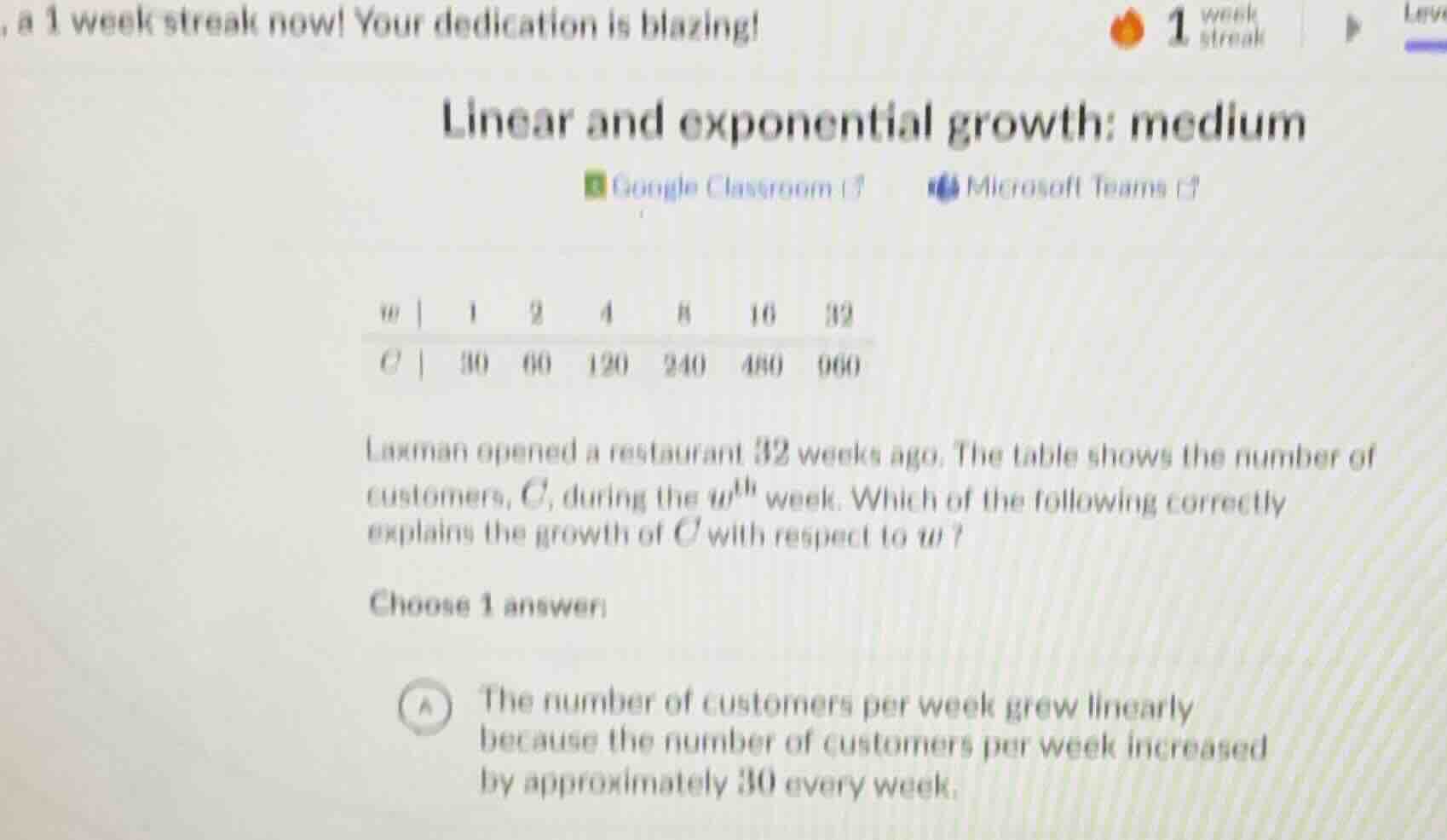
| w | 1 | 2 | 4 | 8 | 16 | 32 |
|---|
laxman opened a restaurant 32 weeks ago. the table shows the number of customers, ( c ), during the ( w^{\text{th}} ) week. which of the following correctly explains the growth of ( c ) with respect to ( w )?
choose 1 answer:
a) the number of customers per week grew linearly because the number of customers per week increased by approximately 30 every week.
To determine the growth type, we analyze the relationship between \( w \) (week) and \( C \) (customers):
Step 1: Check for Exponential Growth (Multiplicative Relationship)
- When \( w \) doubles from 1 to 2, \( C \) doubles from 30 to 60.
- When \( w \) doubles from 2 to 4, \( C \) doubles from 60 to 120.
- When \( w \) doubles from 4 to 8, \( C \) doubles from 120 to 240.
- This pattern (doubling \( w \) leads to doubling \( C \)) continues for all given values. This indicates a multiplicative (exponential) relationship where \( C \) is proportional to \( w \) (or \( C = k \cdot w \), but here the ratio \( \frac{C}{w} \) is constant? Wait, no—wait, let’s check the ratio \( \frac{C}{w} \):
- For \( w = 1 \), \( \frac{C}{w} = \frac{30}{1} = 30 \)
- For \( w = 2 \), \( \frac{C}{w} = \frac{60}{2} = 30 \)
- For \( w = 4 \), \( \frac{C}{w} = \frac{120}{4} = 30 \)
- For \( w = 8 \), \( \frac{C}{w} = \frac{240}{8} = 30 \)
- For \( w = 16 \), \( \frac{C}{w} = \frac{480}{16} = 30 \)
- For \( w = 32 \), \( \frac{C}{w} = \frac{960}{32} = 30 \)
Step 2: Analyze the Relationship
The ratio \( \frac{C}{w} = 30 \) is constant for all \( w \). This means \( C = 30w \), which is a linear relationship (since it fits \( y = mx + b \) with \( b = 0 \) and \( m = 30 \)). Wait, but the option A says: "The number of customers per week grew linearly because the number of customers per week increased by approximately 30 every week." Wait, let's check the "increase per week":
- From \( w = 1 \) to \( w = 2 \): \( C \) increases by \( 60 - 30 = 30 \) (over 1 week, so 30 per week).
- From \( w = 2 \) to \( w = 4 \): \( w \) increases by 2 weeks, \( C \) increases by \( 120 - 60 = 60 \), so 30 per week (60 / 2 = 30).
- From \( w = 4 \) to \( w = 8 \): \( w \) increases by 4 weeks, \( C \) increases by \( 240 - 120 = 120 \), so 30 per week (120 / 4 = 30).
Thus, the rate of increase is constant (30 customers per week), which is characteristic of linear growth. Option A correctly describes this: the number of customers per week grew linearly because the number of customers per week increased by approximately 30 every week.

Snap & solve any problem in the app
Get step-by-step solutions on Sovi AI
Photo-based solutions with guided steps
Explore more problems and detailed explanations
A. The number of customers per week grew linearly because the number of customers per week increased by approximately 30 every week.