QUESTION IMAGE
Question
linear vs. exponential growth rates quick check
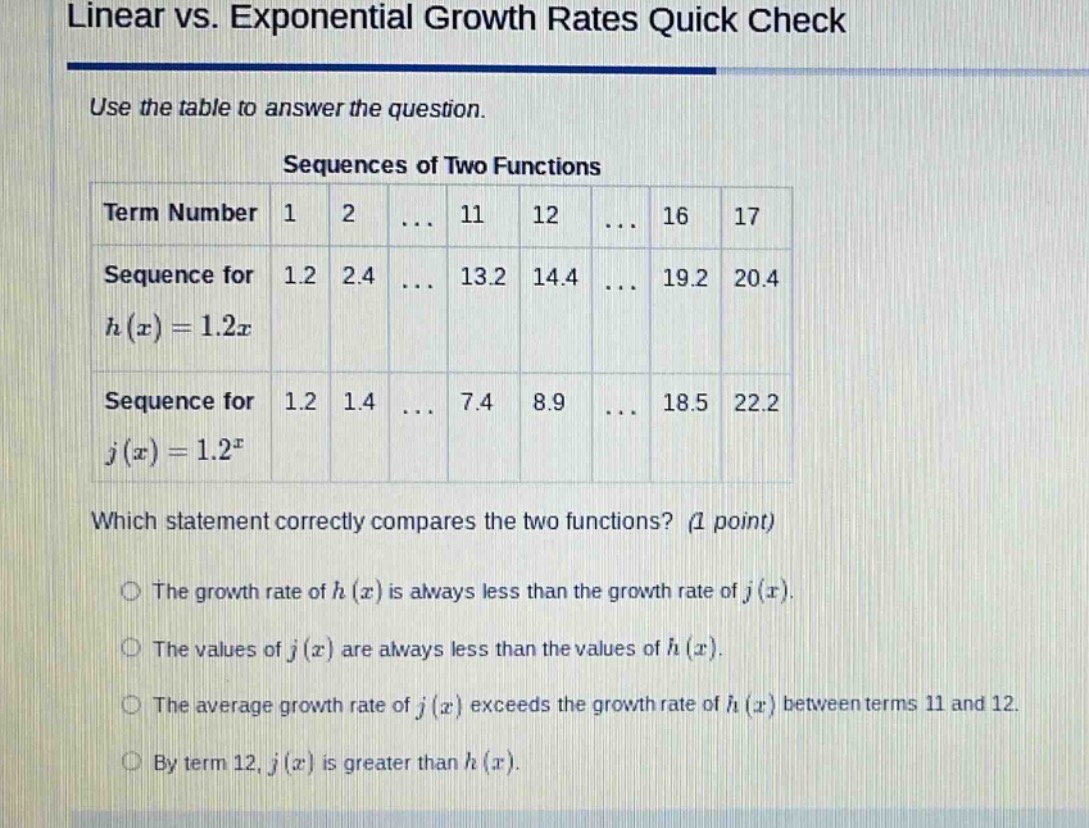
use the table to answer the question.
sequences of two functions
| term number | 1 | 2 | … | 11 | 12 | … | 16 | 17 |
|---|---|---|---|---|---|---|---|---|
| sequence for $j(x) = 1.2^x$ | 1.2 | 1.4 | … | 7.4 | 8.9 | … | 18.5 | 22.2 |
which statement correctly compares the two functions? (1 point)
- the growth rate of $h(x)$ is always less than the growth rate of $j(x)$.
- the values of $j(x)$ are always less than the values of $h(x)$.
- the average growth rate of $j(x)$ exceeds the growth rate of $h(x)$ between terms 11 and 12.
- by term 12, $j(x)$ is greater than $h(x)$.
Brief Explanations
- Analyze the first option: The function \( h(x) = 1.2x \) is linear with a constant rate of change (slope) of \( 1.2 \). The function \( j(x)=1.2^x \) is exponential. At the start, the linear function may grow faster, but exponential functions grow faster over time. So the growth rate of \( h(x) \) is not always less than \( j(x) \), so this option is incorrect.
- Analyze the second option: Looking at the table, at term 17, \( j(17) = 22.2 \) and \( h(17)=20.4 \), so \( j(x) \) is not always less than \( h(x) \), this option is incorrect.
- Analyze the third option: The growth rate of \( h(x) \) (linear) between term 11 and 12: \( h(12)-h(11)=14.4 - 13.2=1.2 \). The average growth rate of \( j(x) \) between term 11 and 12: \( j(12)-j(11)=8.9 - 7.4 = 1.5 \). Since \( 1.5>1.2 \), the average growth rate of \( j(x) \) exceeds that of \( h(x) \) between terms 11 and 12, this option is correct.
- Analyze the fourth option: At term 12, \( h(12) = 14.4 \) and \( j(12)=8.9 \), so \( j(x) \) is not greater than \( h(x) \) at term 12, this option is incorrect.

Snap & solve any problem in the app
Get step-by-step solutions on Sovi AI
Photo-based solutions with guided steps
Explore more problems and detailed explanations
The average growth rate of \( j(x) \) exceeds the growth rate of \( h(x) \) between terms 11 and 12. (The option corresponding to this statement)