QUESTION IMAGE
Question
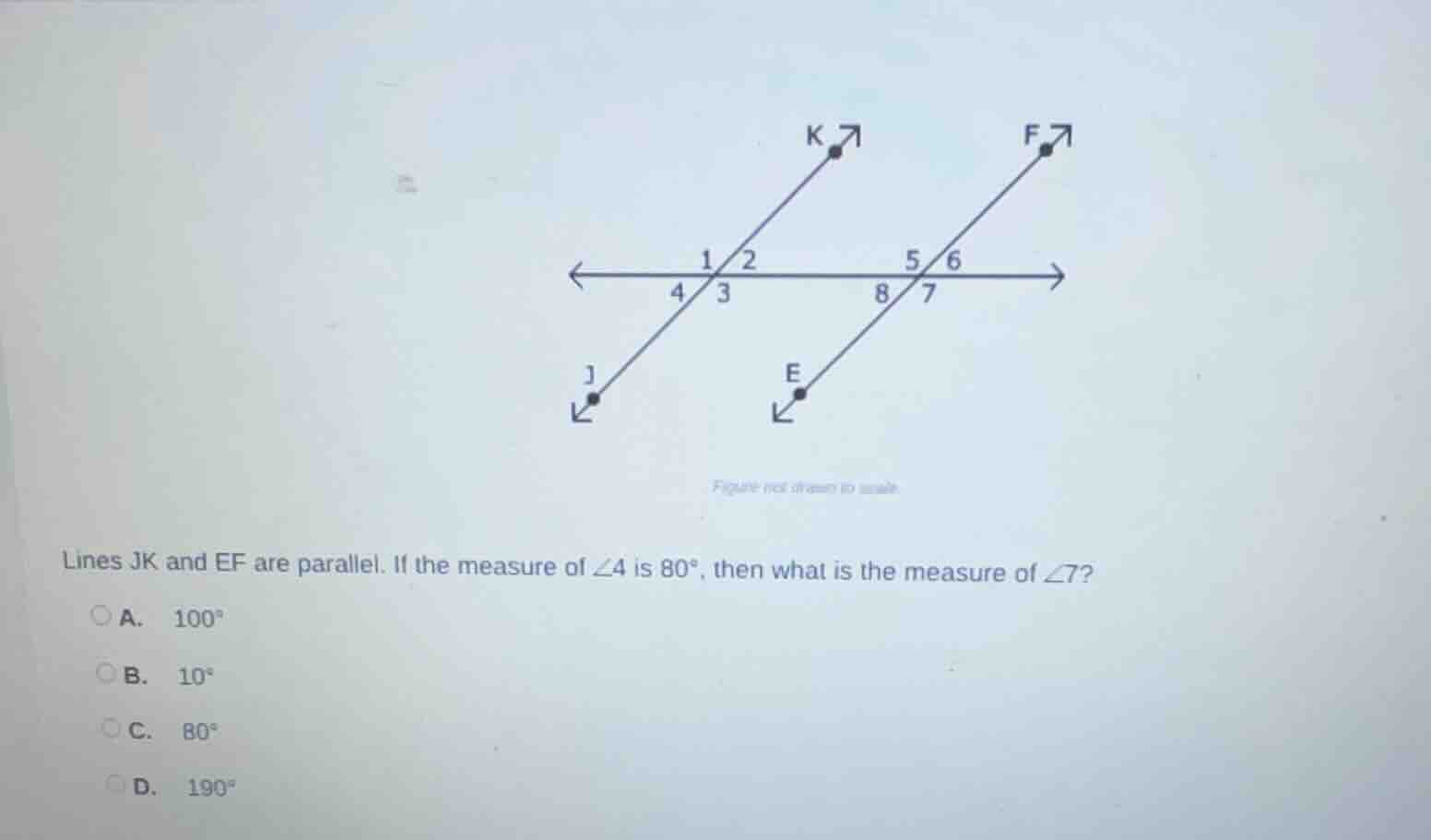
lines jk and ef are parallel. if the measure of $\angle 4$ is $80^\circ$, then what is the measure of $\angle 7$?\
\bigcirc a. $100^\circ$\
\bigcirc b. $10^\circ$\
\bigcirc c. $80^\circ$\
\bigcirc d. $190^\circ$
Step1: Identify Vertical Angles
$\angle 4$ and $\angle 2$ are vertical angles? No, wait, $\angle 4$ and $\angle 2$? Wait, $\angle 4$ and $\angle 2$: no, actually $\angle 4$ and $\angle 2$ are not. Wait, $\angle 4$ and $\angle 2$: no, let's see. The transversal cuts the parallel lines. Wait, $\angle 4$ and $\angle 8$? No, wait, lines JK and EF are parallel. So the transversal is the horizontal line. So $\angle 4$ and $\angle 8$: no, wait, $\angle 4$ and $\angle 2$ are vertical? Wait, no, $\angle 4$ and $\angle 2$: actually, $\angle 4$ and $\angle 2$ are vertical angles? Wait, no, the intersection of JK and the horizontal line: $\angle 1$ and $\angle 3$ are vertical, $\angle 2$ and $\angle 4$ are vertical? Wait, no, when two lines intersect, vertical angles are equal. So $\angle 4$ and $\angle 2$: yes, $\angle 4 = \angle 2 = 80^\circ$. Then, since JK || EF, $\angle 2$ and $\angle 6$ are corresponding angles, so $\angle 6 = 80^\circ$. Then $\angle 6$ and $\angle 7$: they are supplementary? Wait, no, $\angle 6$ and $\angle 7$: wait, $\angle 6$ and $\angle 7$ are adjacent? No, $\angle 6$ and $\angle 7$: wait, the horizontal line is a straight line, so $\angle 5 + \angle 6 = 180^\circ$, but also, $\angle 6$ and $\angle 7$: no, $\angle 6$ and $\angle 8$ are vertical, $\angle 7$ and $\angle 5$ are vertical? Wait, maybe better: $\angle 4$ and $\angle 8$: are they equal? Wait, JK || EF, so alternate interior angles: $\angle 3$ and $\angle 8$? No, $\angle 4$ and $\angle 8$: wait, $\angle 4$ and $\angle 8$: let's see, the transversal is the horizontal line. So $\angle 4$ and $\angle 8$: are they corresponding? No, $\angle 2$ and $\angle 6$ are corresponding (both above the parallel lines, same side of transversal). So $\angle 2 = \angle 6 = 80^\circ$. Then $\angle 6$ and $\angle 7$: since $\angle 6 + \angle 7 = 180^\circ$? No, wait, $\angle 6$ and $\angle 7$: no, $\angle 6$ and $\angle 7$: wait, the angle $\angle 6$ and $\angle 7$: they are adjacent angles forming a linear pair? Wait, no, $\angle 6$ and $\angle 7$: the horizontal line is straight, so $\angle 5 + \angle 6 = 180^\circ$, but $\angle 5$ and $\angle 7$ are vertical? Wait, maybe I made a mistake. Let's start over.
Wait, $\angle 4 = 80^\circ$. $\angle 4$ and $\angle 2$ are vertical angles, so $\angle 2 = 80^\circ$. Since JK || EF, $\angle 2$ and $\angle 6$ are corresponding angles, so $\angle 6 = 80^\circ$. Then $\angle 6$ and $\angle 7$: are they supplementary? No, $\angle 6$ and $\angle 7$: wait, $\angle 6$ and $\angle 8$ are vertical angles, so $\angle 8 = 80^\circ$. Then $\angle 7$: since $\angle 8 + \angle 7 = 180^\circ$ (linear pair), so $\angle 7 = 180^\circ - 80^\circ = 100^\circ$? Wait, no, that can't be. Wait, no, maybe I mixed up. Wait, $\angle 4 = 80^\circ$. $\angle 4$ and $\angle 3$ are supplementary (linear pair), so $\angle 3 = 180^\circ - 80^\circ = 100^\circ$. Then, since JK || EF, $\angle 3$ and $\angle 7$ are corresponding angles? Wait, no, $\angle 3$ and $\angle 7$: let's see, the transversal is the horizontal line. So $\angle 3$ and $\angle 7$: are they corresponding? Yes, because JK || EF, so corresponding angles: $\angle 3$ (below JK, above transversal) and $\angle 7$ (below EF, above transversal). Wait, no, $\angle 3$ is below the transversal, $\angle 7$ is below the transversal? Wait, JK is above and below? Wait, JK has points K (above) and J (below). EF has F (above) and E (below). So the transversal is the horizontal line. So $\angle 3$ is below the transversal, between JK and the transversal. $\angle 7$ is below the transversal, between EF and the transv…

Snap & solve any problem in the app
Get step-by-step solutions on Sovi AI
Photo-based solutions with guided steps
Explore more problems and detailed explanations
A. $100^\circ$