QUESTION IMAGE
Question
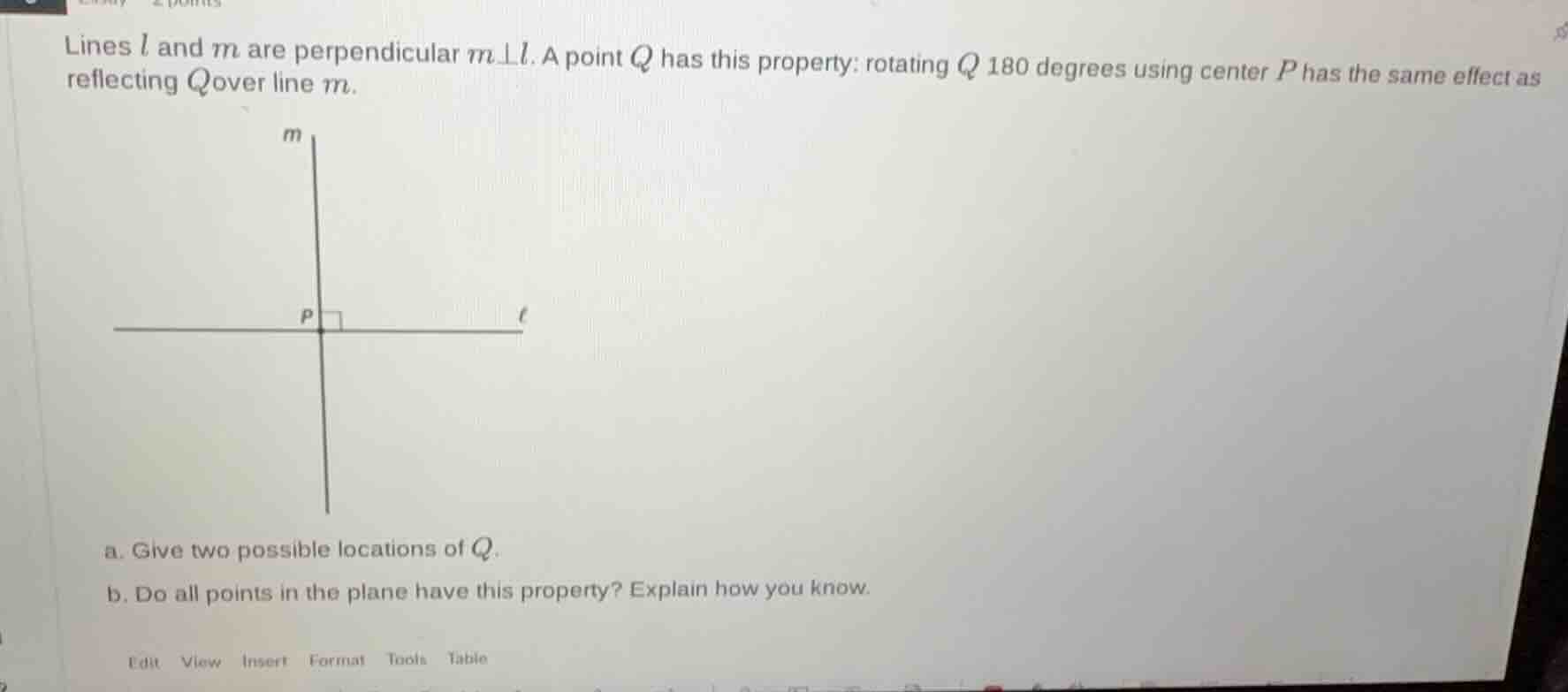
lines ( l ) and ( m ) are perpendicular ( m perp l ). a point ( q ) has this property: rotating ( q ) 180 degrees using center ( p ) has the same effect as reflecting ( q ) over line ( m ).
a. give two possible locations of ( q ).
b. do all points in the plane have this property? explain how you know.
Part (a)
Step1: Analyze Point on Line \( m \)
A point on line \( m \) (excluding \( P \)): Let's take a point \( Q \) on line \( m \), say \( Q \) is above \( P \) on \( m \). Rotating \( Q \) 180° around \( P \) will map it to a point below \( P \) on \( m \). Reflecting \( Q \) over \( m \) (since \( Q \) is on \( m \)) leaves it unchanged? Wait, no—wait, \( m \) is the line of reflection. Wait, no, the rotation is 180° around \( P \), and reflection over \( m \). Let's think about the composition. A 180° rotation around \( P \) is equivalent to two reflections over lines through \( P \) (perpendicular). Since \( l \perp m \), let's denote \( l \) and \( m \) as perpendicular lines through \( P \). A 180° rotation around \( P \) is the same as reflecting over \( l \) then over \( m \) (or vice versa). But the problem says rotating 180° around \( P \) is the same as reflecting over \( m \). Wait, that would mean that reflecting over \( l \) then over \( m \) is the same as reflecting over \( m \), which would imply reflecting over \( l \) is the identity, which is not true. Wait, maybe I misread. Wait, the problem says "rotating \( Q \) 180 degrees using center \( P \) has the same effect as reflecting \( Q \) over line \( m \)". So \( R_{P,180^\circ}(Q) = r_m(Q) \), where \( R_{P,180^\circ} \) is 180° rotation around \( P \), and \( r_m \) is reflection over \( m \). Let's recall that \( R_{P,180^\circ}(Q) \) is the point \( Q' \) such that \( P \) is the midpoint of \( QQ' \). \( r_m(Q) \) is the point \( Q'' \) such that \( m \) is the perpendicular bisector of \( QQ'' \). So we need \( P \) to be the midpoint of \( QQ'' \) and \( m \) to be the perpendicular bisector of \( QQ'' \). Therefore, \( QQ'' \) must be perpendicular to \( m \), and \( P \) is the midpoint. But if \( QQ'' \) is perpendicular to \( m \), then \( QQ'' \) is parallel to \( l \) (since \( l \perp m \)). Wait, maybe points on line \( l \)? Let's take a point \( Q \) on line \( l \), say to the right of \( P \) on \( l \). Rotating \( Q \) 180° around \( P \) maps it to the left of \( P \) on \( l \). Reflecting \( Q \) over \( m \): since \( l \perp m \), the reflection of a point on \( l \) over \( m \) will be a point such that \( m \) is the perpendicular bisector. Wait, maybe \( P \) itself? If \( Q = P \), rotating 180° around \( P \) leaves it at \( P \), reflecting over \( m \) also leaves it at \( P \). So \( Q = P \) is a solution. Another point: let's take a point \( Q \) such that \( P \) is the midpoint of \( Q \) and \( r_m(Q) \), and also \( R_{P,180^\circ}(Q) = r_m(Q) \). So \( R_{P,180^\circ}(Q) = r_m(Q) \implies \) midpoint of \( Q \) and \( r_m(Q) \) is \( P \), and \( m \) is the perpendicular bisector of \( Qr_m(Q) \). Therefore, \( Qr_m(Q) \) is perpendicular to \( m \), so \( Qr_m(Q) \) is parallel to \( l \) (since \( l \perp m \)). So \( Q \) lies on a line parallel to \( l \), and \( P \) is the midpoint of \( Q \) and \( r_m(Q) \). But also, \( R_{P,180^\circ}(Q) = r_m(Q) \implies \) \( r_m(Q) = - \vec{PQ} + P \) (vectorially, 180° rotation). And \( r_m(Q) \) is the reflection over \( m \), so if \( m \) is the y-axis (let's set coordinate system: \( P \) at (0,0), \( m \) as y-axis, \( l \) as x-axis). Then reflection over \( m \) (y-axis) of \( (x,y) \) is \( (-x,y) \). 180° rotation around \( P(0,0) \) of \( (x,y) \) is \( (-x,-y) \). The problem says these are equal: \( (-x,-y) = (-x,y) \implies -y = y \implies y = 0 \). Wait, that's a key insight! So in coordinates, let \( P = (0,0) \), \( m \) (y-axis), \( l \) (x-axis). Then 180° ro…
Step1: Analyze a Point Not on \( l \)
Take a point \( Q \) not on line \( l \) (and not \( P \)). Let’s use coordinates: \( P = (0,0) \), \( m \) (y-axis), \( l \) (x-axis). Let \( Q = (a,b) \) where \( b
eq 0 \) (so not on \( l \)). Rotating \( Q \) 180° around \( P \): \( (a,b) \to (-a,-b) \). Reflecting \( Q \) over \( m \) (y-axis): \( (a,b) \to (-a,b) \). For these to be equal, we need \( -a,-b = -a,b \implies -b = b \implies b = 0 \). But we chose \( b
eq 0 \), so they are not equal. Thus, points not on line \( l \) (and not \( P \)) do not satisfy the property.
Step2: Conclusion
Only points on line \( l \) (including \( P \)) have the property that rotating 180° around \( P \) is the same as reflecting over \( m \). Therefore, not all points in the plane have this property.

Snap & solve any problem in the app
Get step-by-step solutions on Sovi AI
Photo-based solutions with guided steps
Explore more problems and detailed explanations
(a):
Two possible locations of \( Q \) are:
- \( Q = P \) (the intersection point of \( l \) and \( m \)).
- Any point on line \( l \) (e.g., a point to the right of \( P \) on \( l \), or to the left of \( P \) on \( l \)).