QUESTION IMAGE
Question
lipids
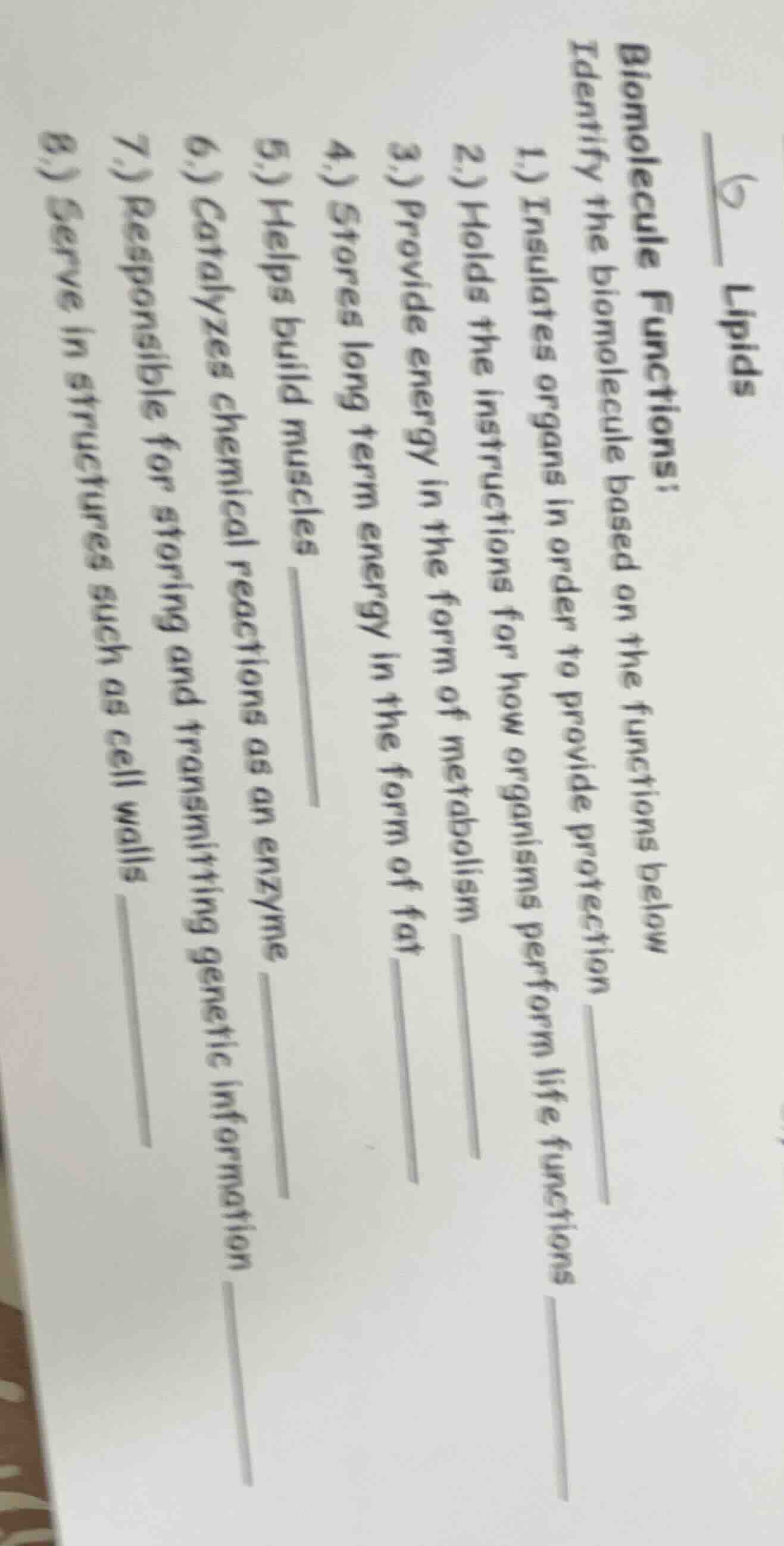
biomolecule functions:
identify the biomolecule based on the functions below
- insulates organs in order to provide protection
- holds the instructions for how organisms perform life functions
- provide energy in the form of metabolism
- stores long term energy in the form of fat
- helps build muscles
- catalyzes chemical reactions as an enzyme
- responsible for storing and transmiting genetic information
- serve in structures such as cell walls
To solve this, we match each function to the correct biomolecule (Lipids, Carbohydrates, Proteins, Nucleic Acids, or others) based on their known roles:
1) Insulates organs for protection
Lipids (like fats) insulate organs.
2) Holds instructions for life functions
Nucleic Acids (DNA/RNA) store genetic instructions.
3) Provide energy (metabolism)
Carbohydrates (e.g., glucose) are quick energy sources.
4) Stores long - term energy (fat)
Lipids (triglycerides) store long - term energy.
5) Helps build muscles
Proteins (muscle is made of protein) build muscles.
6) Catalyzes reactions (enzyme)
Proteins (enzymes are proteins) catalyze reactions.
7) Stores/transmits genetic info
Nucleic Acids (DNA/RNA) store and transmit genetic info.
8) Structural role (cell walls)
Carbohydrates (e.g., cellulose in plant cell walls) or Lipids (cell membrane structure) – for cell walls, Carbohydrates (cellulose) is key, but if considering cell membrane (a structure), Lipids (phospholipids) too. However, for “cell walls” (plant), Carbohydrates (cellulose) is correct.

Snap & solve any problem in the app
Get step-by-step solutions on Sovi AI
Photo-based solutions with guided steps
Explore more problems and detailed explanations
s:
- Lipids
- Nucleic Acids
- Carbohydrates
- Lipids
- Proteins
- Proteins
- Nucleic Acids
- Carbohydrates (or Lipids if cell membrane - but cell walls → Carbohydrates)