QUESTION IMAGE
Question
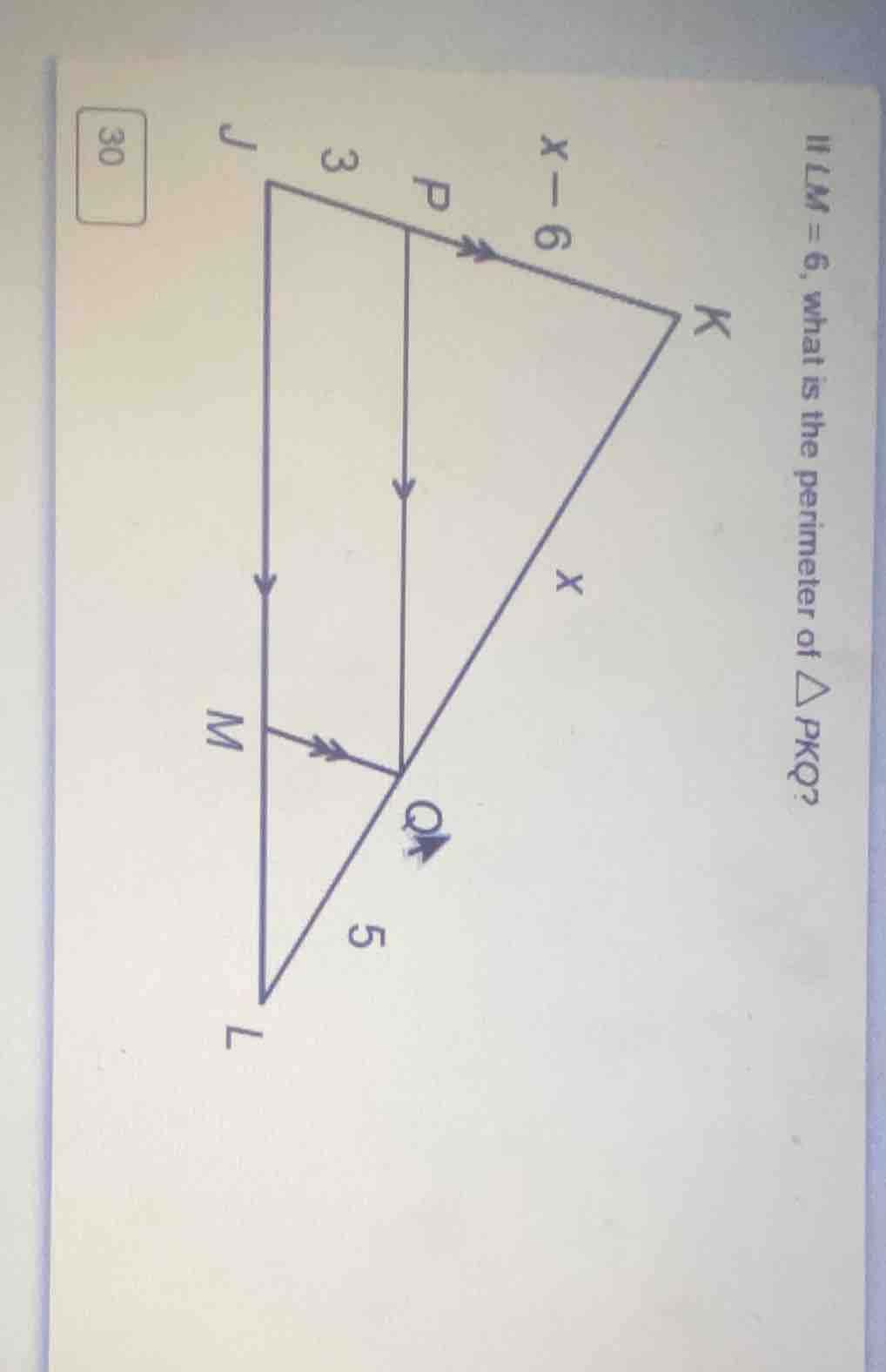
if lm = 6, what is the perimeter of △pkq? (there is a triangle diagram with segments labeled: jp = 3, pk = x - 6, kq = x, ql = 5, and some parallel arrows indicating similar triangles or parallel lines.)
Step 1: Identify Similar Triangles
From the diagram, we can see that \(\triangle PKQ \sim \triangle LK J\) (by the Basic Proportionality Theorem or AA similarity, as the lines are parallel, creating corresponding angles equal). For similar triangles, the ratios of corresponding sides are equal. So, \(\frac{PK}{LK}=\frac{PQ}{LM}=\frac{KQ}{KJ}\)? Wait, no, let's check the sides. Wait, the segments: \(JP = 3\), \(PK=x - 6\), \(LQ = 5\), \(QK=x\)? Wait, maybe the ratio of the sides: Let's assume that \(\triangle LMQ\) and \(\triangle JPQ\) or wait, the key is that the lines are parallel, so the triangles are similar. Let's take the ratio of the sides. Let's see, the side \(LM = 6\), and the corresponding side (since \(PQ\) is parallel to \(LM\))—wait, maybe the ratio of the segments on the sides. Let's look at the sides \(KJ\) and \(LJ\)? Wait, maybe the ratio of \(PK\) to \(LK\) is equal to the ratio of \(PQ\) to \(LM\). Wait, \(PK=x - 6\), \(LK=(x - 6)+x\)? No, maybe the sides: Let's see, the length from \(K\) to \(Q\) is \(x\), and from \(Q\) to \(L\) is \(5\), so \(KL=x + 5\). From \(K\) to \(P\) is \(x - 6\), and from \(P\) to \(J\) is \(3\), so \(KJ=(x - 6)+3=x - 3\). Wait, no, maybe the triangles \(\triangle PKQ\) and \(\triangle LK M\) (wait, the diagram has \(J\), \(M\), \(L\), \(K\), \(P\), \(Q\)). Let's re - examine: \(JP = 3\), \(PK=x - 6\), \(LM = 6\), \(LQ = 5\), \(QK=x\). Since \(PQ\parallel LM\), \(\triangle PKQ\sim\triangle LK M\) (by AA similarity, as \(\angle K\) is common and \(\angle KPQ=\angle KLM\) because \(PQ\parallel LM\), corresponding angles). So the ratio of sides: \(\frac{PK}{LK}=\frac{PQ}{LM}=\frac{KQ}{KJ}\). Wait, \(LK=PK + PL\)? No, \(LK=KQ+QL=x + 5\), \(KJ=KP+PJ=(x - 6)+3=x - 3\). Wait, maybe the ratio of \(KQ\) to \(KJ\) is equal to the ratio of \(QL\) to \(JP\)? Wait, \(QL = 5\), \(JP = 3\), \(KQ=x\), \(KJ=(x - 6)+3=x - 3\). No, that doesn't seem right. Wait, maybe the ratio of the segments on the two sides: \(\frac{KP}{KJ}=\frac{KQ}{KL}\)? Wait, \(KJ=JP + PK=3+(x - 6)=x - 3\), \(KL=KQ+QL=x + 5\), \(PK=x - 6\), \(KQ=x\). And since \(\triangle PKQ\sim\triangle LKJ\) (wait, \(PQ\parallel LJ\)? Wait, \(LM\) is parallel to \(PQ\), so \(PQ\parallel LM\), so \(\triangle PKQ\sim\triangle LK M\) with \(LM = 6\), \(PQ\) is a side of \(\triangle PKQ\), and the ratio of sides: \(\frac{PK}{LK}=\frac{PQ}{LM}\). Wait, \(LK=KQ+QL=x + 5\), \(PK=x - 6\), \(LM = 6\), and \(PQ\) is equal to \(LM\) scaled? Wait, no, maybe the ratio of the segments: \(\frac{KP}{PJ}=\frac{KQ}{QL}\). Let's try that. \(KP=x - 6\), \(PJ = 3\), \(KQ=x\), \(QL = 5\). So \(\frac{x - 6}{3}=\frac{x}{5}\) (because of the parallel lines, the segments are proportional, by the Basic Proportionality Theorem or the property of similar triangles formed by parallel lines). Cross - multiply: \(5(x - 6)=3x\).
Step 2: Solve for \(x\)
Expand the left - hand side: \(5x-30 = 3x\).
Subtract \(3x\) from both sides: \(5x-3x-30=3x - 3x\), which gives \(2x-30 = 0\).
Add 30 to both sides: \(2x=30\).
Divide both sides by 2: \(x = 15\).
Step 3: Find the lengths of the sides of \(\triangle PKQ\)
- Length of \(PK\): \(x - 6=15 - 6 = 9\)
- Length of \(KQ\): \(x = 15\)
- Length of \(PQ\): Since \(\triangle PKQ\sim\triangle LK M\) and the ratio of sides \(\frac{PK}{LK}=\frac{PQ}{LM}\), first find \(LK=KQ+QL=15 + 5=20\), \(\frac{PK}{LK}=\frac{9}{20}\), but wait, we can also use the ratio from the proportionality \(\frac{x - 6}{x}=\frac{PQ}{LM}\)? Wait, no, earlier we had \(\frac{KP}{KJ}=\frac{KQ}{KL}\), but we found \(x = 15\) from \(\frac{x - 6}{3}=\frac{x}{5}\) (wh…

Snap & solve any problem in the app
Get step-by-step solutions on Sovi AI
Photo-based solutions with guided steps
Explore more problems and detailed explanations
\(\boxed{30}\)