QUESTION IMAGE
Question
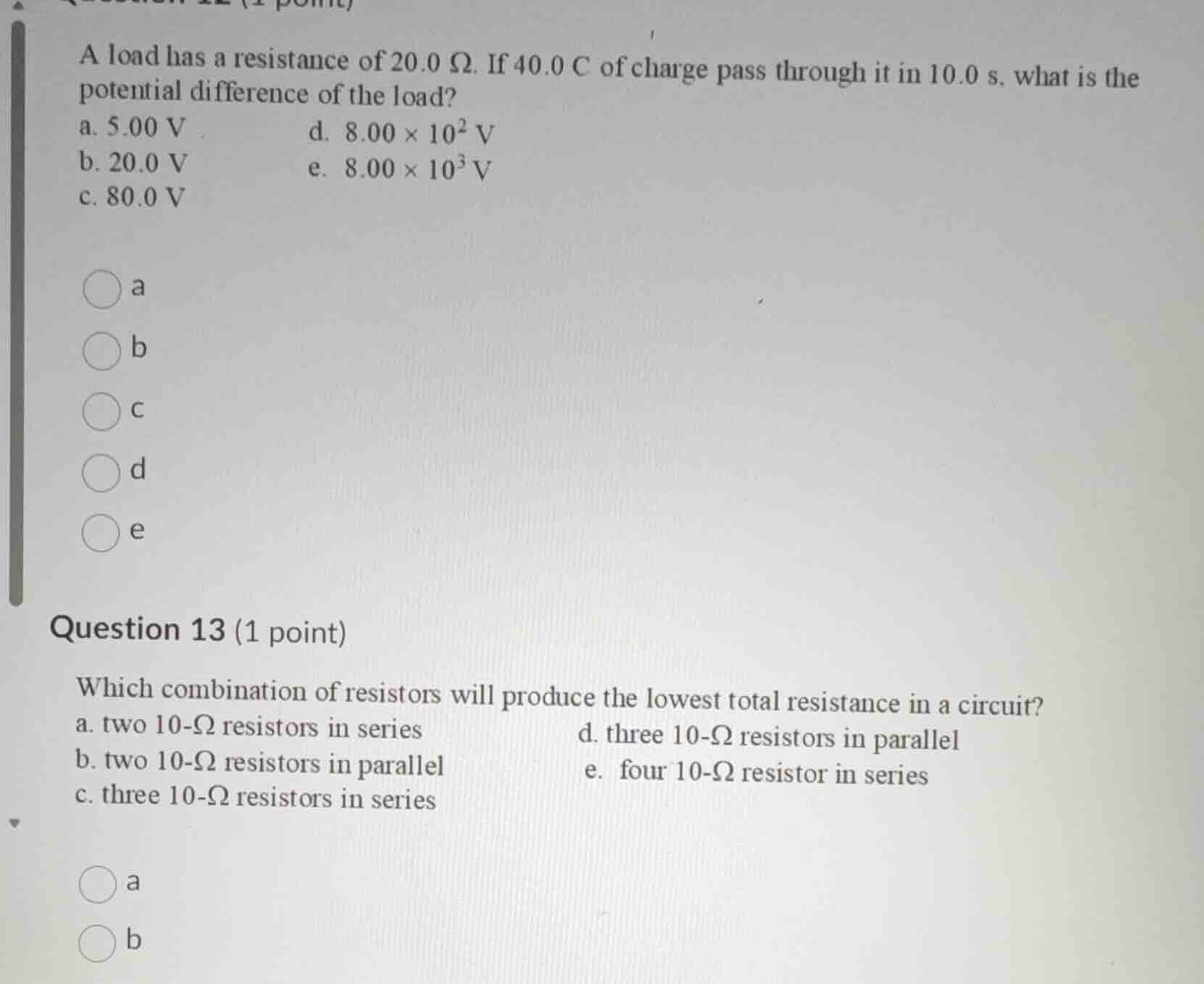
a load has a resistance of 20.0 ω. if 40.0 c of charge pass through it in 10.0 s, what is the potential difference of the load?
a. 5.00 v \td. 8.00 × 10² v
b. 20.0 v \te. 8.00 × 10³ v
c. 80.0 v
question 13 (1 point)
which combination of resistors will produce the lowest total resistance in a circuit?
a. two 10-ω resistors in series \td. three 10-ω resistors in parallel
b. two 10-ω resistors in parallel \te. four 10-ω resistor in series
c. three 10-ω resistors in series
Question 12
Step1: Calculate current (I)
Current \( I \) is charge \( Q \) over time \( t \), so \( I = \frac{Q}{t} \). Given \( Q = 40.0 \, \text{C} \), \( t = 10.0 \, \text{s} \), so \( I = \frac{40.0}{10.0} = 4.00 \, \text{A} \).
Step2: Calculate potential difference (V)
Using Ohm's Law \( V = IR \), where \( R = 20.0 \, \Omega \), \( I = 4.00 \, \text{A} \). So \( V = 4.00 \times 20.0 = 80.0 \, \text{V} \).
- Series resistance: \( R_{\text{series}} = R_1 + R_2 + \dots \)
- Parallel resistance: \( \frac{1}{R_{\text{parallel}}} = \frac{1}{R_1} + \frac{1}{R_2} + \dots \)
- Option a: \( 10 + 10 = 20 \, \Omega \)
- Option b: \( \frac{1}{R} = \frac{1}{10} + \frac{1}{10} = \frac{2}{10} \), \( R = 5 \, \Omega \)
- Option c: \( 10 + 10 + 10 = 30 \, \Omega \)
- Option d: \( \frac{1}{R} = \frac{1}{10} + \frac{1}{10} + \frac{1}{10} = \frac{3}{10} \), \( R \approx 3.33 \, \Omega \)
- Option e: \( 10 + 10 + 10 + 10 = 40 \, \Omega \)
- Lowest is option d.

Snap & solve any problem in the app
Get step-by-step solutions on Sovi AI
Photo-based solutions with guided steps
Explore more problems and detailed explanations
c. 80.0 V