QUESTION IMAGE
Question
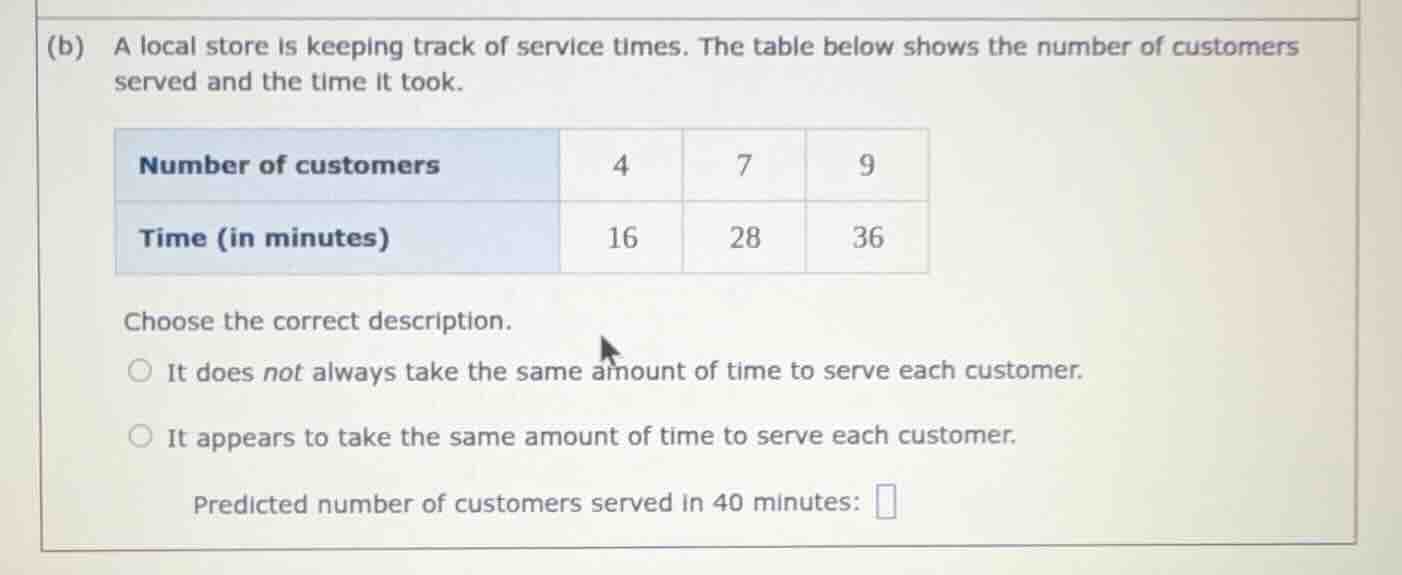
(b) a local store is keeping track of service times. the table below shows the number of customers served and the time it took.
| number of customers | 4 | 7 | 9 |
|---|
choose the correct description.
- it does not always take the same amount of time to serve each customer.
- it appears to take the same amount of time to serve each customer.
predicted number of customers served in 40 minutes: \\(\square\\)
Part 1: Choosing the correct description
To determine if the time per customer is constant, we calculate the time per customer for each data point. For 4 customers and 16 minutes, the time per customer is \( \frac{16}{4} = 4 \) minutes. For 7 customers and 28 minutes, it is \( \frac{28}{7} = 4 \) minutes. For 9 customers and 36 minutes, it is \( \frac{36}{9} = 4 \) minutes. Since the time per customer is 4 minutes in all cases, it appears to take the same amount of time to serve each customer.
Step 1: Identify the time per customer
From the previous calculation, we know that the time taken to serve each customer is 4 minutes (since \( \frac{\text{Time}}{\text{Number of customers}} = 4 \) for all given data points).
Step 2: Calculate the number of customers in 40 minutes
Let \( n \) be the number of customers. We know that the time per customer is 4 minutes, so the total time (40 minutes) is equal to the time per customer multiplied by the number of customers. Mathematically, this is \( 40 = 4 \times n \).
To find \( n \), we solve for \( n \) by dividing both sides of the equation by 4: \( n=\frac{40}{4} \).
Step 3: Solve for \( n \)
\( \frac{40}{4}=10 \).

Snap & solve any problem in the app
Get step-by-step solutions on Sovi AI
Photo-based solutions with guided steps
Explore more problems and detailed explanations
It appears to take the same amount of time to serve each customer.