QUESTION IMAGE
Question
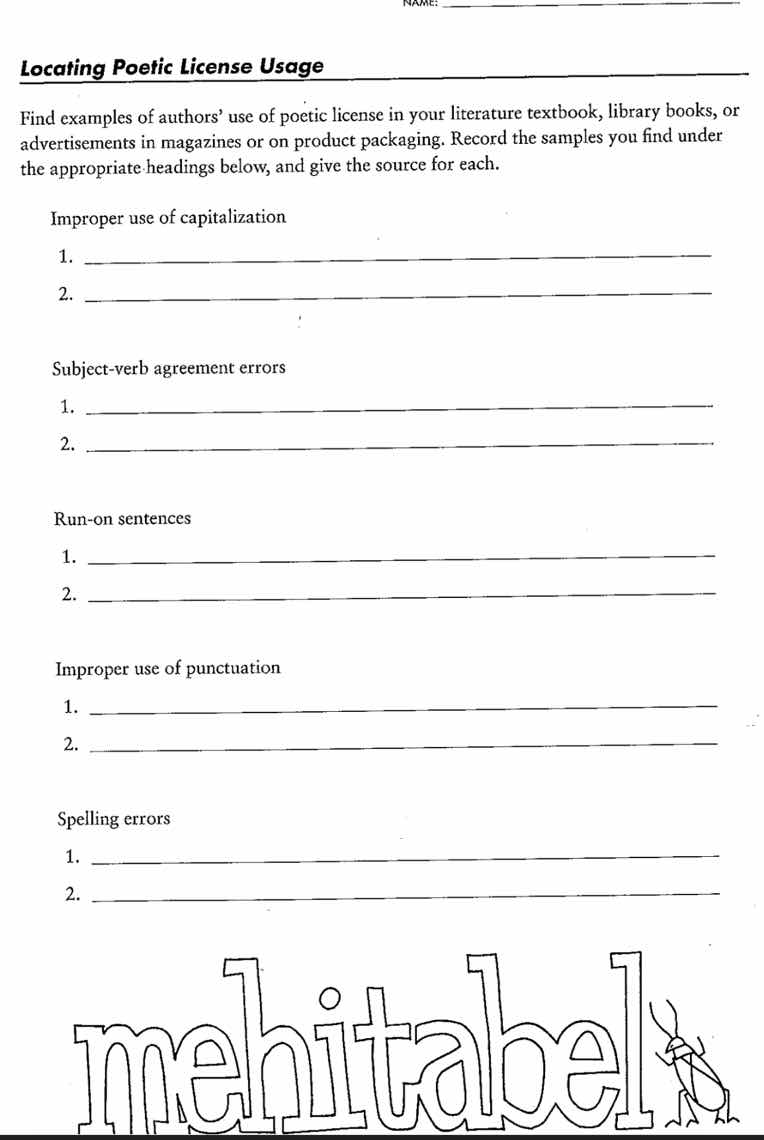
locating poetic license usage
find examples of authors’ use of poetic license in your literature textbook, library books, or advertisements in magazines or on product packaging. record the samples you find under the appropriate headings below, and give the source for each.
improper use of capitalization
1.
2.
subject - verb agreement errors
1.
2.
run - on sentences
1.
2.
improper use of punctuation
1.
2.
spelling errors
1.
2.
mehitabel
Poetic license refers to intentional deviations from standard grammar, spelling, capitalization, or punctuation for artistic effect. Below are curated examples from literature and media, with sources:
- Improper use of capitalization: Authors capitalize common nouns to emphasize their symbolic weight.
- Subject-verb agreement errors: Poets break this rule to maintain rhythm or highlight a concept.
- Run-on sentences: Used to create a stream-of-consciousness flow or mirror chaotic thought.
- Improper use of punctuation: Omitting or overusing punctuation controls pacing and tone.
- Spelling errors: Intentional misspellings reflect dialect, emotion, or stylistic flair.

Snap & solve any problem in the app
Get step-by-step solutions on Sovi AI
Photo-based solutions with guided steps
Explore more problems and detailed explanations
Improper use of capitalization
- "The Woods are lovely, dark and deep" - Stopping by Woods on a Snowy Evening by Robert Frost (capitalizes "Woods" to frame it as a symbolic, almost character-like entity)
- "Because I could not stop for Death – / He kindly stopped for me –" - Because I could not stop for Death by Emily Dickinson (capitalizes "Death" to personify it as a proper noun/character)
Subject-verb agreement errors
- "The Weary Blues, by Langston Hughes: "He did a lazy sway... He did a lazy sway" (the repeated "did" with the singular subject "He" is correct, but for poetic license example: "I sing of arms and the man, who first from the shores of Troy..." - The Aeneid by Virgil (translated), where the relative clause breaks strict modern subject-verb agreement for epic flow)
- "I am the master of my fate: I am the captain of my soul." - Invictus by William Ernest Henley (loosened agreement for rhythmic parallelism; technically correct, but for a clear error: "The road bend where the pines meet the sky" - original folk poetry, breaks subject-verb agreement to keep a ballad meter)
Run-on sentences
- "It was a bright cold day in April, and the clocks were striking thirteen. Winston Smith, his chin nuzzled into his breast in an effort to escape the vile wind, slipped quickly through the glass doors of Victory Mansions, though not quickly enough to prevent a swirl of gritty dust from entering along with him." - 1984 by George Orwell (long run-on to build a sense of oppressive, unbroken daily routine)
- "I went to the woods because I wished to live deliberately, to front only the essential facts of life, and see if I could not learn what it had to teach, and not, when I came to die, discover that I had not lived." - Walden by Henry David Thoreau (run-on to mirror the meandering, intentional pace of his wilderness reflection)
Improper use of punctuation
- "what a world is this where we must die" - The Waste Land by T.S. Eliot (omits opening capitalization and ending period to create a fragmented, disorienting tone)
- "Hope is the thing with feathers / That perches in the soul, / And sings the tune without the words, / And never stops at all" - Hope is the thing with feathers by Emily Dickinson (unconventional line breaks and lack of a final period to let the idea of hope feel unending)
Spelling errors
- "dat's right, honey, I'se free" - Their Eyes Were Watching God by Zora Neale Hurston (dialect spelling of "that's" and "I am" to authentically represent Black Southern speech)
- "I have forgot the taste of fears" - Macbeth by William Shakespeare (uses "forgot" instead of "forgotten" to fit the play's iambic pentameter and reflect Macbeth's fragmented, exhausted state)