QUESTION IMAGE
Question
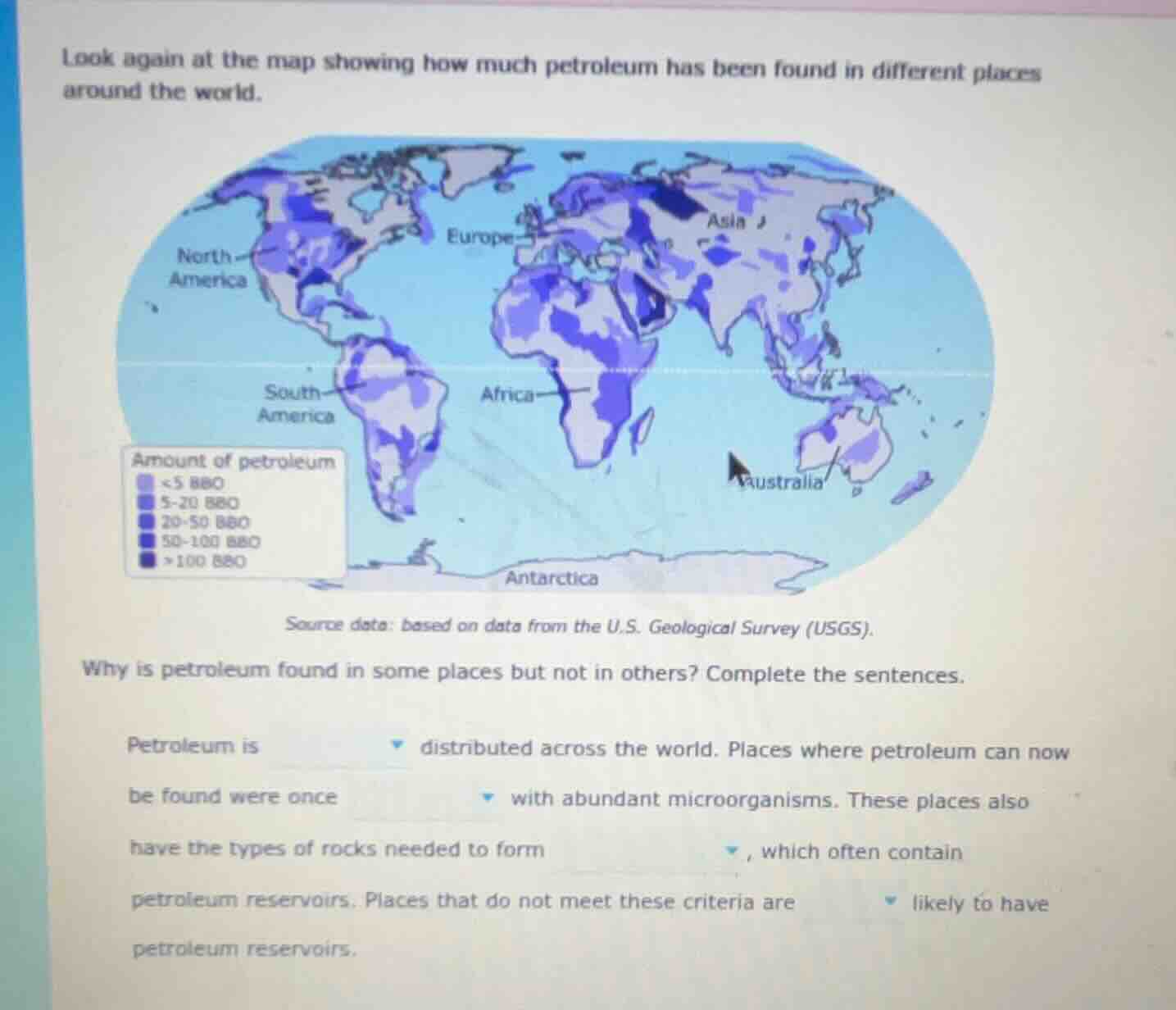
look again at the map showing how much petroleum has been found in different places around the world.
source data: based on data from the u.s. geological survey (usgs).
why is petroleum found in some places but not in others? complete the sentences.
petroleum is distributed across the world. places where petroleum can now be found were once with abundant microorganisms. these places also have the types of rocks needed to form, which often contain petroleum reservoirs. places that do not meet these criteria are likely to have petroleum reservoirs.
- For the first blank: From the map, petroleum amounts vary across regions, so it's "unevenly" distributed.
- For the second blank: Petroleum forms from organic matter (microorganisms) in ancient marine environments or sedimentary basins, so places with petroleum were once "sedimentary basins" or "environments" with abundant microorganisms (more precisely, areas with sedimentary deposits where organic matter accumulated, like ancient seas or swamps—so "covered by water" or "sedimentary environments" but the key here is the geological context; the correct term related to the origin is that these places were once environments with abundant organic matter, often in sedimentary settings, so "sedimentary basins" or "areas with sedimentation"—but the standard answer for this part is that petroleum forms from the remains of organisms in sedimentary environments, so the places were once "sedimentary basins" or "environments with sedimentation"—but the first part of the sentence: "Places where petroleum can now be found were once __ with abundant microorganisms." The correct fill is "sedimentary environments" or more simply, "areas" or "regions" but the key geological concept is that petroleum forms in sedimentary rocks, which form from sediments (like in ancient seas, lakes, etc.) where microorganisms lived. So the first blank in the sentence structure: "Petroleum is [unevenly] distributed across the world. Places where petroleum can now be found were once [sedimentary basins/environments] with abundant microorganisms. These places also have the types of rocks needed to form [reservoirs] (or more precisely, "traps" but the next part says "which often contain petroleum reservoirs"—so the rocks form "traps" or "reservoirs"? Wait, the sentence: "These places also have the types of rocks needed to form , which often contain petroleum reservoirs." So the rocks form "traps" (structural or stratigraphic traps) that hold the petroleum, but the blank is before "which often contain...", so the correct term is "reservoirs" or "traps"? Wait, no—petroleum reservoirs are formed by rocks (porous and permeable) and a cap rock (impermeable) to trap it. So the rocks needed to form "reservoirs" (the porous rock is the reservoir rock, and the cap rock is the trap). But the sentence structure: "These places also have the types of rocks needed to form , which often contain petroleum reservoirs." So the is the "reservoir rocks" or "traps"? Wait, the next part says "which often contain petroleum reservoirs"—so the thing formed by the rocks is what contains the reservoirs? No, the reservoir is the rock that holds the oil. So the correct fill for the third blank is "reservoirs" (or "reservoir rocks"). Then the last blank: "Places that do not meet these criteria are [un]likely to have petroleum reservoirs." Wait, the sentence: "Places that do not meet these criteria are __ likely to have petroleum reservoirs." So the answer is "less" or "not"—but the options (if it's a dropdown) would have "unevenly", "sedimentary environments" (or "covered by water"), "reservoirs", "less".
Putting it all together:
- Petroleum is unevenly distributed across the world. (Because the map shows different amounts in different regions.)
- Places where petroleum can now be found were once sedimentary environments (or "covered by water", "areas with sedimentation") with abundant microorganisms. (Petroleum forms from the remains of organisms in sedimentary rocks, which form in environments where sediment accumulates, like ancient seas, lakes, swamps—these have ab…

Snap & solve any problem in the app
Get step-by-step solutions on Sovi AI
Photo-based solutions with guided steps
Explore more problems and detailed explanations
- Petroleum is \boxed{unevenly} distributed across the world.
- Places where petroleum can now be found were once \boxed{sedimentary environments} (or "covered by water", "areas with sedimentation") with abundant microorganisms.
- These places also have the types of rocks needed to form \boxed{reservoirs}, which often contain petroleum reservoirs.
- Places that do not meet these criteria are \boxed{less} likely to have petroleum reservoirs.
(Note: If the blanks are dropdowns with specific options, adjust accordingly. The above is based on geological principles of petroleum formation: uneven distribution due to geological processes, formation in sedimentary environments with organic matter, reservoir rocks (or traps) to hold the oil, and lack of these conditions making presence less likely.)