QUESTION IMAGE
Question
look at this diagram:
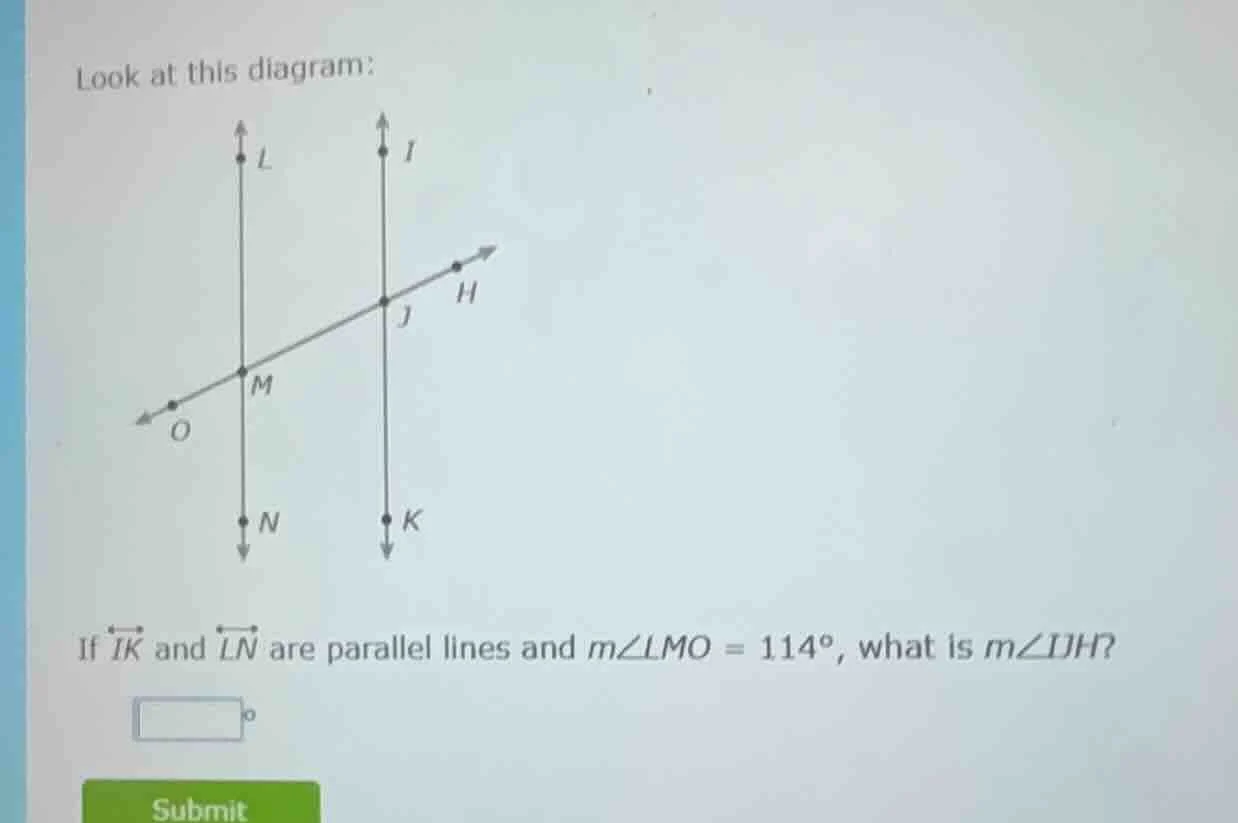
diagram with lines ln, ik (parallel), and transversal oh intersecting at m (on ln) and j (on ik); points l, n on ln; i, k on ik; o, m, j, h on oh
if \\(\overleftrightarrow{ik}\\) and \\(\overleftrightarrow{ln}\\) are parallel lines and \\(m\angle lmo = 114^\circ\\), what is \\(m\angle ijh\\)?
box for answer\\(^\circ\\)
submit
Step1: Identify supplementary angle
$\angle LMO$ and $\angle LMH$ are supplementary, so $m\angle LMH = 180^\circ - m\angle LMO$
$m\angle LMH = 180^\circ - 114^\circ = 66^\circ$
Step2: Use parallel lines property
Since $\overleftrightarrow{IK} \parallel \overleftrightarrow{LN}$, $\angle IJH$ and $\angle LMH$ are corresponding angles, so they are congruent.
$m\angle IJH = m\angle LMH$

Snap & solve any problem in the app
Get step-by-step solutions on Sovi AI
Photo-based solutions with guided steps
Explore more problems and detailed explanations
$66^\circ$