QUESTION IMAGE
Question
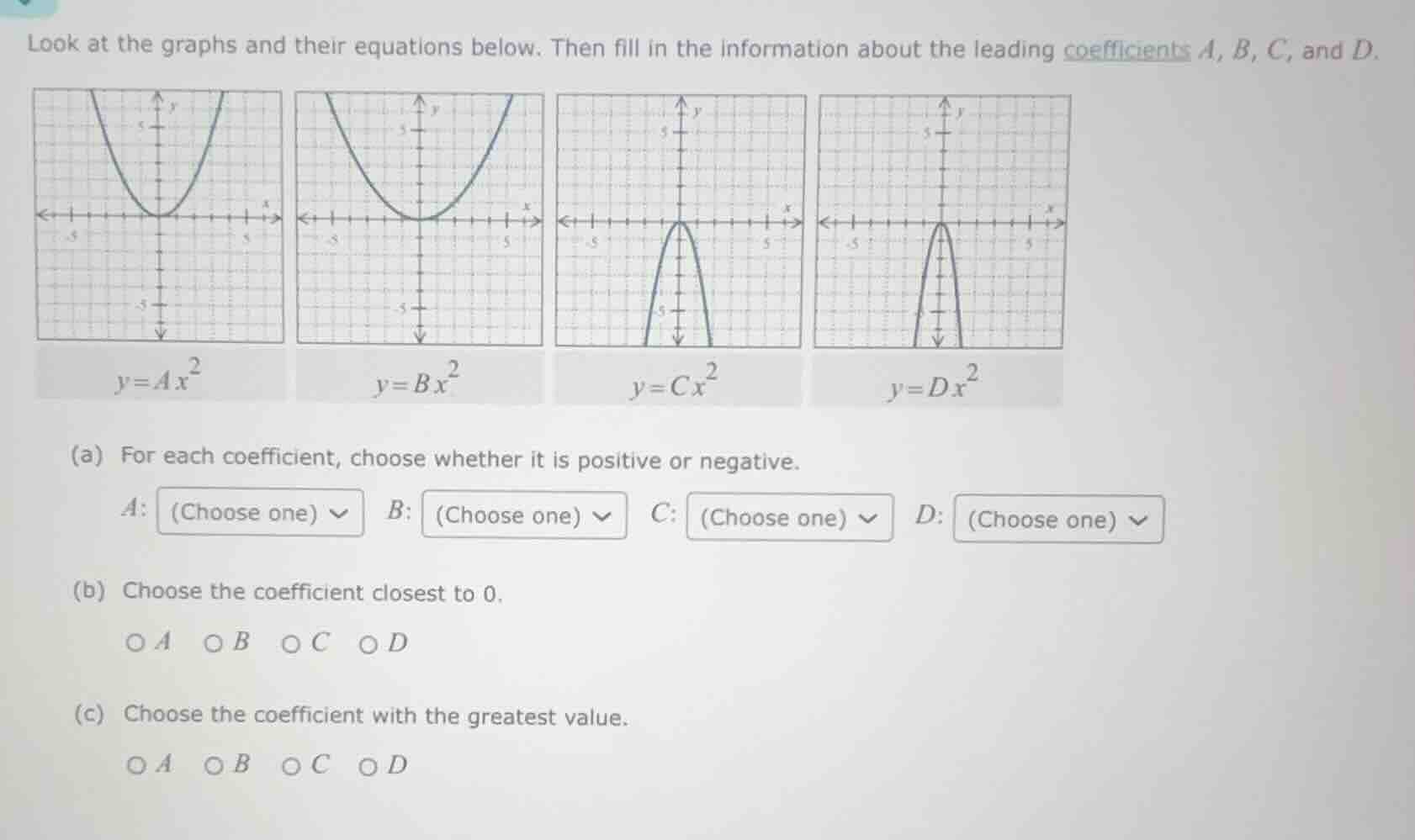
look at the graphs and their equations below. then fill in the information about the leading coefficients a, b, c, and d.
y = a x²
y = b x²
y = c x²
y = d x²
(a) for each coefficient, choose whether it is positive or negative.
a: (choose one) b: (choose one) c: (choose one) d: (choose one)
(b) choose the coefficient closest to 0.
a b c d
(c) choose the coefficient with the greatest value.
a b c d
Part (a)
To determine the sign of the leading coefficient for a quadratic function \( y = ax^2 \):
- If the parabola opens upward, the coefficient \( a \) is positive.
- If the parabola opens downward, the coefficient \( a \) is negative.
- For \( y = Ax^2 \): The parabola opens upward, so \( A \) is positive.
- For \( y = Bx^2 \): The parabola opens upward, so \( B \) is positive.
- For \( y = Cx^2 \): The parabola opens downward, so \( C \) is negative.
- For \( y = Dx^2 \): The parabola opens downward, so \( D \) is negative.
Part (b)
The coefficient closest to 0 is the one whose parabola is the widest (since a coefficient with a smaller absolute value makes the parabola wider). Among the upward - opening parabolas (\( A \) and \( B \)) and downward - opening parabolas (\( C \) and \( D \)):
- The parabola \( y = Bx^2 \) is wider than \( y = Ax^2 \), and the parabola \( y = Dx^2 \) is narrower than \( y = Cx^2 \). But when comparing the absolute values, the wider the parabola, the smaller the absolute value of the coefficient. Among all four, \( B \) (since its parabola is the widest among the upward - opening ones and wider than the downward - opening ones in terms of the "width" relative to the others) has the smallest absolute value, so it is closest to 0.
Part (c)
To find the coefficient with the greatest value:
- Positive coefficients are greater than negative coefficients. Among the positive coefficients \( A \) and \( B \), the parabola \( y = A x^2 \) is narrower than \( y=Bx^2 \). A narrower parabola (for upward - opening) has a larger positive coefficient. So \( A \) has a larger value than \( B \). Among the negative coefficients \( C \) and \( D \), they are negative, so they are less than the positive coefficients. So \( A \) has the greatest value.

Snap & solve any problem in the app
Get step-by-step solutions on Sovi AI
Photo-based solutions with guided steps
Explore more problems and detailed explanations
s
(a)
- \( A \): Positive
- \( B \): Positive
- \( C \): Negative
- \( D \): Negative
(b)
The coefficient closest to 0 is \( B \).
(c)
The coefficient with the greatest value is \( A \).