QUESTION IMAGE
Question
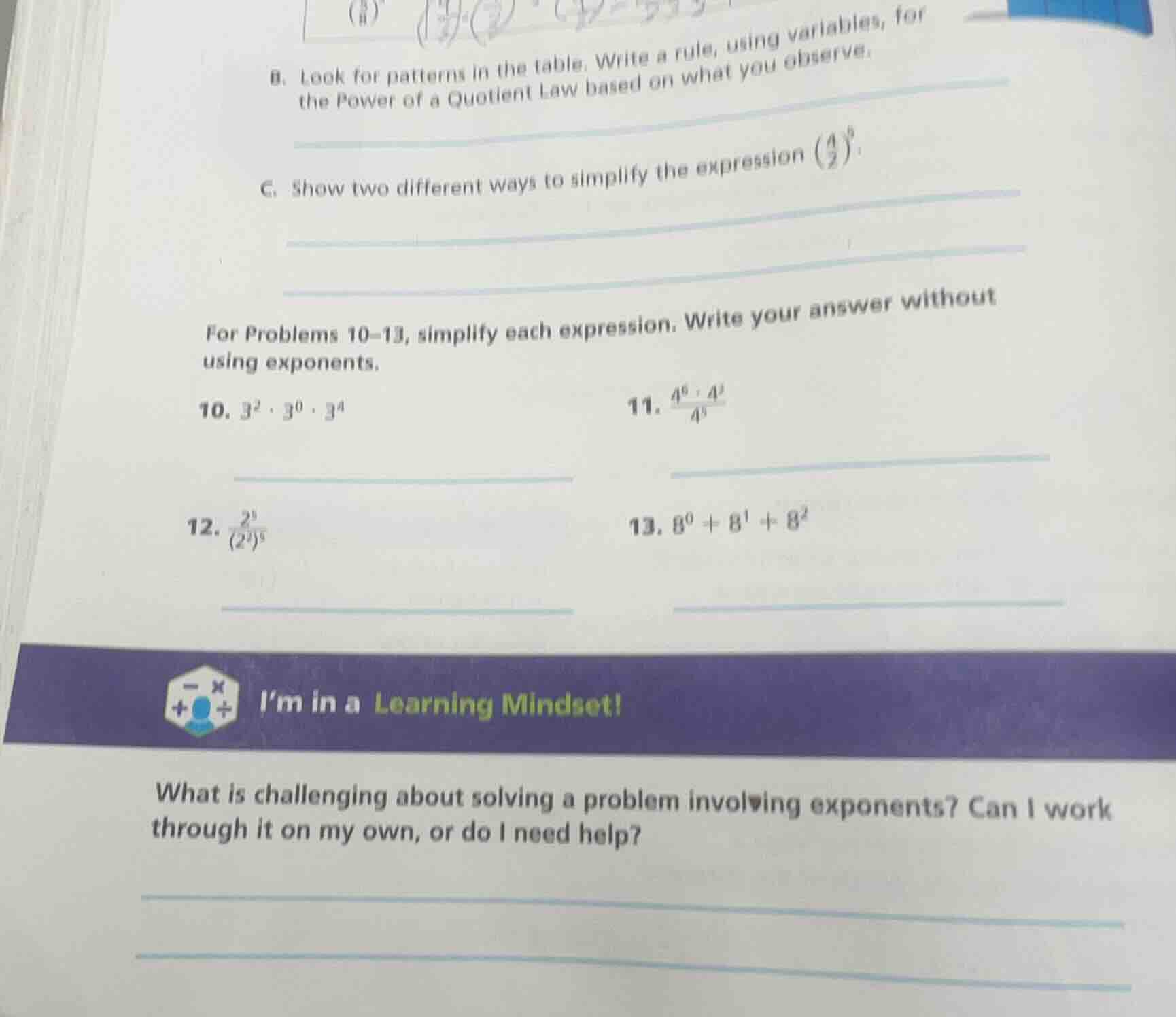
b. look for patterns in the table. write a rule, using variables, for the power of a quotient law based on what you observe.
c. show two different ways to simplify the expression $\left(\frac{4}{2}\
ight)^3$.
for problems 10–13, simplify each expression. write your answer without using exponents.
- $3^2 \cdot 3^0 \cdot 3^4$
- $\frac{4^6 \cdot 4^3}{4^5}$
- $\frac{2^9}{(2^3)^3}$
- $8^0 + 8^1 + 8^2$
i’m in a learning mindset!
what is challenging about solving a problem involving exponents? can i work through it on my own, or do i need help?
Problem 10:
Step1: Recall exponent rule for multiplication
When multiplying exponents with the same base, we add the exponents: \(a^m \cdot a^n = a^{m + n}\), and \(a^0=1\) (any non - zero number to the power of 0 is 1). So for \(3^{2}\cdot3^{0}\cdot3^{4}\), first, \(3^{0} = 1\), and then we use the multiplication rule.
\(3^{2}\cdot3^{0}\cdot3^{4}=3^{2 + 0+4}\)
Step2: Calculate the sum of exponents
\(2 + 0+4=6\), so \(3^{6}\). Now, calculate \(3^{6}=3\times3\times3\times3\times3\times3 = 729\)
Step1: Recall exponent rule for division and multiplication
For division of exponents with the same base, \(a^m\div a^n=a^{m - n}\), and for multiplication, \(a^m\cdot a^n=a^{m + n}\). First, handle the numerator \(4^{6}\cdot4^{3}\). Using the multiplication rule, \(4^{6}\cdot4^{3}=4^{6 + 3}=4^{9}\)
Step2: Divide by \(4^{5}\)
Now, divide \(4^{9}\) by \(4^{5}\). Using the division rule, \(4^{9}\div4^{5}=4^{9 - 5}=4^{4}\)
Step3: Calculate \(4^{4}\)
\(4^{4}=4\times4\times4\times4 = 256\)
Step1: Recall exponent rule for power of a power
The rule \((a^m)^n=a^{m\times n}\). So \((2^{3})^{5}=2^{3\times5}=2^{15}\)
Step2: Recall exponent rule for division
For division of exponents with the same base, \(a^m\div a^n=a^{m - n}\). So \(\frac{2^{9}}{2^{15}}=2^{9-15}\)
Step3: Calculate the exponent
\(9 - 15=- 6\), and \(2^{-6}=\frac{1}{2^{6}}\) (negative exponent rule: \(a^{-n}=\frac{1}{a^{n}}\)). Then \(2^{6}=64\), so \(\frac{1}{64}\)

Snap & solve any problem in the app
Get step-by-step solutions on Sovi AI
Photo-based solutions with guided steps
Explore more problems and detailed explanations
\(729\)