QUESTION IMAGE
Question
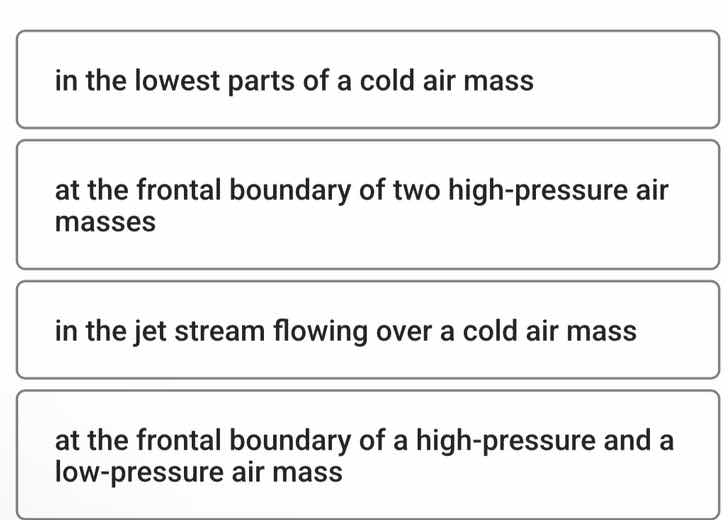
in the lowest parts of a cold air mass
at the frontal boundary of two high - pressure air masses
in the jet stream flowing over a cold air mass
at the frontal boundary of a high - pressure and a low - pressure air mass
Response
To determine where clouds and precipitation typically form, we analyze each option:
- "in the lowest parts of a cold air mass": Cold air is dense and stable, so it doesn’t typically rise to form clouds/precipitation here.
- "at the frontal boundary of two high - pressure air masses": High - pressure systems are associated with sinking air. Two high - pressure masses meeting don’t create the lifting needed for cloud/precipitation formation.
- "in the jet stream flowing over a cold air mass": The jet stream is a fast - moving air current at high altitudes, and it doesn’t directly cause the lifting of air necessary for typical cloud/precipitation formation related to frontal boundaries.
- "at the frontal boundary of a high - pressure and a low - pressure air mass": At a front between a high - pressure (sinking air) and low - pressure (rising air) system, the warmer, moister air from the low - pressure side is forced to rise over the colder, denser air from the high - pressure side. This rising air cools, condenses, and forms clouds and precipitation.

Snap & solve any problem in the app
Get step-by-step solutions on Sovi AI
Photo-based solutions with guided steps
Explore more problems and detailed explanations
at the frontal boundary of a high - pressure and a low - pressure air mass