QUESTION IMAGE
Question
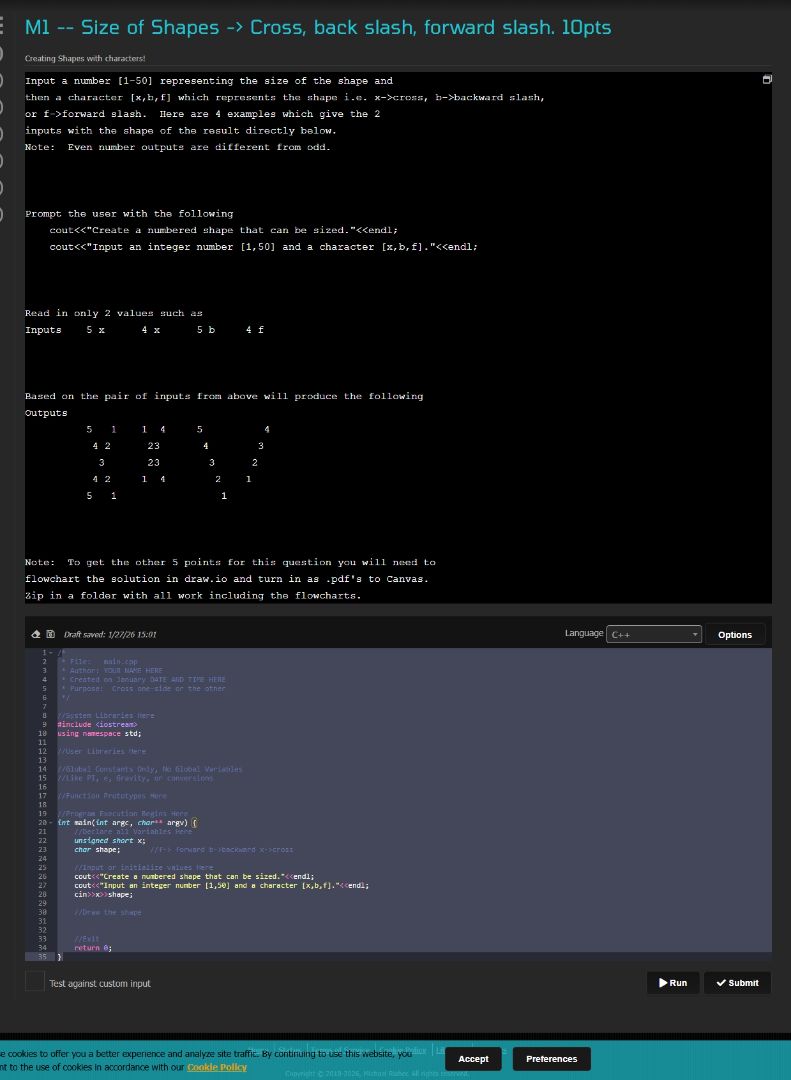
m1 -- size of shapes -> cross, back slash, forward slash. 10pts
creating shapes with characters!
input a number 1-50 representing the size of the shape and
then a character x,b,f which represents the shape i.e. x->cross, b->backward slash,
or f->forward slash. here are 4 examples which give the 2
inputs with the shape of the result directly below.
note: even number outputs are different from odds.
prompt the user with the following
cout<<\create a numbered shape that can be sized.\<<endl;
cout<<\input an integer number 1,50 and a character x,b,f.\<<endl;
read in only 2 values such as
inputs 5 x 4 x 5 b 4 f
based on the pair of inputs from above will produce the following
outputs
5 1 1 4 5 4
4 2 23 4 3
3 3 3 23 3 2
4 2 1 4 2 1
5 1 1
note: to get the other 5 points for this question you will need to
flowchart the solution in draw.io and turn in as .pdfs to canvas.
zip in a folder with all work including the flowcharts.
(the lower part is a programming interface with c++ code, including some code snippets like including headers, main function, input prompts, etc.)
To solve this problem, we need to generate different shapes (cross, backslash, forward slash) based on user input (a number between 1 - 50 and a character x, b, or f). The solution involves reading the input values, determining the shape type, and then generating the corresponding pattern.
Approach
- Input Reading: Read the integer (size) and the character (shape type) from the user.
- Shape Determination: Based on the character (
xfor cross,bfor backslash,ffor forward slash), generate the appropriate pattern. - Pattern Generation: For each shape, generate the pattern by iterating over rows and columns, determining which character to print at each position based on the current row and column indices.
Solution Code
#include <iostream>
#include <string>
using namespace std;

int main() {
    int size;
    char shape;
    cout << "Create a numbered shape that can be sized." << endl;
    cout << "Input an integer number [1,50] and a character [x,b,f]." << endl;
    cin >> size >> shape;

    for (int row = 1; row <= size; ++row) {
        for (int col = 1; col <= size; ++col) {
            if (shape == 'x') {
                // Cross shape: print number if row == col or row + col == size + 1, else space
                if (row == col || row + col == size + 1) {
                    cout << row;
                } else {
                    cout << " ";
                }
            } else if (shape == 'b') {
                // Backslash shape: print number if row + col == size + 1, else space
                if (row + col == size + 1) {
                    cout << row;
                } else {
                    cout << " ";
                }
            } else if (shape == 'f') {
                // Forward slash shape: print number if row == col, else space
                if (row == col) {
                    cout << row;
                } else {
                    cout << " ";
                }
            }
        }
        cout << endl;
    }

    return 0;
}- Input Reading: The code prompts the user to enter a size (integer between 1 and 50) and a shape character (
x,b, orf). These values are read usingcin. - Loop Through Rows and Columns: The outer loop iterates over each row from 1 to the input size. The inner loop iterates over each column from 1 to the input size.
- Cross Shape (
x): For each cell, if the row index equals the column index (diagonal from top-left to bottom-right) or the sum of the row and column indices equals the size + 1 (diagonal from top-right to bottom-left), print the row number. Otherwise, print a space. - Backslash Shape (
b): For each cell, if the sum of the row and column indices equals the size + 1 (diagonal from top-right to bottom-left), print the row number. Otherwise, print a space. - Forward Slash Shape (
f): For each cell, if the row index equals the column index (diagonal from top-left to bottom-right), print the row number. Otherwise, print a space. - Output Each Row: After processing all columns in a row, a new line is printed to move to the next row.
This approach ensures that the correct pattern is generated based on the input size and shape character. The code efficiently generates the required shapes by leveraging nested loops and conditional checks to determine which character (or space) to print at each position.

Snap & solve any problem in the app
Get step-by-step solutions on Sovi AI
Photo-based solutions with guided steps
Explore more problems and detailed explanations
- Input Reading: The code prompts the user to enter a size (integer between 1 and 50) and a shape character (
x,b, orf). These values are read usingcin. - Loop Through Rows and Columns: The outer loop iterates over each row from 1 to the input size. The inner loop iterates over each column from 1 to the input size.
- Cross Shape (
x): For each cell, if the row index equals the column index (diagonal from top-left to bottom-right) or the sum of the row and column indices equals the size + 1 (diagonal from top-right to bottom-left), print the row number. Otherwise, print a space. - Backslash Shape (
b): For each cell, if the sum of the row and column indices equals the size + 1 (diagonal from top-right to bottom-left), print the row number. Otherwise, print a space. - Forward Slash Shape (
f): For each cell, if the row index equals the column index (diagonal from top-left to bottom-right), print the row number. Otherwise, print a space. - Output Each Row: After processing all columns in a row, a new line is printed to move to the next row.
This approach ensures that the correct pattern is generated based on the input size and shape character. The code efficiently generates the required shapes by leveraging nested loops and conditional checks to determine which character (or space) to print at each position.