QUESTION IMAGE
Question
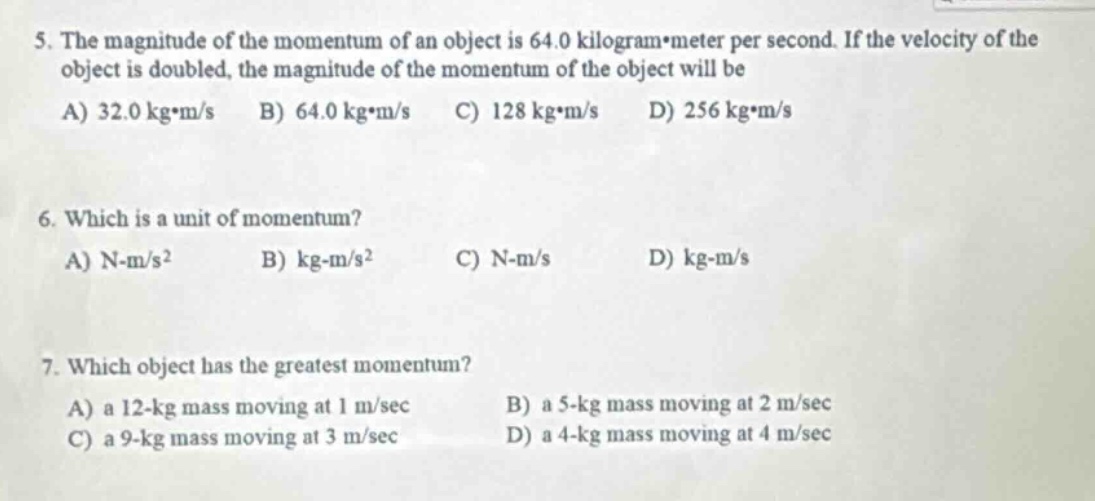
- the magnitude of the momentum of an object is 64.0 kilogram·meter per second. if the velocity of the object is doubled, the magnitude of the momentum of the object will be
a) 32.0 kg·m/s b) 64.0 kg·m/s c) 128 kg·m/s d) 256 kg·m/s
- which is a unit of momentum?
a) n·m/s² b) kg·m/s² c) n·m/s d) kg·m/s
- which object has the greatest momentum?
a) a 12-kg mass moving at 1 m/sec b) a 5-kg mass moving at 2 m/sec
c) a 9-kg mass moving at 3 m/sec d) a 4-kg mass moving at 4 m/sec
Question 5
Step1: Recall momentum formula
Momentum \( p = mv \), where \( m \) is mass and \( v \) is velocity.
Step2: Analyze effect of doubling velocity
Mass \( m \) is constant. If \( v' = 2v \), then new momentum \( p' = m(2v)=2(mv) \). Given \( mv = 64.0 \, \text{kg·m/s} \), so \( p' = 2\times64.0 = 128 \, \text{kg·m/s} \).
Momentum \( p = mv \). Unit of mass \( m \) is kg, unit of velocity \( v \) is m/s. So unit of momentum is \( \text{kg·m/s} \). Also, force \( F = ma \), unit of force is N (Newton), \( 1 \, \text{N} = 1 \, \text{kg·m/s}^2 \), but momentum unit is derived from \( mv \), so \( \text{kg·m/s} \) (option D) or also, since \( F = \frac{\Delta p}{\Delta t} \), \( \Delta p = F\Delta t \), unit of \( F\Delta t \) is \( \text{N·s} \), and \( 1 \, \text{N·s} = 1 \, \text{kg·m/s} \), but among options, D is \( \text{kg·m/s} \) which matches.
Step1: Recall momentum formula \( p = mv \)
Calculate momentum for each option:
- Option A: \( m = 12 \, \text{kg}, v = 1 \, \text{m/s} \), \( p = 12\times1 = 12 \, \text{kg·m/s} \)
- Option B: \( m = 5 \, \text{kg}, v = 2 \, \text{m/s} \), \( p = 5\times2 = 10 \, \text{kg·m/s} \)
- Option C: \( m = 9 \, \text{kg}, v = 3 \, \text{m/s} \), \( p = 9\times3 = 27 \, \text{kg·m/s} \)
- Option D: \( m = 4 \, \text{kg}, v = 4 \, \text{m/s} \), \( p = 4\times4 = 16 \, \text{kg·m/s} \)
Step2: Compare momenta
27 (option C) is greatest.

Snap & solve any problem in the app
Get step-by-step solutions on Sovi AI
Photo-based solutions with guided steps
Explore more problems and detailed explanations
C) 128 kg·m/s