QUESTION IMAGE
Question
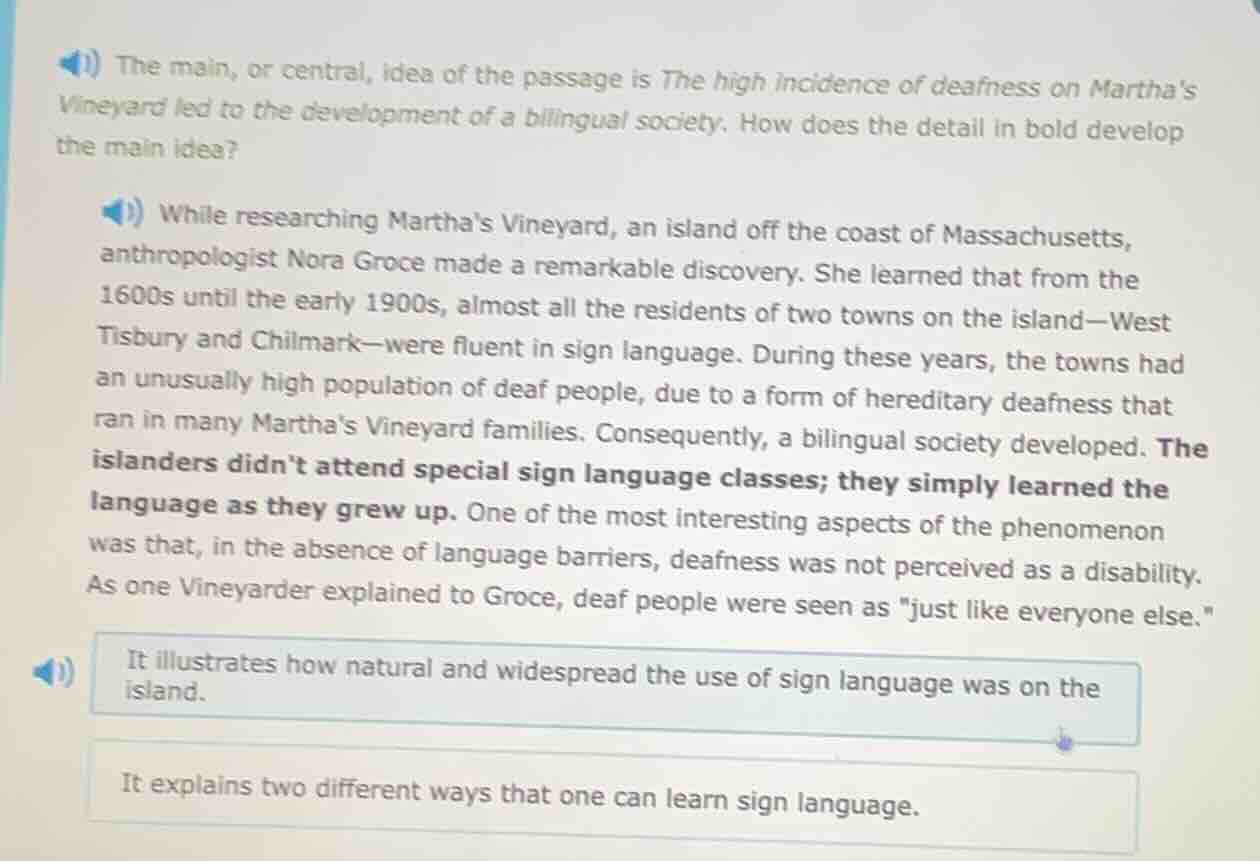
the main, or central, idea of the passage is the high incidence of deafness on marthas vineyard led to the development of a bilingual society. how does the detail in bold develop the main idea?
while researching marthas vineyard, an island off the coast of massachusetts, anthropologist nora groce made a remarkable discovery. she learned that from the 1600s until the early 1900s, almost all the residents of two towns on the island—west tisbury and chilmark—were fluent in sign language. during these years, the towns had an unusually high population of deaf people, due to a form of hereditary deafness that ran in many marthas vineyard families. consequently, a bilingual society developed. the islanders didnt attend special sign language classes; they simply learned the language as they grew up. one of the most interesting aspects of the phenomenon was that, in the absence of language barriers, deafness was not perceived as a disability. as one vineyarder explained to groce, deaf people were seen as \just like everyone else.\
it illustrates how natural and widespread the use of sign language was on the island.
it explains two different ways that one can learn sign language.
The bolded detail says islanders learned sign language as they grew up, not through special classes. This shows sign language use was natural (learned informally while growing up) and widespread (since almost all residents in two towns were fluent, implying it was common enough to be learned this way), which supports the main idea of a bilingual society developing due to high deafness. The other option is incorrect as it doesn't explain two ways; it explains one natural way of learning.

Snap & solve any problem in the app
Get step-by-step solutions on Sovi AI
Photo-based solutions with guided steps
Explore more problems and detailed explanations
It illustrates how natural and widespread the use of sign language was on the island.