QUESTION IMAGE
Question
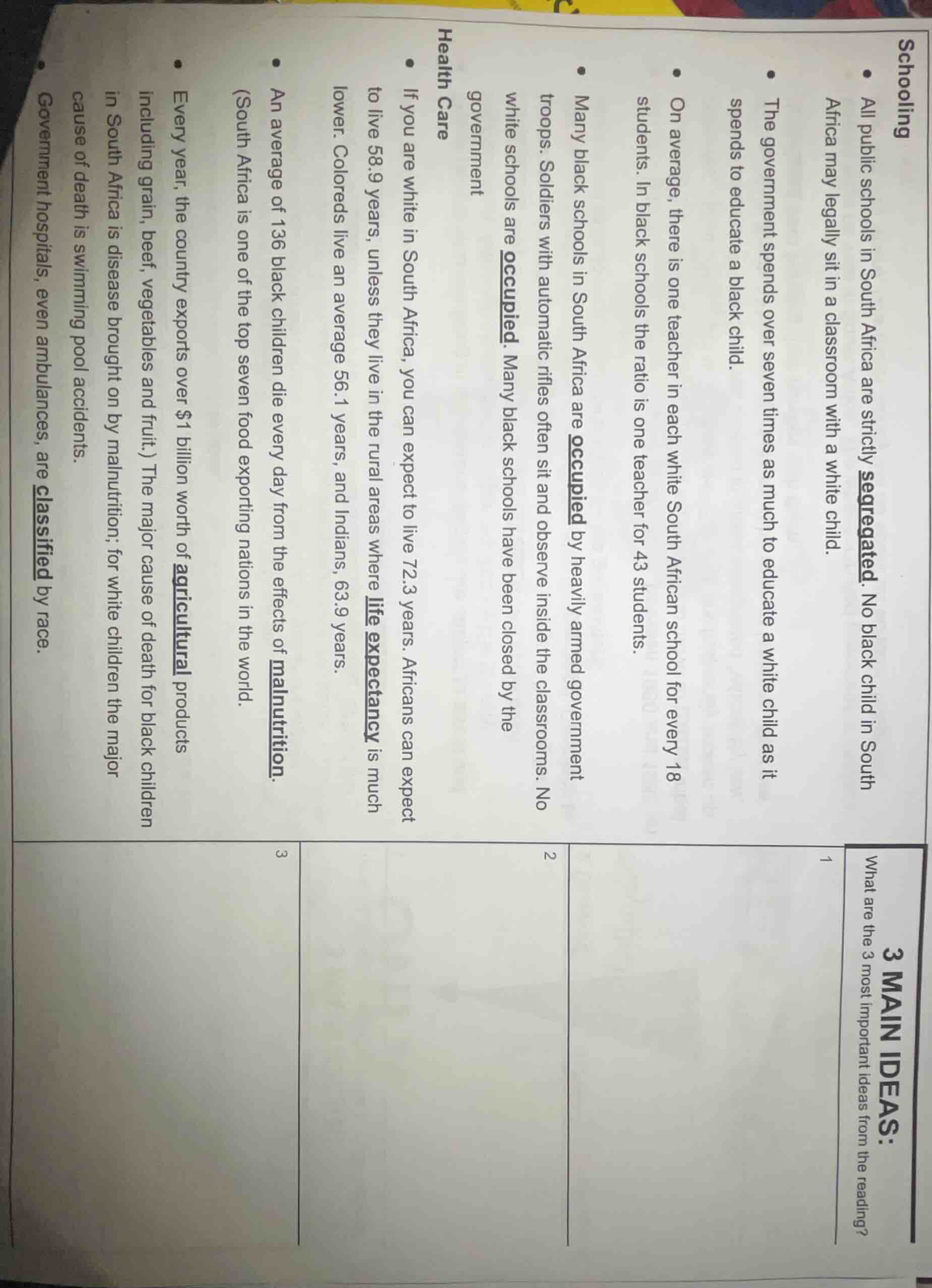
3 main ideas:
what are the 3 most important ideas from the reading?
1
schooling
- all public schools in south africa are strictly segregated. no black child in south africa may legally sit in a classroom with a white child.
- the government spends over seven times as much to educate a white child as it spends to educate a black child.
- on average, there is one teacher in each white south african school for every 18 students. in black schools the ratio is one teacher for 43 students.
- many black schools in south africa are occupied by heavily armed government troops. soldiers with automatic rifles often sit and observe inside the classrooms. no white schools are occupied. many black schools have been closed by the government
2
health care
- if you are white in south africa, you can expect to live 72.3 years. africans can expect to live 58.9 years, unless they live in the rural areas where life expectancy is much lower. coloreds live an average 56.1 years, and indians, 63.9 years.
- an average of 136 black children die every day from the effects of malnutrition. (south africa is one of the top seven food exporting nations in the world.
- every year, the country exports over $1 billion worth of agricultural products including grain, beef, vegetables and fruit.) the major cause of death for black children in south africa is disease brought on by malnutrition; for white children the major cause of death is swimming pool accidents.
- government hospitals, even ambulances, are classified by race.
Brief Explanations
The reading is organized into three labeled sections, each covering a distinct area of racial inequality in South Africa. Each main idea corresponds to one of these sections, summarizing the core details of racial disparities in that domain.

Snap & solve any problem in the app
Get step-by-step solutions on Sovi AI
Photo-based solutions with guided steps
Explore more problems and detailed explanations
- South African public schools are strictly segregated, with the government spending far more on white students, white schools having better teacher-to-student ratios, and black schools facing heavy military occupation or closure.
- There are extreme racial disparities in life expectancy and health outcomes in South Africa, with white people having the longest average lifespan, while Black, Colored, and Indian groups have much shorter lifespans, and Black children face high daily mortality from malnutrition.
- South Africa faces severe racial inequities in food security and healthcare access: the country exports large amounts of food while malnutrition is the top killer of Black children, and government healthcare resources are classified by race.