QUESTION IMAGE
Question
make sure to show all work to receive credit. you may need a separate sheet of paper.
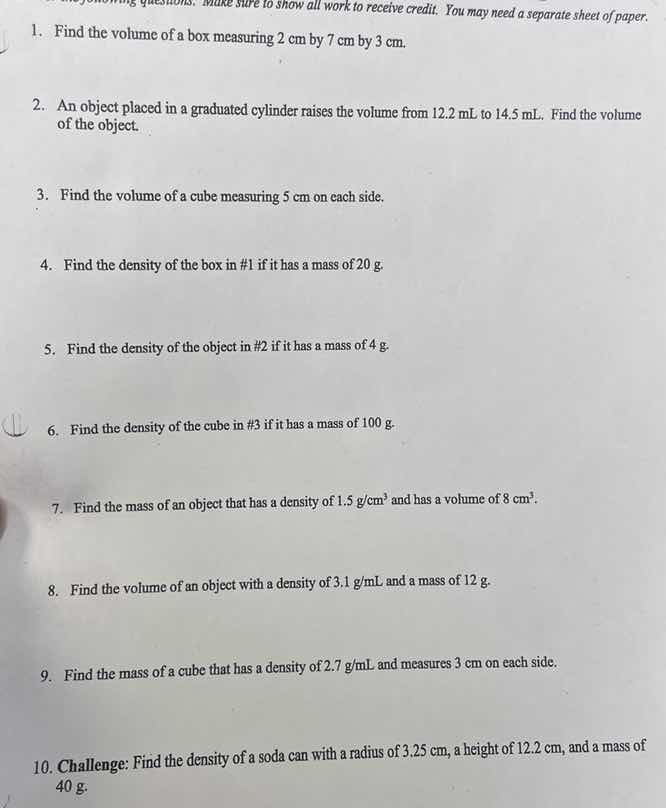
- find the volume of a box measuring 2 cm by 7 cm by 3 cm.
- an object placed in a graduated cylinder raises the volume from 12.2 ml to 14.5 ml. find the volume of the object.
- find the volume of a cube measuring 5 cm on each side.
- find the density of the box in #1 if it has a mass of 20 g.
- find the density of the object in #2 if it has a mass of 4 g.
- find the density of the cube in #3 if it has a mass of 100 g.
- find the mass of an object that has a density of 1.5 g/cm³ and has a volume of 8 cm³.
- find the volume of an object with a density of 3.1 g/ml and a mass of 12 g.
- find the mass of a cube that has a density of 2.7 g/ml and measures 3 cm on each side.
- challenge: find the density of a soda can with a radius of 3.25 cm, a height of 12.2 cm, and a mass of 40 g.
Response
1.
Step1: Recall the formula for the volume of a rectangular box (which is a rectangular prism), \( V = l \times w \times h \), where \( l \) is length, \( w \) is width, and \( h \) is height.
Here, \( l = 2 \, \text{cm} \), \( w = 7 \, \text{cm} \), \( h = 3 \, \text{cm} \).
Step2: Substitute the values into the formula.
\( V = 2 \times 7 \times 3 \)
\( V = 42 \, \text{cm}^3 \)
Step1: The volume of the object is the difference between the final volume and the initial volume in the graduated cylinder. The formula is \( V_{\text{object}} = V_{\text{final}} - V_{\text{initial}} \).
Here, \( V_{\text{initial}} = 12.2 \, \text{mL} \), \( V_{\text{final}} = 14.5 \, \text{mL} \).
Step2: Substitute the values.
\( V_{\text{object}} = 14.5 - 12.2 \)
\( V_{\text{object}} = 2.3 \, \text{mL} \)
Step1: Recall the formula for the volume of a cube, \( V = s^3 \), where \( s \) is the length of a side.
Here, \( s = 5 \, \text{cm} \).
Step2: Substitute the value into the formula.
\( V = 5^3 \)
\( V = 125 \, \text{cm}^3 \)

Snap & solve any problem in the app
Get step-by-step solutions on Sovi AI
Photo-based solutions with guided steps
Explore more problems and detailed explanations
\( 42 \, \text{cm}^3 \)