QUESTION IMAGE
Question
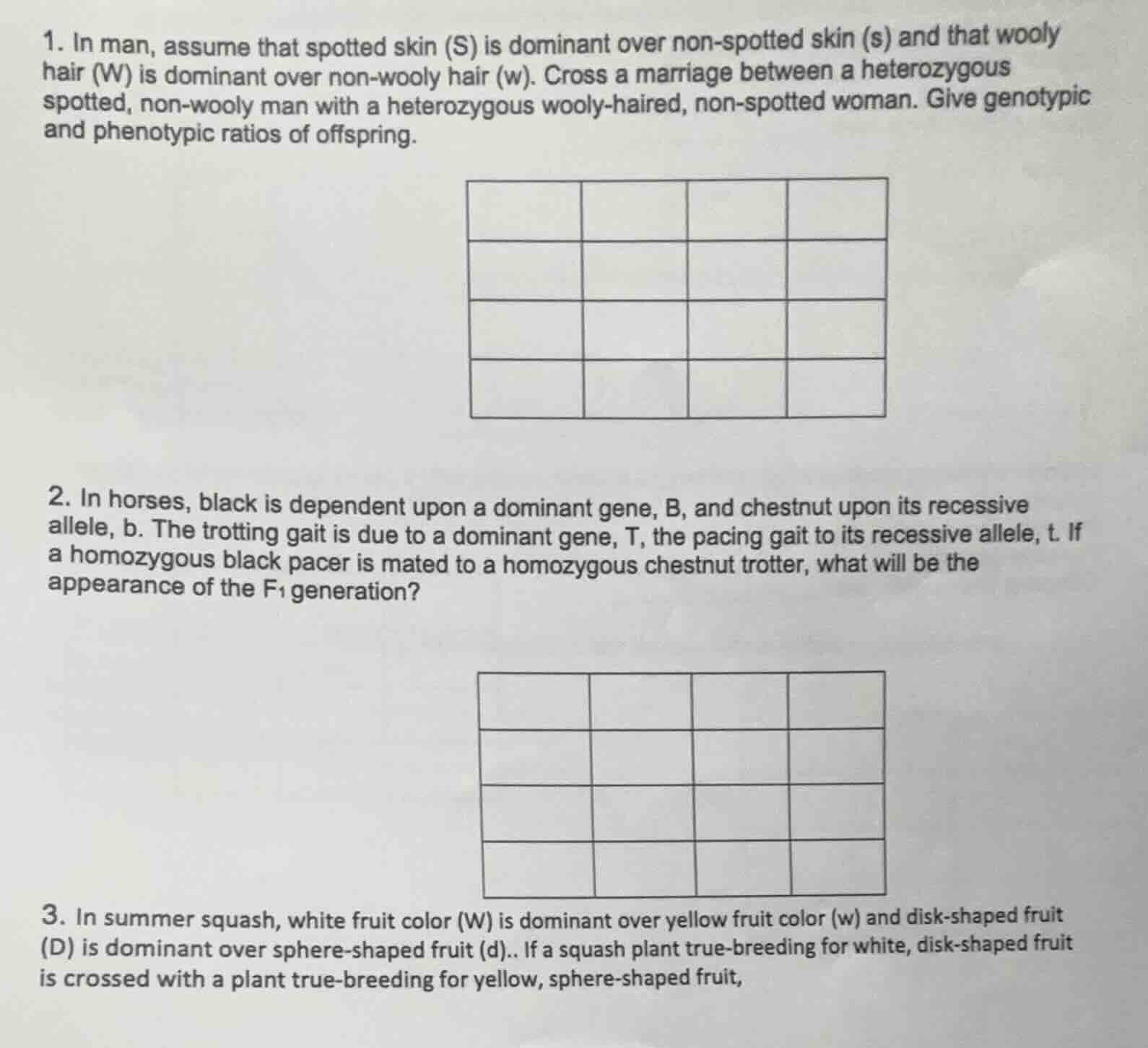
- in man, assume that spotted skin (s) is dominant over non - spotted skin (s) and that wooly hair (w) is dominant over non - wooly hair (w). cross a marriage between a heterozygous spotted, non - wooly man with a heterozygous wooly - haired, non - spotted woman. give genotypic and phenotypic ratios of offspring.
- in horses, black is dependent upon a dominant gene, b, and chestnut upon its recessive allele, b. the trotting gait is due to a dominant gene, t, the pacing gait to its recessive allele, t. if a homozygous black pacer is mated to a homozygous chestnut trotter, what will be the appearance of the f₁ generation?
- in summer squash, white fruit color (w) is dominant over yellow fruit color (w) and disk - shaped fruit (d) is dominant over sphere - shaped fruit (d).. if a squash plant true - breeding for white, disk - shaped fruit is crossed with a plant true - breeding for yellow, sphere - shaped fruit,
Problem 1
Step1: Determine Genotypes
The man is heterozygous spotted (S s) and non - wooly (w w), so his genotype is \( Ssww \). The woman is heterozygous wooly - haired (W w) and non - spotted (s s), so her genotype is \( ssWw \).
The man's gametes: From \( Ss \), he can produce \( S \) or \( s \); from \( ww \), he can only produce \( w \). So his gametes are \( Sw \) and \( sw \).
The woman's gametes: From \( ss \), she can only produce \( s \); from \( Ww \), she can produce \( W \) or \( w \). So her gametes are \( sW \) and \( sw \).
Step2: Create Punnett Square
| \( Sw \) | \( sw \) | |
|---|---|---|
| \( sw \) | \( Ssww \) | \( ssww \) |
Step3: Determine Genotypic Ratios
Count the genotypes:
- \( SsWw \): 1
- \( ssWw \): 1
- \( Ssww \): 1
- \( ssww \): 1
So the genotypic ratio is \( SsWw:ssWw:Ssww:ssww = 1:1:1:1\)
Step4: Determine Phenotypic Ratios
- \( SsWw \): Spotted, Wooly
- \( ssWw \): Non - spotted, Wooly
- \( Ssww \): Spotted, Non - wooly
- \( ssww \): Non - spotted, Non - wooly
Each phenotype has a count of 1, so the phenotypic ratio is Spotted Wooly : Non - spotted Wooly : Spotted Non - wooly : Non - spotted Non - wooly \(= 1:1:1:1\)
Step1: Determine Genotypes
The homozygous black pacer has genotype \( BBtt \) (black is \( B \), pacer is recessive \( tt \)). The homozygous chestnut trotter has genotype \( bbTT \) (chestnut is recessive \( bb \), trotter is dominant \( TT \)).
The gametes of \( BBtt \): From \( BB \), only \( B \); from \( tt \), only \( t \). So gamete is \( Bt \).
The gametes of \( bbTT \): From \( bb \), only \( b \); from \( TT \), only \( T \). So gamete is \( bT \).
Step2: Create Punnett Square (for \( F_1 \))
| \( Bt \) |
|---|
Step3: Determine Phenotype of \( F_1 \)
The genotype \( BbTt \) has \( B \) (black) and \( T \) (trotter) dominant alleles. So the phenotype is Black, Trotter.
Step1: Determine Genotypes
The true - breeding white, disk - shaped plant has genotype \( WWDD \) (true - breeding means homozygous for both traits). The true - breeding yellow, sphere - shaped plant has genotype \( wwdd \) (homozygous for both recessive traits).
The gametes of \( WWDD \): From \( WW \), only \( W \); from \( DD \), only \( D \). So gamete is \( WD \).
The gametes of \( wwdd \): From \( ww \), only \( w \); from \( dd \), only \( d \). So gamete is \( wd \).
Step2: Determine \( F_1 \) Genotype and Phenotype
The offspring ( \( F_1 \)) will have genotype \( WwDd \). Since \( W \) (white) and \( D \) (disk - shaped) are dominant, the phenotype of \( F_1 \) is White, Disk - shaped fruit.

Snap & solve any problem in the app
Get step-by-step solutions on Sovi AI
Photo-based solutions with guided steps
Explore more problems and detailed explanations
Genotypic ratio: \( SsWw:ssWw:Ssww:ssww = 1:1:1:1\)
Phenotypic ratio: Spotted Wooly : Non - spotted Wooly : Spotted Non - wooly : Non - spotted Non - wooly \(= 1:1:1:1\)