QUESTION IMAGE
Question
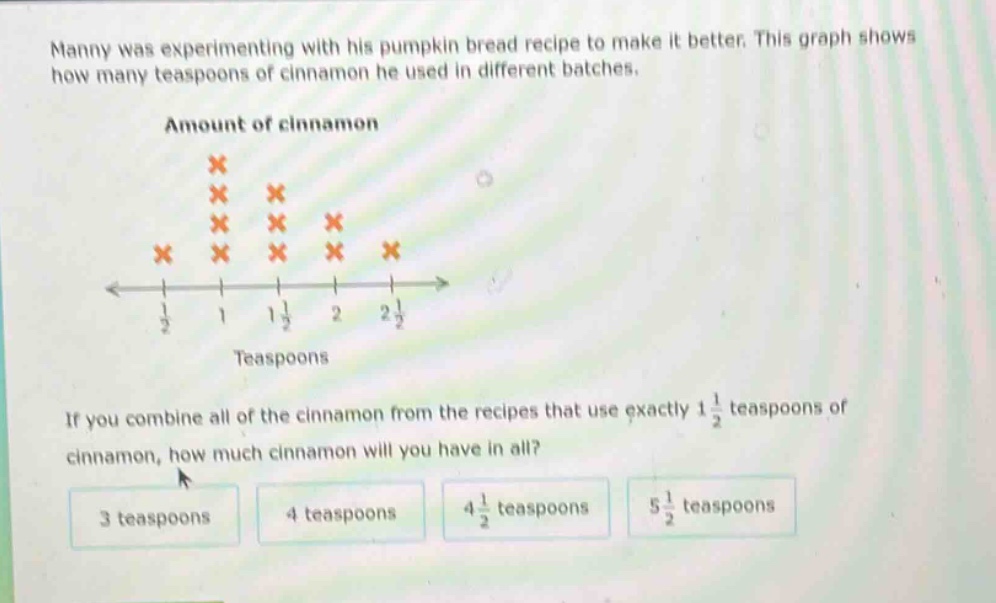
manny was experimenting with his pumpkin bread recipe to make it better. this graph shows how many teaspoons of cinnamon he used in different batches. amount of cinnamon graph omitted if you combine all of the cinnamon from the recipes that use exactly $1\frac{1}{2}$ teaspoons of cinnamon, how much cinnamon will you have in all? 3 teaspoons 4 teaspoons $4\frac{1}{2}$ teaspoons $5\frac{1}{2}$ teaspoons
Step1: Count the number of batches with \( 1\frac{1}{2} \) teaspoons
From the graph, we can see that there are 3 batches that use \( 1\frac{1}{2} \) teaspoons of cinnamon.
Step2: Calculate the total cinnamon
To find the total cinnamon, we multiply the amount per batch (\( 1\frac{1}{2} \) teaspoons) by the number of batches (3). First, convert \( 1\frac{1}{2} \) to an improper fraction: \( 1\frac{1}{2}=\frac{3}{2} \). Then, multiply by 3: \( \frac{3}{2} \times 3=\frac{9}{2}=4\frac{1}{2} \) teaspoons. Wait, no, wait. Wait, looking at the graph again, maybe I miscounted. Wait, the x's at \( 1\frac{1}{2} \): let's check the graph. The first mark is \( \frac{1}{2} \) (1 x), then 1 (4 x's), then \( 1\frac{1}{2} \) (3 x's?), wait no, the original graph: at \( \frac{1}{2} \): 1 x; at 1: 4 x's; at \( 1\frac{1}{2} \): 3 x's? Wait, no, maybe I made a mistake. Wait, the problem is to combine all cinnamon from recipes that use exactly \( 1\frac{1}{2} \) teaspoons. Wait, maybe the number of x's at \( 1\frac{1}{2} \) is 3? Wait, no, let's re-express. Wait, \( 1\frac{1}{2} \) is \( \frac{3}{2} \). If there are 3 batches, then \( 3\times1\frac{1}{2}=3\times\frac{3}{2}=\frac{9}{2}=4\frac{1}{2} \)? But wait, maybe the number of x's is 3? Wait, no, maybe I miscounted. Wait, the options include \( 4\frac{1}{2} \), but let's check again. Wait, maybe the number of batches with \( 1\frac{1}{2} \) is 3? Wait, no, let's look at the graph again. The x's: at \( \frac{1}{2} \): 1; at 1: 4; at \( 1\frac{1}{2} \): 3; at 2: 2; at \( 2\frac{1}{2} \): 1. Wait, so 3 batches of \( 1\frac{1}{2} \). Then \( 3\times1\frac{1}{2}=3\times\frac{3}{2}=\frac{9}{2}=4\frac{1}{2} \). But wait, the options have \( 4\frac{1}{2} \) as one of them. Wait, but maybe I made a mistake. Wait, no, let's check the calculation again. \( 1\frac{1}{2} \) times 3: \( 1\frac{1}{2}+1\frac{1}{2}+1\frac{1}{2}= (1 + 1 + 1)+(\frac{1}{2}+\frac{1}{2}+\frac{1}{2}) = 3 + \frac{3}{2}=4\frac{1}{2} \). So the total is \( 4\frac{1}{2} \) teaspoons. Wait, but let me check the graph again. Wait, maybe the number of x's at \( 1\frac{1}{2} \) is 3? Yes, so the calculation is correct.
Wait, no, wait, maybe I miscounted the x's. Let's look at the graph:
- \( \frac{1}{2} \): 1 x
- 1: 4 x's (since there are four x's stacked)
- \( 1\frac{1}{2} \): 3 x's (three x's stacked)
- 2: 2 x's
- \( 2\frac{1}{2} \): 1 x
So for \( 1\frac{1}{2} \), number of batches is 3. So total cinnamon is \( 3 \times 1\frac{1}{2} \).
Calculating \( 3 \times 1\frac{1}{2} \):
First, convert \( 1\frac{1}{2} \) to an improper fraction: \( 1\frac{1}{2} = \frac{3}{2} \)
Then, \( 3 \times \frac{3}{2} = \frac{9}{2} = 4\frac{1}{2} \) teaspoons.

Snap & solve any problem in the app
Get step-by-step solutions on Sovi AI
Photo-based solutions with guided steps
Explore more problems and detailed explanations
\( 4\frac{1}{2} \) teaspoons (corresponding to the option " \( 4\frac{1}{2} \) teaspoons")