QUESTION IMAGE
Question
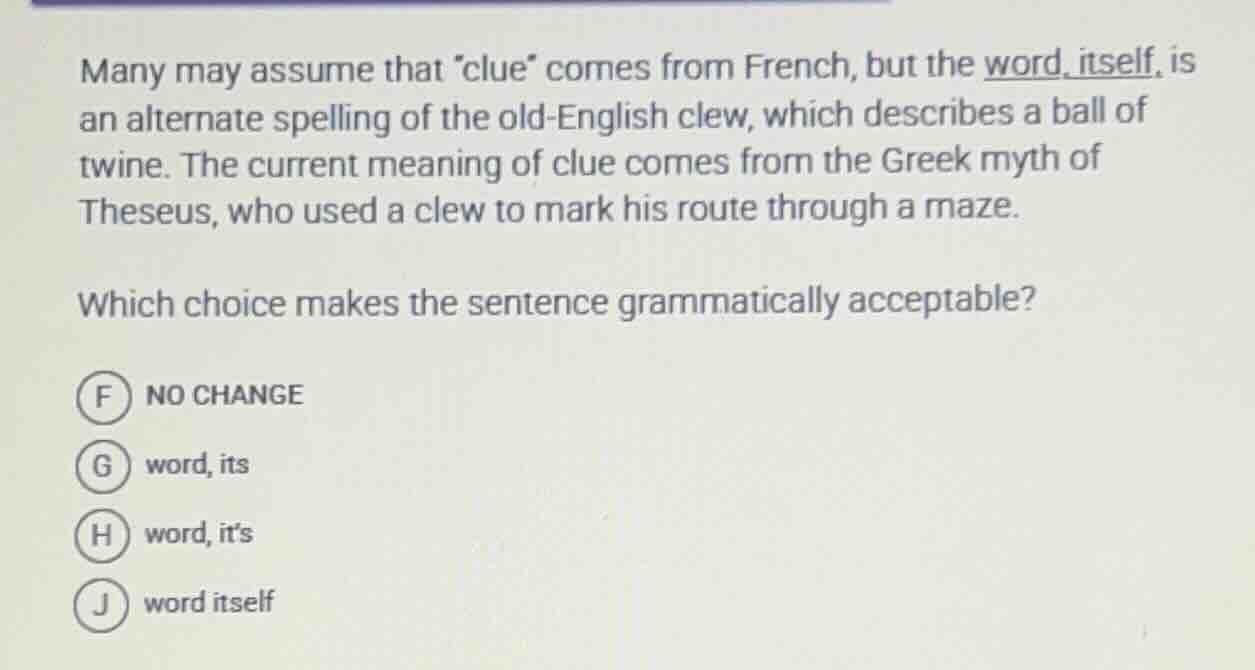
many may assume that clue comes from french, but the word, itself, is an alternate spelling of the old - english clew, which describes a ball of twine. the current meaning of clue comes from the greek myth of theseus, who used a clew to mark his route through a maze. which choice makes the sentence grammatically acceptable? f no change g word, its h word, its j word itself
Brief Explanations
To determine the correct choice, we analyze each option:
- Option F: "word, itself" is incorrect because the comma after "word" and the use of "itself" here creates a non - standard construction. The phrase "the word itself" should be a single unit without an unnecessary comma between "word" and "itself".
- Option G: "word, its" is wrong. "its" is a possessive pronoun, and in this context, we need a word that emphasizes the word "clue" itself, not a possessive form. Also, the comma is incorrect.
- Option H: "word, it's" is incorrect. "it's" is a contraction for "it is", which does not fit the meaning of emphasizing the word "clue" itself.
- Option J: "word itself" is correct. The phrase "the word itself" is a grammatically correct way to emphasize that the word "clue" (the word in question) has a certain origin. The original "word, itself" has an incorrect comma, and by removing the comma and having "word itself", we get a grammatically acceptable phrase.

Snap & solve any problem in the app
Get step-by-step solutions on Sovi AI
Photo-based solutions with guided steps
Explore more problems and detailed explanations
J. word itself