QUESTION IMAGE
Question
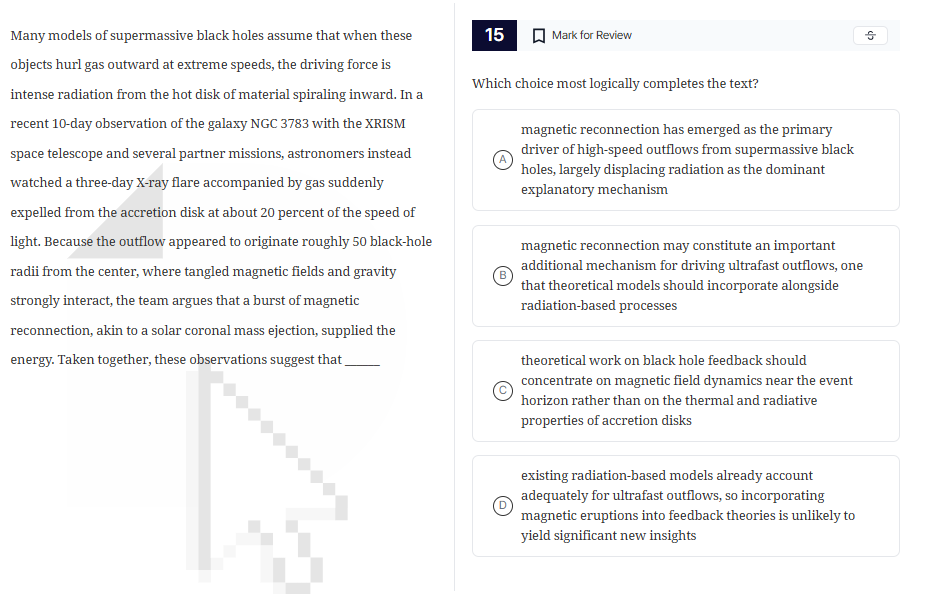
many models of supermassive black holes assume that when these objects hurl gas outward at extreme speeds, the driving force is intense radiation from the hot disk of material spiraling inward. in a recent 10 - day observation of the galaxy ngc 3783 with the xrism space telescope and several partner missions, astronomers instead watched a three - day x - ray flare accompanied by gas suddenly expelled from the accretion disk at about 20 percent of the speed of light. because the outflow appeared to originate roughly 50 black - hole radii from the center, where tangled magnetic fields and gravity strongly interact, the team argues that a burst of magnetic reconnection, akin to a solar coronal mass ejection, supplied the energy. taken together, these observations suggest that ______
15 ◇ mark for review
which choice most logically completes the text?
a magnetic connection has emerged as the primary driver of high - speed outflows from supermassive black holes, largely displacing radiation as the dominant explanatory mechanism
b magnetic connection may constitute an important additional mechanism for driving ultrafast outflows, one that theoretical models should incorporate alongside radiation - based processes
c theoretical work on black hole feedback should concentrate on magnetic field dynamics near the event horizon rather than on the thermal and radiative properties of accretion disks
d existing radiation - based models already account adequately for ultrafast outflows, so incorporating magnetic eruptions into feedback theories is unlikely to yield significant new insights
The original text states that many models assume radiation is the driving force for supermassive black hole outflows, but the new observation shows magnetic reconnection (a new mechanism) also supplied energy for the outflow. Option A says magnetic reconnection "largely displaces" radiation, but the text doesn't say radiation is no longer dominant, just that magnetic reconnection is another factor. Option C shifts focus to magnetic field dynamics near event horizon, but the observation's origin is 50 black - hole radii from center, not near event horizon. Option D says existing radiation - based models already account for outflows, which contradicts the new observation showing a new mechanism (magnetic reconnection) is involved. Option B says magnetic reconnection is an important additional mechanism to be incorporated alongside radiation - based processes, which matches the idea that the new observation suggests it's another factor to consider with the existing radiation - based models.

Snap & solve any problem in the app
Get step-by-step solutions on Sovi AI
Photo-based solutions with guided steps
Explore more problems and detailed explanations
B. magnetic reconnection may constitute an important additional mechanism for driving ultrafast outflows, one that theoretical models should incorporate alongside radiation - based processes