QUESTION IMAGE
Question
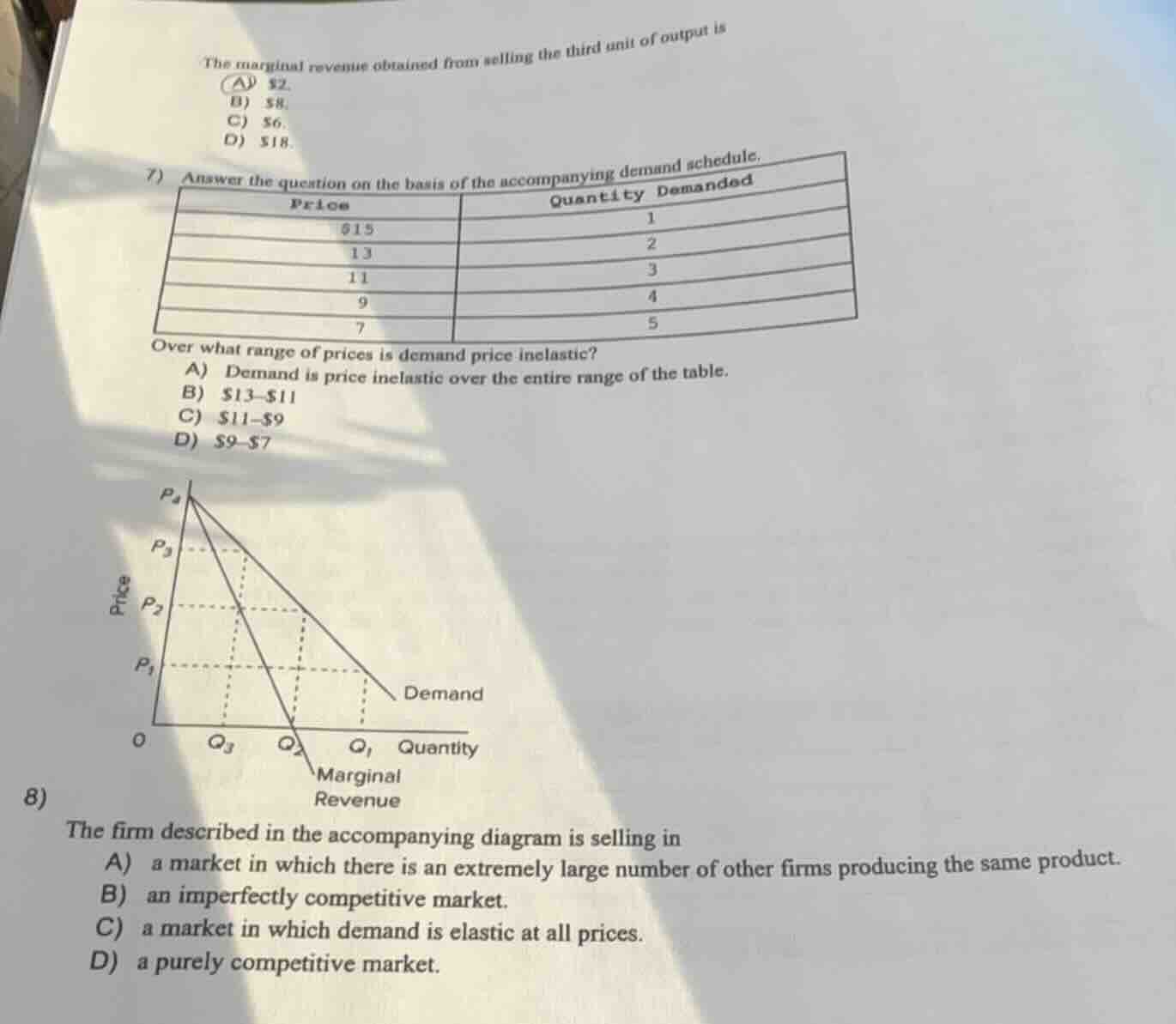
the marginal revenue obtained from selling the third unit of output is
(a) $2.
(b) $8.
(c) $6.
(d) $18.
- answer the question on the basis of the accompanying demand schedule.
| price | quantity demanded |
|---|---|
| 13 | 2 |
| 11 | 3 |
| 9 | 4 |
| 7 | 5 |
over what range of prices is demand price inelastic?
a) demand is price inelastic over the entire range of the table.
b) $13–$11
c) $11–$9
d) $9–$7
8)
the firm described in the accompanying diagram is selling in
a) a market in which there is an extremely large number of other firms producing the same product.
b) an imperfectly competitive market.
c) a market in which demand is elastic at all prices.
d) a purely competitive market.
Question 7 (Demand Price Inelasticity)
To determine where demand is price - inelastic, we use the formula for price elasticity of demand \(E_d=\frac{\%\Delta Q}{\%\Delta P}\). Price - inelastic demand occurs when \(|E_d|< 1\), which means that the percentage change in quantity demanded is less than the percentage change in price.
We calculate total revenue \(TR = P\times Q\) for each price - quantity combination:
- For \(P = 15\), \(Q = 1\), \(TR_1=15\times1 = 15\)
- For \(P = 13\), \(Q = 2\), \(TR_2 = 13\times2=26\)
- For \(P = 11\), \(Q = 3\), \(TR_3=11\times3 = 33\)
- For \(P = 9\), \(Q = 4\), \(TR_4=9\times4 = 36\)
- For \(P = 7\), \(Q = 5\), \(TR_5=7\times5 = 35\)
When price decreases from \(9\) to \(7\) (a decrease of \(\frac{9 - 7}{9}=\frac{2}{9}\approx22.22\%\)) and quantity increases from \(4\) to \(5\) (an increase of \(\frac{5 - 4}{4}=\frac{1}{4} = 25\%\))? Wait, no, let's check the revenue change. When price is in the range of \(9 - 7\), as price decreases from \(9\) to \(7\), total revenue decreases from \(36\) to \(35\). In a demand - price inelastic situation, a decrease in price leads to a decrease in total revenue (because the percentage increase in quantity is less than the percentage decrease in price). Let's check the other ranges:
- From \(15\) to \(13\): \(TR\) increases from \(15\) to \(26\) (elastic, since price decrease leads to revenue increase)
- From \(13\) to \(11\): \(TR\) increases from \(26\) to \(33\) (elastic)
- From \(11\) to \(9\): \(TR\) increases from \(33\) to \(36\) (elastic)
- From \(9\) to \(7\): \(TR\) decreases from \(36\) to \(35\) (inelastic, because price decrease leads to revenue decrease, so \(|E_d|<1\))
Question 8 (Market Structure)
- Option A: In a market with an extremely large number of firms producing the same product (pure competition), the demand curve for an individual firm is horizontal, and marginal revenue equals price. But in the diagram, the marginal revenue curve is below the demand curve, so this is not pure competition.
- Option B: In an imperfectly competitive market (monopolistic competition, oligopoly, monopoly), the firm faces a downward - sloping demand curve, and marginal revenue is below the demand curve (because to sell more units, the firm has to lower the price for all units). The diagram shows a downward - sloping demand curve and a marginal revenue curve below it, which is characteristic of an imperfectly competitive market.
- Option C: The demand curve in the diagram is a straight - line demand curve. A straight - line demand curve has elastic, unit - elastic, and inelastic portions. So demand is not elastic at all prices.
- Option D: In a purely competitive market, the firm's demand curve is horizontal, and \(MR = P\). The diagram shows \(MR\) below the demand curve, so it's not purely competitive.

Snap & solve any problem in the app
Get step-by-step solutions on Sovi AI
Photo-based solutions with guided steps
Explore more problems and detailed explanations
s:
- D) \(\$9 - \$7\)
- B) an imperfectly competitive market.