QUESTION IMAGE
Question
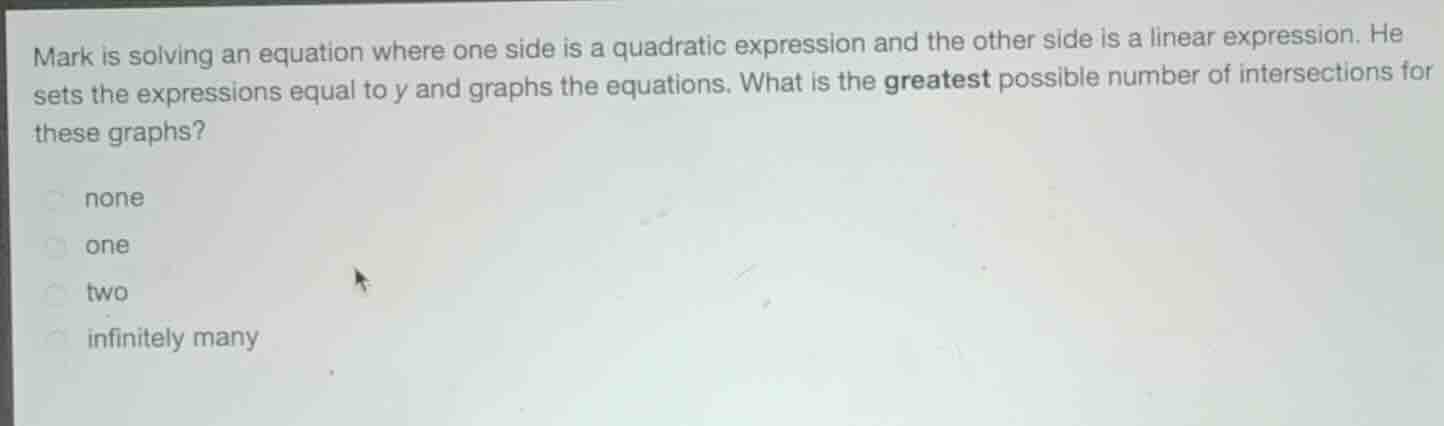
mark is solving an equation where one side is a quadratic expression and the other side is a linear expression. he sets the expressions equal to y and graphs the equations. what is the greatest possible number of intersections for these graphs? none one two infinitely many
Step1: Recall the graphs of functions
A quadratic expression (when set to \( y \)) represents a parabola (a U - shaped or inverted U - shaped graph), and a linear expression (when set to \( y \)) represents a straight line.
Step2: Analyze the intersection of a line and a parabola
The general form of a quadratic equation is \( y = ax^{2}+bx + c\) (\( a
eq0\)) and a linear equation is \( y=mx + n\). To find the intersection points, we set \( ax^{2}+bx + c=mx + n\), which simplifies to \( ax^{2}+(b - m)x+(c - n)=0\). This is a quadratic equation in the form \( Ax^{2}+Bx + C = 0\) (where \( A = a\), \( B=(b - m)\), \( C=(c - n)\)). The number of solutions of a quadratic equation \( Ax^{2}+Bx + C = 0\) is given by the discriminant \( D=B^{2}-4AC\).
- If \( D>0\), there are two distinct real solutions (so two intersection points).
- If \( D = 0\), there is one real solution (one intersection point).
- If \( D<0\), there are no real solutions (no intersection points).
Since a quadratic equation can have at most two distinct real solutions (when the discriminant is positive), the greatest possible number of intersections between the graph of a quadratic function (parabola) and the graph of a linear function (line) is two.

Snap & solve any problem in the app
Get step-by-step solutions on Sovi AI
Photo-based solutions with guided steps
Explore more problems and detailed explanations
two